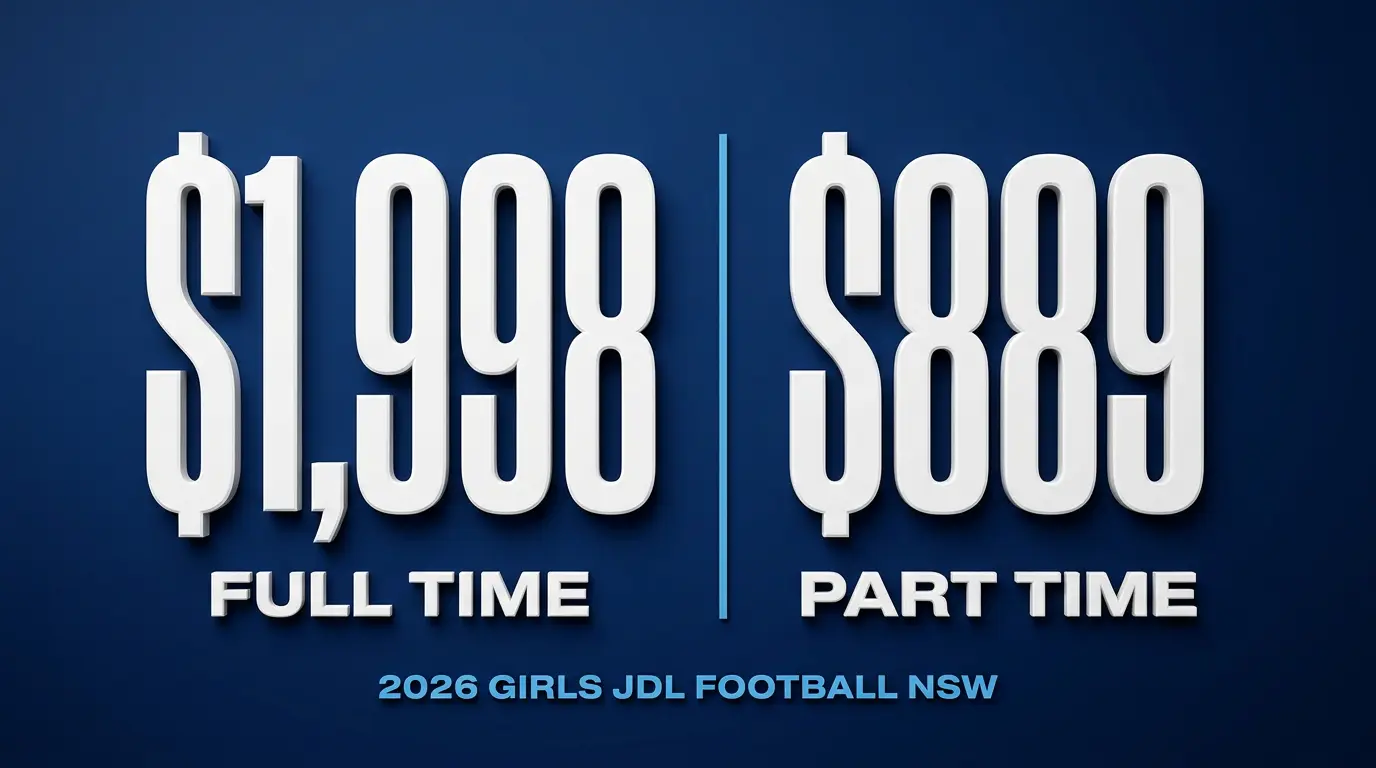
It is a Wednesday night. Your daughter is at the kitchen table doing homework. The email arrived an hour ago: trial invite for the 2026 Girls Junior Development League from one of the Football NSW JDL Clubs. You read it twice. The acceptance form is at the bottom. One of the fields says "Tier: Full Time or Part Time." You scroll down to the fees. Full Time is $1,998. Part Time is $889. The gap between them is $1,109. Your daughter looks up. You do not know what to tell her yet.
The answer is not about choosing a cheaper option. The Full Time versus Part Time decision is whether your daughter moves her primary registration to the JDL Club and plays only there, or keeps her registration at her community club and joins the JDL program as an addition. Full Time is the JDL Club as her one home. Part Time is two homes. The fee gap follows that structural choice.
Two numbers stare back at you
The 2026 cap on Full Time Girls JDL is $1,998. The 2026 cap on Part Time Girls JDL is $889. Both apply to the U10 to U13 age band. The Football NSW 2026 Competitions Registration Fees Circular, dated 3 November 2025 and signed by Football NSW Chief Executive Officer John Tsatsimas, sets these as the maximum a JDL Club may charge for the season. A club may charge less. A club may not charge more.
Behind the headline number sits a four-part breakdown. Full Time pays the Football Australia National Registration Fee of $18, the Football NSW Capitation Fee of $122.44, the Football NSW Insurance Fee of $14.56, and a club portion of up to $1,843. Part Time pays no Football Australia National Registration Fee through the JDL Club, only a $41 administration fee to Football NSW, and a club portion of up to $848. The numbers add to $1,998 and $889 respectively.
That $41 admin fee is the structural giveaway. It is so much smaller than the $122.44 capitation that the national and state fees on a Part Time player are clearly being collected somewhere else.
What Part Time actually means
Part Time Girls JDL means your daughter is primarily registered at a community football club. Her National Registration Fee and her Football NSW Community Capitation Fee are paid through that community club, exactly the way they would be if she were not in the JDL program at all. She then pays a separate program fee to the Girls JDL Club for the JDL training, the JDL matches, and the JDL kit. The Girls JDL Club forwards $41 per Part Time player to Football NSW as an administration fee.
The Football NSW JDL Parent Information Guide adds one operating rule. A Part Time player must register with a community football club located in the region of the JDL Club she plays for. She cannot register at a community club two zones away and play Part Time JDL at the JDL Club nearest her home. The community club has to sit inside the JDL Club's geographic catchment.
This matters because not every JDL Club operates a Part Time tier. Each JDL licensee decides whether to offer Full Time only, Part Time only, or both. The trial invite tells you which one your daughter has been offered. If you want to know whether the alternative exists at this club, ask before the trial.
The question that decides it for your daughter
The decision turns on a single question with a $1,109 price tag. Does your daughter want to keep playing community football alongside her JDL training? If yes, Part Time. If no, Full Time.
Three sub-questions sit underneath that one. First: can she manage the combined load? A JDL program runs over 36 to 40 weeks, plus matches. Community football adds Saturday or Sunday fixtures and more training. Some U11 or U12 girls thrive on multiple football sessions a week. Others lose the love for the game by August. You know your daughter better than anyone.
Second: does the JDL training schedule clash with community fixtures? Most JDL training falls midweek. Most community matches fall on weekends. The clash, where it exists, is usually around pre-season friendlies and finals series weeks. Ask the JDL Club and the community club for their 2026 calendars side by side before accepting.
Third: is the JDL Club licensed at the Part Time tier? You may have been invited to a Full Time program because Part Time is not on offer there. In that case the choice is binary: register Full Time at the JDL Club and step away from the community club for the season, or decline JDL this year.
The fee gap is not the lead variable. It is the result of the structural choice. A family that picks Part Time saves $1,109 because the daughter is splitting her football life across two clubs, and the financial load follows where she is primarily registered.
The U13 fact most parents miss
Mixed JDL covers U9 to U12. Girls JDL covers U10 to U13. That extra year matters at both ends.
At U10, a girl entering Girls JDL is at the bottom of the band. She is competing for selection against girls a year older and a year more developed. Some clubs run separate U10 and U11 teams. Others mix the two. Read the squad structure before accepting.
At U13, the band ends. A girl in U13 Girls JDL is in her final JDL year. The pathway after U13 is Girls Youth League One or Two, depending on club tier and selection. That step up is a separate competition with separate fees: the 2026 cap for Girls Youth Leagues One and Two is $2,692 per the same Football NSW 2026 Circular. U13 is not a renewable position. Players age out.
Mixed JDL works differently. A U12 boy aging out of Mixed JDL moves up to Boys Youth League Three or NPL Boys Youth at the licensee club. There is no parallel decision about Full Time or Part Time at all on the boys side. Mixed JDL has no Part Time tier. Your daughter's choice is structurally different from your son's, even at the same club.
What the cap covers, and what it cannot
A cap means a ceiling. $1,998 is the most a JDL Club may charge a Full Time player for the season. The cap is not an itemised list of services. It is the maximum total amount the family will pay for the program over the year.
What sits inside the cap. The 36 to 40 week JDL program. Training. Matches. The full apparel pack: jacket, pants, training shirt, shorts, socks, polo, kit bag, playing kit. Medical coverage at every match, with a Level 1 Sports Trainer present at minimum. End-of-season presentation. The team photo. Any support services the club bundles, including video analysis, GPS units, sports science consultations, or nutrition education.
What does not sit inside the cap. One-on-one appointments with physiotherapists outside training and game days, where the player is choosing the practitioner. Tournament travel costs for events beyond the Football NSW JDL calendar. Optional family attendance at functions beyond the player and one parent.
What a club cannot do. Layer a Coaching Levy, a Facilities Levy, a Club Administration Fee, or any other surcharge on top of the cap. The Football NSW Circular language is explicit on this point. If your JDL Club has added a separate line item on the invoice, that is the moment to read the JDL registration fee cap explainer and use the three steps it sets out.
Coaches must hold minimum qualifications too. The Head of JDL must hold the B Diploma. The Head Coach must hold the C Diploma. If yours does not, the coaching qualifications article explains the proof and the conversation to have.
Why one fee jumped 15 percent and the other barely moved
The Full Time cap rose from $1,736 in 2025 to $1,998 in 2026. That is a 15.1 percent increase in a single year. The Part Time cap rose from $866 to $889 over the same period. That is a 2.7 percent increase.
The gap in the increase rate is structural, not arbitrary. Most of the Full Time fee is the National Registration Fee ($3 increase from 2025), the Football NSW Capitation, and the Football NSW Insurance ($14.56, split out from Capitation as a separate line for the first time in 2026). When those three line items move, the Full Time cap moves with them. When the National Registration Fee moved from $15 to $18 across the country, every Full Time JDL family in NSW absorbed it.
The Part Time fee does not include any of those three line items at the JDL Club level. The National Registration Fee and the Football NSW Community Capitation are paid through the community club, not the JDL Club. The Part Time JDL Club fee is mostly the program cost. Program costs rose modestly. That is why the Part Time cap moved a fraction of what the Full Time cap moved.
Practical consequence. If Football NSW or Football Australia raise community-level fees in 2027, Part Time families absorb that through their community club registration, while Full Time families absorb it through the JDL Club. Both families pay it, just on different invoices.
What to ask before you accept
Five questions to put to the JDL Club in writing before you sign the acceptance form. Email, not phone. Written answers are the record if anything is contested later.
- Does this club operate a Full Time tier, a Part Time tier, or both?
- If both, what training nights and match days apply to each?
- If she accepts Part Time, will she be required to play her community fixtures every weekend, or are some weekends reserved for JDL?
- What is the published 2026 fee for the tier you have offered, and is anything proposed outside the Football NSW cap?
- If she accepts Full Time, can she return to her community club mid-season if the program does not suit her?
The five answers will tell you which tier suits your family, whether the JDL Club is operating inside the Football NSW rules, and what your options are if the choice turns out wrong. Re-verify these answers against the Football NSW 2026 Circular if there is any conflict. The next Circular release window is November 2026.
If your child has been offered a tier and you are unsure why, or if you suspect the offer is being framed around the fee rather than the structure, that conversation belongs in writing with the JDL Club Head of Football. Not with the coach. The coach does not set the registration tier. The Football NSW Club Benchmarking Standards explain the qualifications and responsibilities involved.