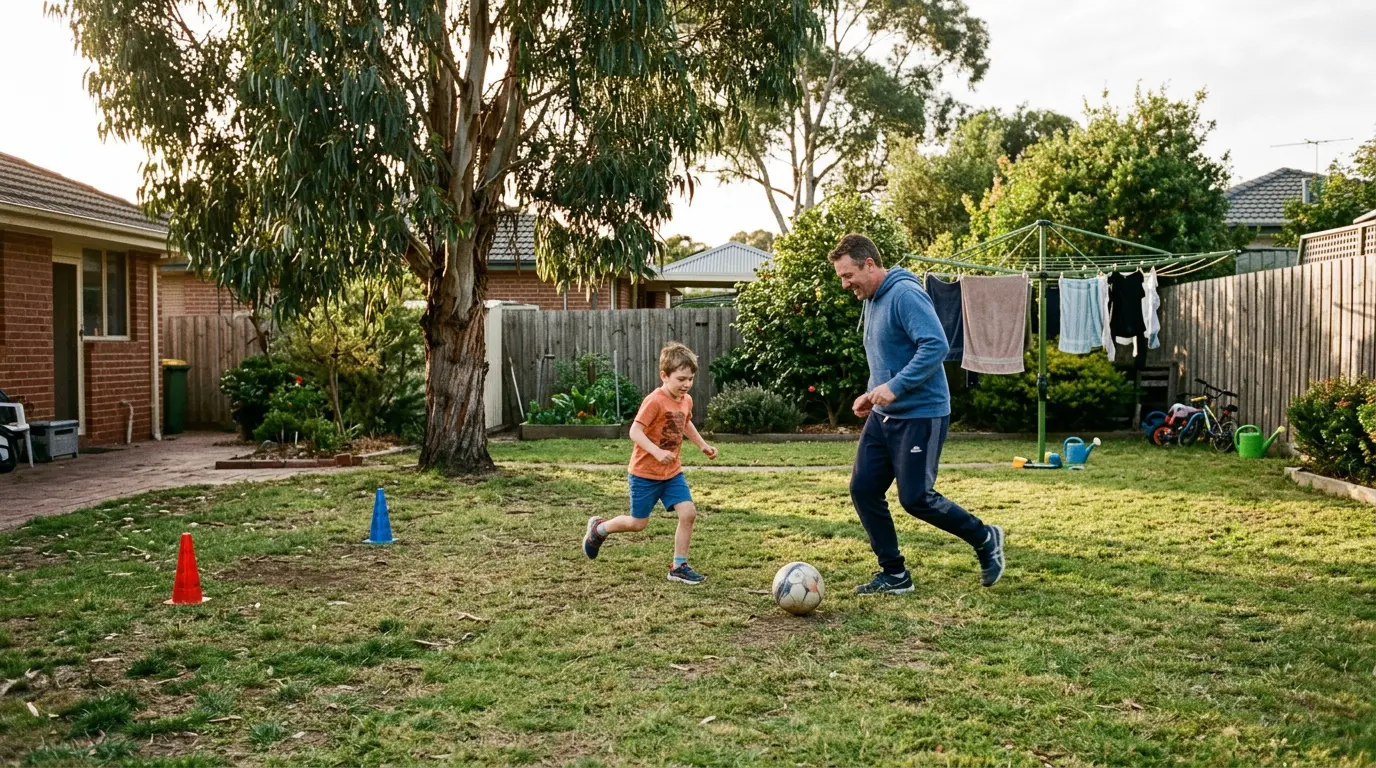
Picture this. You're at the stove. Saturday morning. Through the kitchen window you can see your kid in the backyard, alone, with a ball at their feet. They're turning around an old chair like it's a defender. They're taking shots at the gap between the bin and the lemon tree. They're talking to themselves in a low commentator's voice about scoring the winner against Argentina. You haven't said a word. You haven't suggested anything. They're just out there.
This is the goal. Not the volume of drills. Not the perfection of technique. This. Most parents never get here because they try to create it the wrong way. They turn the backyard into a coaching session, and the kid quietly stops asking for the ball.
Then there is the better version. Two or three kids. A neighbour. A sibling. A mate from down the road. They're arguing about whether that hit the chair, on a goal that's clearly halfway off the chair leg. They're making a rule on the fly that headers don't count. They're playing on regardless. Twenty minutes from now they will have invented a new game and forgotten the argument. This second version is gold. Most of what football actually develops in a kid happens in this scene, not in any drill.
This article is about how to set the conditions so this happens at your place. It is not a list of drills. The drills article is a separate piece, and you can read the 15-minute ball mastery routine here once your kid is the kind of kid who picks up a ball without being asked. This article is about getting them to that point.
Why this matters more than the drills
There is twenty-five years of research on how children get good at sport, and the punchline is unsexy. Kids do not get good through structured, adult-directed practice. Not at six, not at eight, not at ten. They get good through what researchers call deliberate play. The original 1999 definition is worth saying in plain English: an activity that is intrinsically motivating, designed to maximise fun, with the kids making and bending the rules as they go. The textbook example in the literature is backyard soccer.
Kids who only do structured practice and never get any deliberate play are the ones who drop out by thirteen. The Wall and Côté study from 2007 found exactly this: dropouts had less play and more practice in childhood than the kids who stayed in. The Aspen Institute's Project Play research goes further. In organised youth sport practice, kids spend roughly 43 per cent of the time inactive. Standing in lines. Listening to a coach. Waiting their turn. The backyard fixes that on day one. Every minute is a touch.
Football Australia's own MiniRoos curriculum, the official program for ages 4 to 11, says the same thing in coach-speak. The Discovery Phase guidance tells coaches to encourage children to improvise, that kids this age cannot handle a lot of instruction, and that sessions should resemble street football where kids express themselves freely. That is the official line from the body that runs every junior club in the country. Your backyard, with no coach, is the truest version of what they are asking for.
Three things you set up, then leave alone
Sport psychologists have known for forty years what makes a kid keep showing up. Three things. Autonomy: the kid feels it is their thing, not yours. Competence: the challenge is hard enough to feel real but not so hard it crushes them. Relatedness: sometimes you are in there playing with them, more often you are cheering from the kitchen, but they do not feel alone in it.
Your job is to set the room and step back. The room is a ball that lives outside, not in a box, not in the garage, not stored away after each session. A target the kid can shoot at. Anything: a milk crate, a chalk square on the back fence, a couple of shoes for goalposts. A flat patch of nothing. The driveway, the end of the cul-de-sac, the park up the road. Once those exist, a kid with a ball will use them. They will not use them if you stand there with a clipboard.
The four things that kill it before it starts
Tactics. A six-year-old does not need to know what a winger does. A nine-year-old does not need a debrief on transitional play. If you find yourself talking about positions or shape in the backyard, you have stepped on the kid's autonomy and the magic stops.
Technique lectures. When you say "no, like this, plant your foot here, strike with the laces" you have just turned a play session into a school lesson. The kid will internalise that the ball is something they can do wrong. Right now you want the opposite. You want the ball to be something they can mess about with for an hour with no consequence.
Talking too much. This one is the hardest for parents who played. The instinct is to share what you know. The kid does not need it. Watch them, smile, say one short thing if it lands naturally, then go back to whatever you were doing. The signal is that the activity is theirs.
Contracted rewards. "If you do fifty kick-ups I'll buy you a Slurpee." Don't. Forty years of research on what is called the overjustification effect shows that expected rewards for things kids already enjoy actually reduce their interest. The kid stops loving the ball and starts loving the deal. The fix is the opposite move. An unexpected celebration after the fact. A casual "you were absolutely flying out there today, let us grab one on the way home." The reward lands. The love of the ball stays intact.
How to actually light the fire
Start small. The ball lives outside. There is a target. There is space. Once a week, you mention one thing they could try, in passing, then drop it. Not "today we're going to work on weak-foot." More like "I bet you can't hit that bin three times in a row" said while walking out to peg the washing. Then you keep walking. Whether they do it or not is up to them.
Invite one other kid. A neighbour, a cousin, a school friend. This is the single most underrated move in the whole article. Two kids in a backyard for an hour beats one kid for three hours, every time. The second they are together they will start a game, even if you do not suggest one. They will argue about a rule. They will copy each other. The younger one will learn three things in five minutes that no drill could teach. The older one will learn that being older means setting some kind of standard. None of that needs you.
Get in there occasionally. Five minutes. Not as the coach. As the second body. Head-tennis with a balloon. A 1v1 where you are slightly worse than them on purpose. Then you are gone. The point is presence, not instruction.
The argument is the development
The hardest thing for parents to do, when two kids are playing in your backyard, is to sit on the back step and not referee. They are going to argue. About whether that was a goal. About whose turn it is. About whether headers should count.
Don't step in. Sit there.
The American Academy of Pediatrics has been clear on this since at least 2018, and they reaffirmed the position in 2025. Unstructured peer play is where children develop negotiation, conflict resolution, decision-making, leadership, planning, and self-control. The argument is the lesson. If you decide the goal counts, you have stolen the lesson and replaced it with a verdict. Sit on the step. Eat the toast. Let them sort it.
The Brazilian thing every parent has heard about
You have heard it a thousand times. Pelé learned to play in the streets. Ronaldinho came up through pelada and futsal. Neymar credits informal play for his close control. The standard reading of this is cultural mythology: Brazilians are just like that. The actual story, in the research, is more boring and more useful.
Brazilian kids who became elite players had logged thousands of hours of self-organised play in tight spaces by the time they were ten. Pickup games on small surfaces. Futsal in concrete courts. Multi-age groups where the small kids learned to release the ball quickly because the big kids would otherwise overpower them. Constant, kid-led problem solving with the ball.
This is not a national-character thing. It is a deliberate-play-volume thing. Australian kids are racking up far less of this kind of time than they used to. The fix is not to move to São Paulo. The fix is two kids in your backyard, four times a week, for an hour, with you nowhere near it.
What you will see, three months in
If you have actually done this, here is what changes. The kid goes outside without being asked. They invent games on their own. They get bored, then unbored, on their own. They start asking you if you will play. That last one is the moment. They asked you. You did not ask them. The fire is now self-sustaining. You can tend it from the kitchen.
The job from here is light. The ball still lives outside. The space is still there. Once a fortnight you mention something in passing. Once a fortnight you get in there for ten minutes. The rest is them.