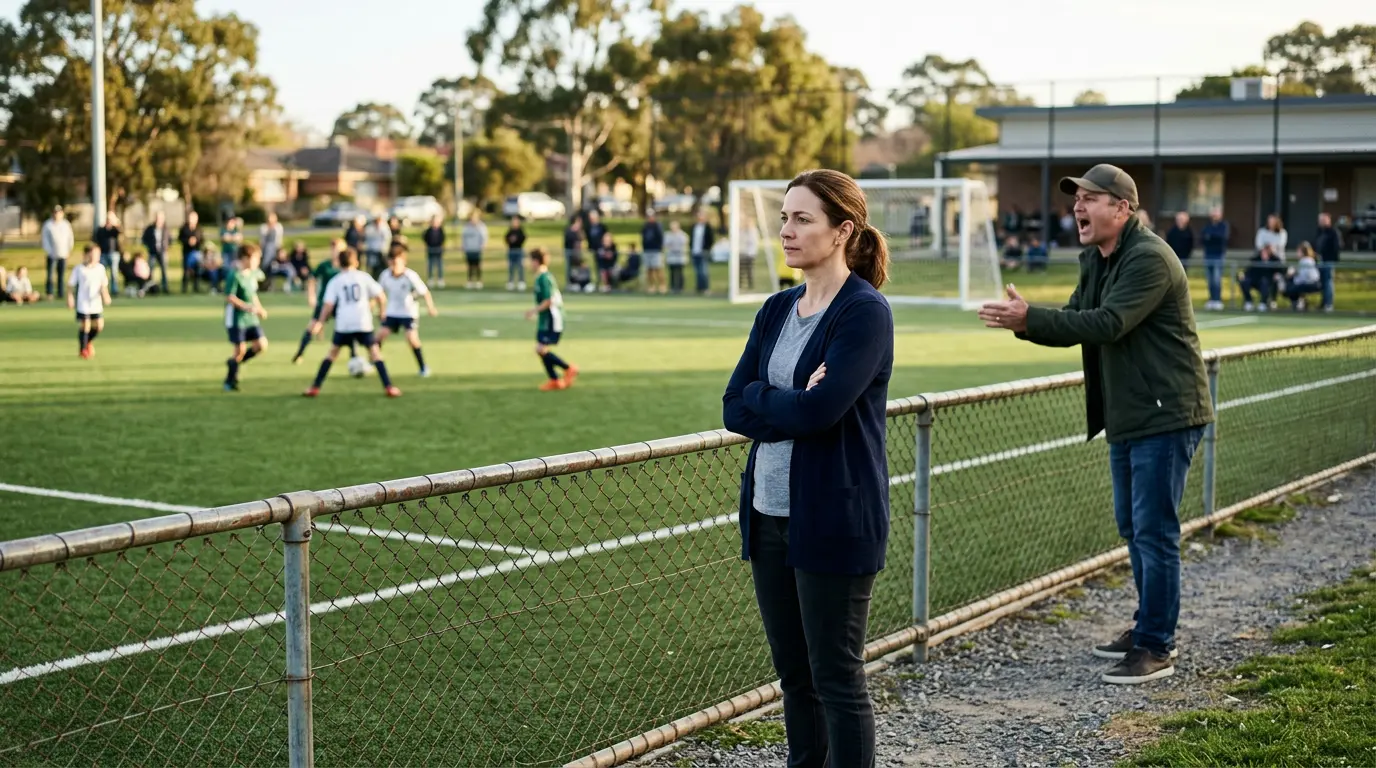
There is a parent at your child's club who shouts at every game. Their own child. Teammates. The opposition. The referee. Sometimes it is loud encouragement. Often it is angry instruction. Occasionally it is something worse, and the rest of the sideline goes quiet for a moment, and nobody quite looks at each other.
Your child has come home twice now uncomfortable about something this parent said.
You want to do something. The instinct is direct: a quiet word at the next game, parent to parent, "this is not okay." Most parents try this. Most of the time it backfires. The yelling parent has a story they already tell themselves about why their volume is fine, and your honest conversation reinforces that story rather than denting it.
There is one thing that works much of the time. There is a path to escalate when it does not. And there is a framework with actual teeth, the Football Australia Spectator Code of Behaviour, that most parents do not know exists and almost never invoke. This article walks through all three.
Why direct confrontation almost always fails
The yelling parent on a junior sideline is rarely a calm person having a bad afternoon. They are, almost without exception, dysregulated under pressures the rest of the sideline cannot see. Job stress. Marriage stress. Their own football story, often disappointing. A diagnosed or undiagnosed condition. A childhood spent watching their own father do exactly this.
This perspective does not excuse the behaviour. It does inform what works on it.
A 2019 Frontiers in Psychology study of 773 parents of young athletes found that 98 percent of them had experienced anger during youth sport competitions. The same body of research identifies the most reliable triggers: a sense of unfairness from coaches or officials, embarrassment at the child's performance, and a feeling that the child is not being given a fair shake. The yelling parent is, statistically, expressing the same anger most of the sideline feels in milder form. They are just not regulating it.
A direct confrontation lands on this nervous system as a threat. The instinctive response is to defend, double down, and recruit allies. Whatever volume they were operating at gets louder, not quieter. They go home and tell their partner about the parent who confronted them, framed as the unreasonable one, and they arrive at the next game with reinforced certainty that they are doing nothing wrong.
This is why the playbook starts somewhere else.
The one thing first: a written message to the head coach
Not the parent. The coach. Not face to face. In writing.
The coach has authority over the team environment, including the sideline. They have a relationship with the noisy parent that you do not. Their intervention, even a small one, lands differently than yours would. And a written message gives them time to think before responding, instead of forcing an awkward conversation in front of other parents at the field.
The message that works is short and specific. Something like:
"Hi [coach], thanks for everything you do. Just a quick note. My child has been finding [other parent's] sideline volume hard at the last few games. They mentioned it twice this week. I am not asking for a confrontation, I just thought you should know in case you can have a quiet word about volume from the sideline. We trust your judgement on how to handle it. Cheers."
That message does several things in three short paragraphs.
It surfaces the issue without naming it as a formal complaint. The coach now knows the pattern is affecting children, not just bothering parents.
It avoids putting the coach in the position of having to choose sides. It is information, not a demand.
It empowers the coach to act in their own way. The most common response is a polite team-wide message reminding parents about volume on the sideline. The yelling parent reads it as addressed to them, but is not singled out. Their dignity is preserved, which lowers the chance of the dug-in defensive response a direct confrontation would produce.
Most coaches who get a message like this respond constructively within a week. A high proportion of cases resolve at this stage and never escalate further. This is the boring procedural step that does most of the work.
What to skip in the first move
A few moves to actively avoid in the first phase.
Do not approach the parent directly first. The yelling parent will read it as an attack on their parenting, not as feedback on their volume. The conversation does not produce the change you want.
Do not raise it on a club WhatsApp or Facebook group. Whatever you write will be screenshotted and circulated. The yelling parent will hear about it before you have finished typing. Whatever they were doing before will get worse, and your child becomes the casualty.
Do not bring your child into the conversation. They mentioned it once or twice, that is data, not a campaign brief. Children should not be pulled into adult management of an adult's behaviour. Their job is to enjoy their game. Your job is to remove the friction without putting it on their plate.
Do not let it sit. If your child is uncomfortable, the situation will recur. Doing nothing is its own decision, and the cost of that decision shows up on your kid's face on Sunday morning.
When the coach's intervention does not work
Two scenarios.
The coach does not act. Some coaches, especially volunteers, do not feel they have authority over parent behaviour. The re-prompt is one polite follow-up, then escalation: "Hi [coach], not sure if you got my note last week, just wanted to flag the issue has happened again. Happy to chat in person if easier."
If the coach still does not act, the next stop is the club committee. Most clubs have a defined parent-conduct contact person. The titles vary: club secretary, welfare officer, or a Member Protection Information Officer (MPIO). The MPIO is a specific Sport Integrity Australia trained role that exists at most clubs above a certain size. They are trained for exactly this kind of issue.
The coach acts, but the behaviour continues. This is the harder case. The polite first step has been done. The coach has tried. The parent has not changed. At this point the issue is no longer a quiet word. It is a pattern, and the framework that applies has a name.
The framework with actual teeth: the FA Spectator Code of Behaviour
Every patron at a junior football match is bound by the Football Australia Spectator Code of Behaviour. Parents on the sideline are patrons. The Code has been in effect since 2007 and was most recently consolidated in the 2021 National Code of Conduct and Ethics. It is published at footballaustralia.com.au under governance and statutes. The key clauses parents of children at junior football should know:
A spectator must not engage in discrimination, harassment or abuse in any form, including obscene or offensive language or gestures.
A spectator must never ridicule or unduly scold a child for making a mistake. That clause is in the Code by name. The Code anticipates exactly the kind of parent this article is about.
A spectator must respect the rights, dignity and worth of every person regardless of gender, ability, race, colour, religion, language, politics, national or ethnic origin.
A spectator must respect match officials' decisions and teach children to do the same. Persistent dissent against the referee is a breach.
A spectator must not bring the game into disrepute through disorderly conduct.
These are not vague aspirations. They are enforceable clauses, and most chronic-yelling behaviour meets at least one of them.
The enforcement pathway is club first, then association if not resolved. Sanctions at association level are real and used. Northern Suburbs Football Association in Sydney, for example, publishes sentences ranging from one fixture suspension to twenty-four months for abusive language or intimidating conduct in the presence of minors. Other associations have similar ranges. The clubs are responsible for enforcing the Code at their own venues, and breaches by their supporters can result in sanctions against the club itself, not just the individual parent.
To raise a formal concern, the simplest move is an email to the club secretary or MPIO with three things: a short factual description of the behaviour, the dates and games where it occurred, and the impact (children affected, sideline atmosphere, whether your own child was named or implied). Keep emotion out of the email. Stick to behaviours and dates. Most clubs treat this seriously when it arrives in writing because once it is in writing, the club has a record and is accountable for how it handled it.
When the rules change: your child as the direct target
Different rules apply if the yelling parent is yelling specifically at your child by name.
A parent yelling instructions or criticism at your child by name, whether a parent on the opposition bench or another parent on your child's own team, is not a sideline-volume issue. It is a child welfare matter. The Member Protection Framework, available at the same Football Australia governance page, is the relevant pathway. Not the Spectator Code.
The first move here is faster: notify the head coach immediately, in person at the game or by phone the same day. Not a polite written message a week later. The coach should remove your child from any further interaction with that parent's child or that parent at training, until resolved.
If the yelling parent is one of the coaches themselves, the issue is more serious again. A child being verbally abused by a coach at junior football is not something to manage through a quiet chat. It is something to escalate to the club, then the association, then the state body if not resolved promptly. There is no shame in moving up the chain quickly when the issue involves a coach and a child. The framework exists for exactly this kind of situation, and using it is what makes the framework work for the next family.
The sideline self-audit, briefly
Before any of the above, it is worth asking whether you are reading the situation accurately.
The three-question audit in your own sideline behaviour: the three-question self-audit is for self-use, not for diagnosing other people. Run it on yourself first. The parent who is most uncomfortable with another parent's loud sideline behaviour is sometimes a parent calibrating their own. Run the audit, then proceed with whichever step above fits.
The recap
The first move is not direct confrontation. The yelling parent is dysregulated, and confrontation reinforces their existing story rather than denting it.
The first move is a brief written message to the head coach, framed as information, not complaint. Most cases resolve at this stage.
If they do not, the club committee is next, then the FA Spectator Code of Behaviour as a formal process. Sanctions at association level are real and range from one fixture suspension to twenty-four months for abusive conduct in the presence of minors.
If your child is the direct target, or the yelling parent is a coach, the Member Protection Framework applies and the timeline is faster.
The yelling parent is rarely behaving badly because they are a bad person. The structures around them are what shift the behaviour, not your own confrontation. The Code of Behaviour is the structure. Use it.
Your child gets in the car after the game. They mention the parent yelled at someone again. You ask if it bothered them. They say a bit. You say you have spoken to the coach. They look at you, surprised, and a bit relieved. The thing that helped them was a parent doing the boring procedural thing rather than the dramatic one.