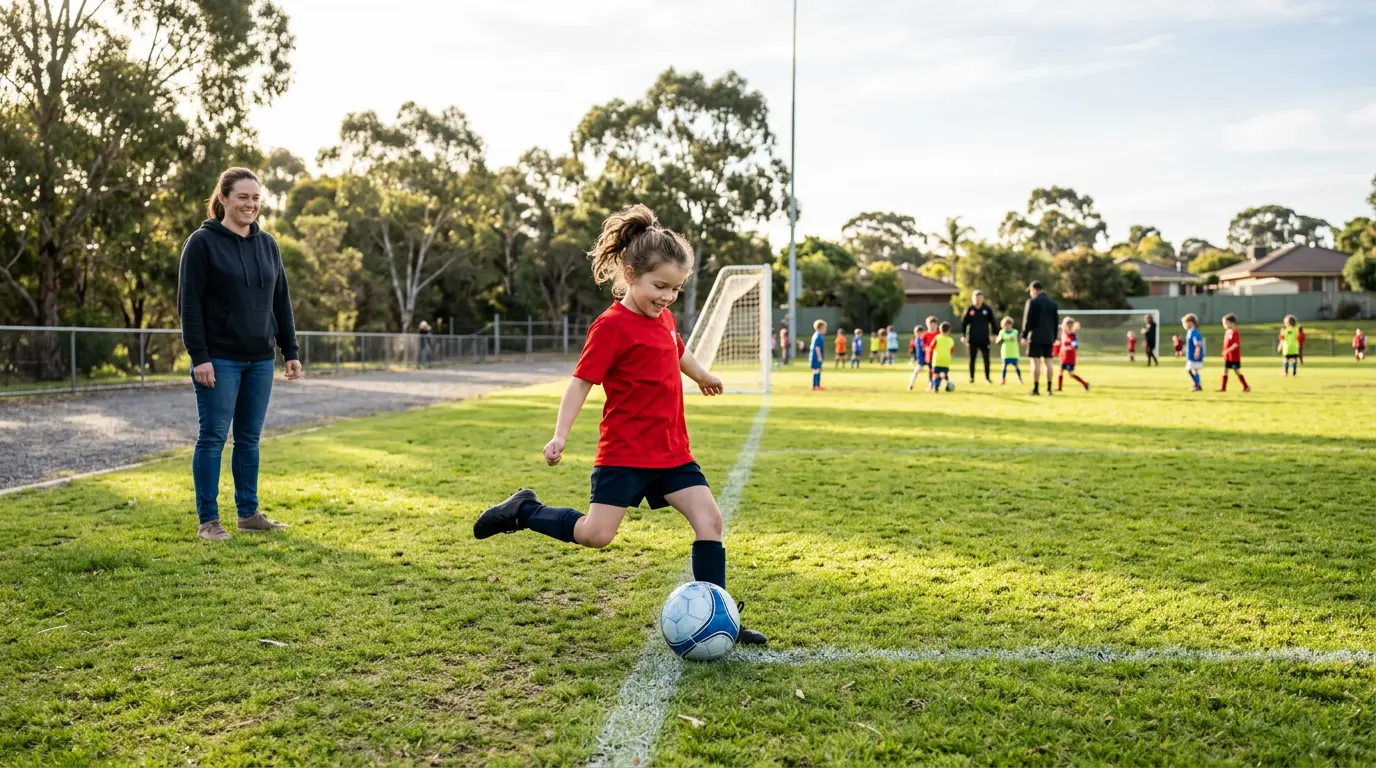
Your eight year old daughter has decided. She wants to play football. The conversation in the kitchen lasted two minutes. Now you need to do something about it.
You promised her you would find out. You sit down at the laptop at nine that night with seventeen tabs open and two acronyms you do not recognise. The websites are confusing. The pricing is opaque. There are pictures of girls in club kit that look professional and you wonder if you have already missed something.
You have not. The path from "she wants to play" to "she has boots on Saturday morning" is short. Most parents make it longer than it needs to be by treating it like a research project. This article walks the actual path, with the prices, the questions to ask the club, the things to skip in year one, and the part the websites do not tell you.
Where to look, and what you are looking at
The starting place for almost every girl aged 4 to 11 is MiniRoos. This is Football Australia's small-sided youth program, and it is the framework most clubs use as their entry product. Sessions are short, the field is small, the focus is on touches and fun. There are MiniRoos-affiliated clubs across every state and territory.
The 2024 National Participation Report recorded 1,911,539 total participants nationally and 221,436 women and girls in the game, up 16 percent from the year before. There are roughly 200 community clubs running formal girls' programs across Australia, and most communities of any size have at least one club within ten minutes drive. To find your nearest one, the public directory at miniroos.com.au lets you enter your suburb and returns a list.
Above MiniRoos age, your state body site lists the affiliated clubs in your area. Football NSW, Football Victoria, Football Queensland, Football West, Football South Australia, Capital Football, Football Tasmania and Football NT each maintain a club directory. Search "[your state] Football clubs near me" and the directory is one click away.
What to actually look for in a first club is simpler than the website browsing makes it look. Proximity (you will be doing this twice a week for nine months a year, distance compounds), MiniRoos affiliation for primary-school children, and whether they have a girls-only stream or run mixed teams in your daughter's age group. Reputation matters less than fit at this age.
Mixed or girls-only
This is the question that confuses first-time parents most often. The short version: ages 4 to about 8, mixed is fine, often better.
MiniRoos at U5 to U7 is mixed by Football Australia framework at most clubs. Children play, learn, and develop together. The structural decision about gender-segregated streams typically happens between U8 and U10 and varies by club and association.
The case for keeping it mixed past U8 if it is an option: mixed-gender play to about age 11 has documented developmental benefits for girls in technical confidence and decision-making speed. Girls who play with boys at this age often report later that they felt prepared for any environment. The technical bar in mixed play tends to sit slightly higher because of physical asymmetry, and the girls who play through it gain a kind of composure that compounds.
The case for moving to girls-only earlier: some daughters flourish in single-gender environments. This is a temperament question, not a skill question. If your daughter is shy, or noticeably hangs back when boys dominate, a girls-only stream can be the better fit. There is no wrong answer.
A practical pattern that works for many families: keep it mixed until U10 or U11, then look at moving to a girls-only stream as serious-football decisions start being made. There is a longer breakdown of this question in mixed teams or girls-only at U8.
What it actually costs
The starting cost is smaller than the websites make it look, once you know which numbers to subtract.
Three components.
Registration. Typically $150 to $400 in 2026, depending on club and state. The fee bundles the National Registration Fee paid through to Football Australia, the state body component, and the club component. Most clubs publish the inclusive figure on their registration page.
Voucher schemes. Most states subsidise children's sport at amounts that meaningfully reduce the registration cost. NSW Active and Creative Kids gives $50 plus $50 per calendar year. Victoria Get Active Kids gives up to $200 per child per year. Queensland FairPlay $200. Western Australia KidSport $300 to $500 depending on need. South Australia Sports Vouchers Plus $100 plus $100. Tasmania Ticket to Play $100 plus $100. Northern Territory Sport Voucher Scheme $100 plus $100. ACT does not run a voucher scheme but has hardship arrangements via club. The vouchers apply before payment if you set them up first. Most clubs accept the voucher at checkout. The cost difference between applying the voucher and not applying it is the difference between a parent who paid $360 for the season and a parent who paid $260 for the same season.
Equipment. Boots and shin pads are mandatory. A club shirt or jersey is usually included in registration. That is it for the first season. Total equipment cost typically $80 to $200 for new gear, less for second-hand.
There is no need for a backpack of training gear, ball pump, water bottle holder, special socks, or compression wear. None of it is needed at the starting age. The retailers who sell it are not lying. They are optimistic.
The three questions to ask the club
Before you register, three short questions to the registrar or head coach. The way they answer tells you more than any website does.
"How many children are in a session at this age group?" If the answer is more than 12 to 14 per coach for primary-school age, the touches per child will be low. Better to find a club with smaller groups even if it is slightly further away. The 16 percent participation lift since 2023 has put many community clubs above their historical group sizes, and clubs that managed it well are clubs that limited their intake.
"Do you follow the MiniRoos coaching framework?" The answer should be yes for any child under 12. This is the FA-endorsed game-based learning model, and clubs that go their own way at this age are usually doing the child a disservice. The framework is set out at miniroos.com.au.
"Are the coaches Working with Children-cleared, and how many qualifications do they hold?" The legal answer to the first part must be yes (state-issued WWCC). The qualification answer varies. Volunteer coaches at MiniRoos level are common and fine. The FA Foundation course (or the equivalent state body entry-level coach education) is what to look for. A club where coaches have done the basics is a club that takes coach development seriously, even if every coach is a volunteer.
If the registrar struggles to answer any of these, that is information. It does not necessarily disqualify the club. It does tell you what kind of club it is.
The first month, what to actually watch
A dedicated guide on this exists: what to actually watch when your U7 plays. The first four sessions are a feeling-out period for both your daughter and the club. Expect the first session to be socially confusing. Children at this age cluster in friend groups quickly, and a new arrival may stand on the outside for a session or two. By the third or fourth session, most children find their place.
What to watch for. Is the coach engaging with your daughter individually, even briefly. Is she doing more than standing in a queue. Is she smiling on the way home. These are not pass-fail tests. They are signals.
If after a month she is still standing on the outside socially, ask the coach whether they can pair her with a buddy for a few sessions. A specific named child to partner up with for warm-ups makes a noticeable difference and most coaches are happy to arrange it if asked.
If after a month the coaching is so chaotic that no one is learning anything, that is a different problem. Most clubs are fine. Some are run by good people without enough resources. A few are not run well. Trust your read after four sessions, not after one.
What to skip in the first year
Skip private skills sessions. At this age the right ratio is much more team time and free play, much less paid one-on-one. The money is not buying what the marketing claims it is.
Skip the upgrade boots. Children's feet at this age are still growing. A mid-range pair that fits properly is the right call. Top-of-range professional boots are a waste of money on small feet, and the marketing message that "the right boots accelerate development" is sales talk.
Skip the rep football conversation. Rep selections do not start until U10 or U11 in most associations. Anyone telling you to think about elite pathways at U7 is either selling something or misinformed. There is plenty of time. Stay in the community game until at least U10.
Skip the Matildas pressure. The senior national team is brilliant. Participation surged 16 percent after the 2023 home World Cup. None of it means your eight year old needs to be on a Matildas pathway. The honest pathway numbers are in the Matildas effect on your daughter.
The recap
MiniRoos is the entry product for ages 4 to 11. Most state bodies have club directories that find a local one. Mixed is fine, often better, until at least U8 to U10. Registration is $150 to $400 before vouchers, $50 to $250 after. Three questions before signing up: group size, MiniRoos framework, coach qualifications. Skip the upgrades, the private sessions, and the rep football conversation in year one. Watch the first month. Most clubs are fine.
Your eight year old daughter has decided. The first session is on Saturday morning. You have boots, shin pads, a club shirt, and a voucher applied at checkout. The pathway from here is not as complicated as the websites make it look.