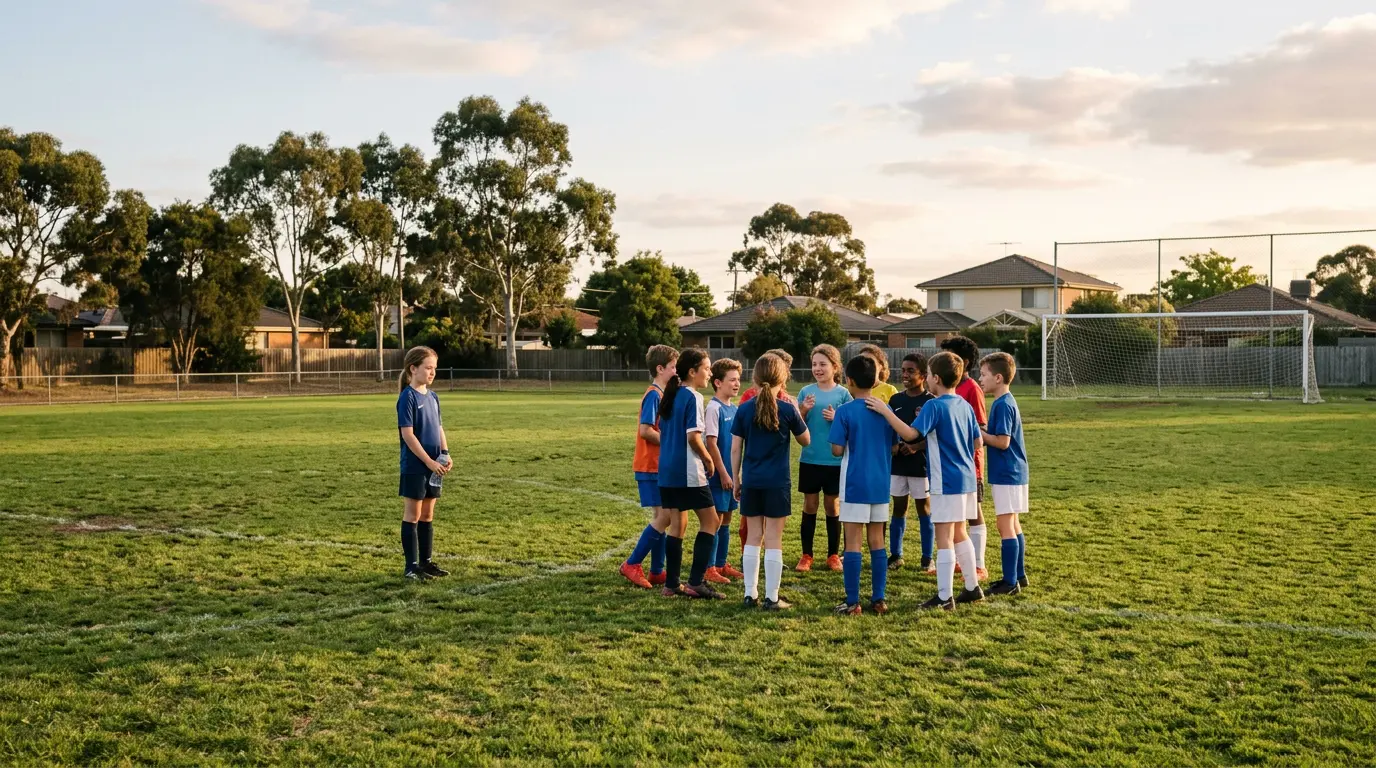
Your nine year old loves training. Tuesday and Thursday nights they cannot wait to get there. They do every drill. The coach loves having them.
Saturday morning is different. They get out of the car like they are walking into an exam. They will not call for the ball during the game. After the final whistle, when the team gathers for the huddle, your child stands slightly back. They want to be there. They do not want to be in it.
You ask if they enjoyed it. They say yes, quietly, and look away.
If you were a chatty kid yourself, this is confusing. You may have been told as a parent that your child needs to "be more confident" or "speak up more." That phrasing assumes the issue is something to fix. Often it is not. What you are watching is temperament, and temperament is stable. The 9 year old standing slightly back from the huddle is not a kid waiting to come out of their shell. They are a kid showing you exactly who they will be at 14, 18 and 26, just smaller.
The mistake parents and coaches make is reading reservation as a deficit and reaching for tools that worsen it. This article is what the research actually says about introvert kids in junior football, what works on game day, what to never do, and the reframe for parents who were the loud kid and quietly worry their child is missing something.
What introversion actually is, and why it does not change
Introversion is the temperamental tendency to draw energy from internal processing rather than from social interaction. Introverted children think before they speak, observe before they join, and tire more quickly from group activity. None of this is a deficit. Roughly 30 to 50 percent of any junior team will have this temperament, depending on which assessment you use; in personality research, modern surveys put around half of the population on the introverted side of the spectrum.
The harder fact is that it is stable. A landmark longitudinal study published by the United States National Institutes of Health in 2025 followed children from infancy through to age 26 and found that behavioural inhibition (the temperamental signature of introversion) measured in infancy reliably predicted introversion in young adulthood. Twenty six years. Same pattern.
The quiet 9 year old does not become a loud 14 year old. They become a quieter 14 year old, with more confidence, who has worked out which situations drain them and which restore them. The job between 9 and 14 is not to change the child. It is to give them tools to operate effectively while staying themselves. Anything that tries to change the temperament does not work. Anything that works with the temperament does.
What works on game day
A few specific things help an introverted child arrive at games ready, without trying to convert them.
Arrive five minutes earlier than the other kids do. Introverted children settle better when they have time to acclimatise to a space before others pile into it. They get to walk the field, put their bag down, lace their boots without an audience. Five minutes is enough. Twenty minutes is too much; they get bored and go inward in a different way.
Do not load the car with conversation about the game. The drive is for being quiet. The pre-game routine for an extroverted child involves chatting and joking. The pre-game routine for an introverted child involves listening to music or saying nothing. Both are valid. Match yours to your child, not to your own past Saturday morning.
Tell the coach. Most coaches misread introverted children as "not confident" and try to coach the personality rather than the player. A polite chat at the start of the season is enough. "Our child is quiet but loves football. They will not yell, will not call for the ball, but they will read the game and be in the right places. Please do not assume the silence means disengagement." Most coaches respond well to this and adjust how they read the kid for the rest of the season.
One-on-one debriefs after the game beat group debriefs. If the team does post-game group huddles where everyone shares, your child is enduring it. The actual debrief that helps them happens with you, in the car or at home, in private, on their timeline. Often that is later in the week, not after the game. Wednesday evening over dinner is more often when the real conversation happens than Saturday in the car.
What does not work
A few moves parents and coaches reach for that backfire on this temperament.
"Speak up out there." A direct instruction to be louder. Introverted children take this as evidence they are not enough as they are. The on-field result is that they call for the ball less, not more. The internal voice gets louder and the external voice gets quieter. The kid loses, the team loses, the parent has caused it.
Forcing a captaincy "to bring them out of their shell." Captaincy is a role that drains an introvert. They will do it because they do not want to disappoint the coach. They will hate the season. They will think less of football for the rest of their time in it. Captaincies are for children who want to lead loudly. Introverted leaders exist, but they lead by example. If a coach offers your introverted child the armband, decline politely on their behalf unless your child enthusiastically wants it.
Pep talks at half time about energy and effort. Introverts cannot deliver visible energy in the way an extroverted teammate can. They can deliver decisions and calmness. Coaching them by metrics that are easy for an extrovert to perform is a way of telling them they are doing it wrong.
Comparing them to a louder teammate. "Look at how Joey calls for the ball." A specific way of saying "you are wrong as you are." Children at this age internalise this in seconds and remember it for years. The cost of the comment is paid for the rest of the season.
What to encourage instead
An introverted footballer's strengths show up differently. Three areas where they often excel.
Reading the game. Quiet observation is a strength on the pitch. Introverts often see the pass before others do. The thing to praise is the decisions they make, not the volume at which they make them.
Calmness under pressure. When things go wrong, introverts often stay collected while louder players panic. This is a form of leadership. Name it when you see it. "You stayed calm when they scored. The team needed that." Specific, observable, true.
Repetition and patience. Introverts often have higher tolerance for technical work in repetition. They will do the boring drill twenty times to get one new touch. Across years, this compounds into the kind of technical base that gets a kid noticed at trial when louder teammates have plateaued.
There are positions on the football field where this temperament tends to thrive: holding midfield, centre back, and goalkeeping all reward calm reading of the game. Quiet does not equal limited. It just operates differently.
The reframe for parents who were the loud kid
If you were the loud kid yourself, the difficulty here is that your child's experience of football looks unfamiliar. They are not having the social fun you had. The teammates are not, by your standards, mates yet. They might never be in the way that yours were.
That is okay. They are getting something different from football. They are getting the technical and decisional development, the rhythm of a season, the body in motion, the small ritual of game day. The team-as-family piece is for a different temperament.
The two questions to ask, quietly, of yourself. Do they keep showing up? Do they smile in the car on the way home, even quietly? If yes to both, the friendship piece is not the problem you think it is. Help them find one or two good friends in or out of the team and the social-football piece sorts itself.
When to look beyond temperament
There is a difference between an introverted child who plays well and goes quiet around it, and a child who is anxious about football. The first does not need fixing. The second is a different conversation.
Signs the issue is anxiety not introversion: dread in the lead-up to games, sleep problems before football specifically, physical symptoms (stomach pain, headaches) on game day, declining engagement at training too. If those are present, see a pre-performance routine for a nervous kid and consider a chat with the GP if the pattern lasts more than four weeks. The same NIH research that confirms introversion is stable also flags that infant behavioural inhibition is associated with elevated risk for anxiety disorders later. Most introverted children never develop anxiety. The ones who do tend to show the signals above.
For broader temperamental development across the years, emotional development from 5 to 16 walks through age-typical patterns.
The recap
Roughly half of any junior team is introverted, and the trait is stable from infancy through adulthood. Reading the quiet as a problem leads to the wrong interventions. Arrive earlier, accept the quiet drive, brief the coach, swap group debriefs for private ones. Skip "speak up," forced captaincies, pep talks based on visible energy, and comparisons to louder teammates. Praise reading the game, calmness under pressure, and patience with repetition. The job is not to change the temperament. It is to give the child tools to operate as themselves.
Your nine year old comes off the pitch. The team huddles. They stand slightly to the side, the way they always do. They look at you. You smile. You do not say anything about how quiet they were. They get in the car. By Tuesday they are at training again. That is what success looks like for this child.