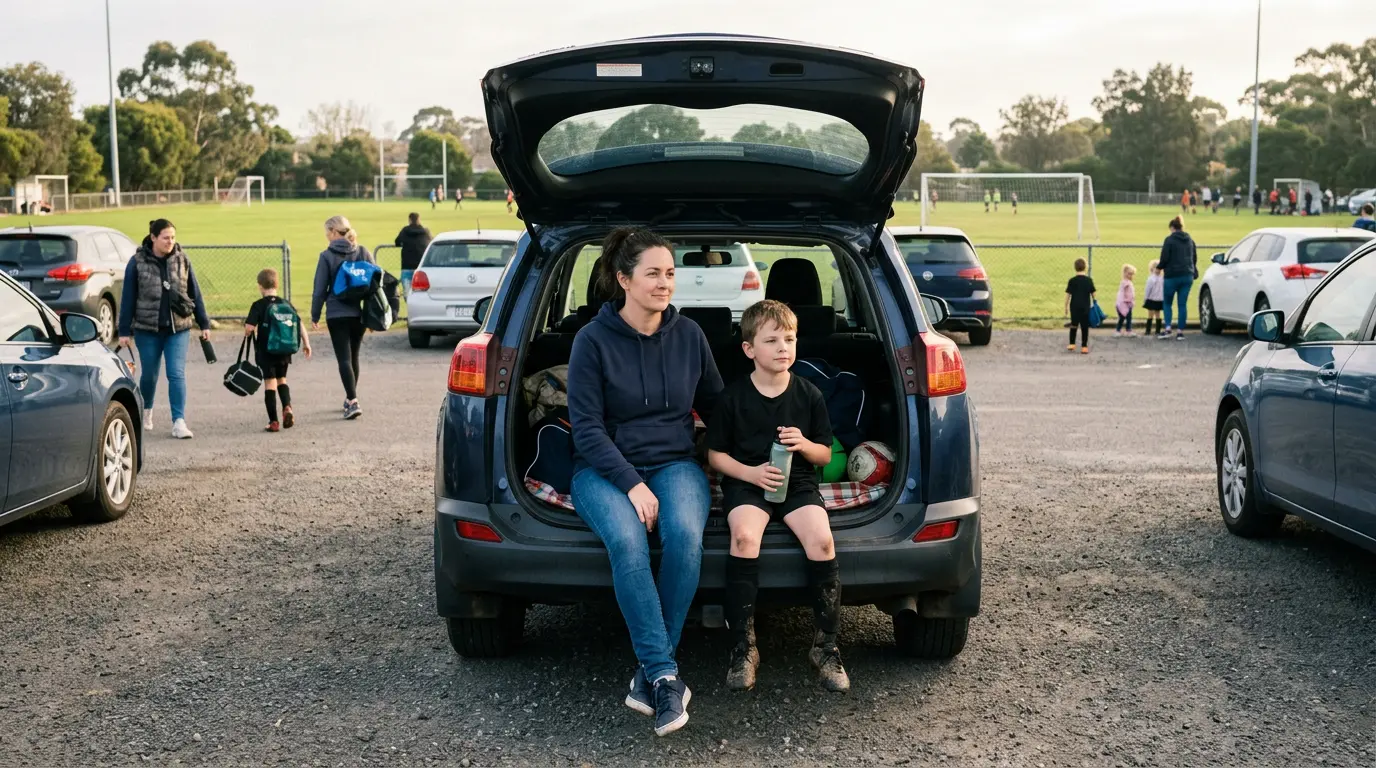
Your eight year old is in the back seat. Twenty-five minutes until kick-off. They have been quiet for the whole drive. Then they say it: "I don't want to play today."
You have heard this before. You have answered it badly before, and well. Today you want to do better.
What is happening for them is real. Their nervous system is preparing for a perceived threat, and the threat is the game. It does not matter that the game is meant to be fun. Their body has decided this is something to brace for. Telling them to "calm down" or "you'll be fine" does not switch off a body that is bracing. Sometimes it makes it worse.
A pre-performance routine works because it gives the body something to do other than escalate. The five steps below take about 15 to 20 minutes from car park to kick-off. They do not require special skills. They do not require your child to talk about feelings in any depth. They are designed for a kid who is already on edge.
Step 1. Park earlier and walk
Get to the ground 25 to 30 minutes before kick-off. Park further away than you have to. Walk together to the pitch. Movement does the first half of the work for you. The body uses some of the adrenaline by walking. The slow approach is also a signal: nothing is being rushed at them.
Do not fill the walk with sport talk. Talk about the dog. Talk about the leaves. Talk about nothing. The point is the walk itself.
Step 2. Slow the breath
This is the smallest thing that changes the most. You do it together, where they can copy you, not be coached.
Four counts in, six counts out. Through the nose if they can. Three or four rounds is enough.
You do not have to call it breathing exercises. You can call it nothing. Just sit on the boot of the car or on a fence and do it. They will copy. Once their body has slowed the out-breath a few times, the heart rate drops on its own. This is documented in plain physiology and it works in a junior football car park exactly the way it works anywhere else.
If they will not do it, you do it. Children copy parents. They will get there.
Step 3. Name the feeling, do not fight it
Once the breathing is done, you can speak.
Name the feeling out loud, simply. "Your tummy is doing the thing it does before games. That makes sense. Your body is getting ready."
Not: "Don't be nervous." Not: "There's nothing to worry about." Not: "Other kids are nervous too."
Naming a feeling out loud is one of the most evidence-backed parent moves for emotional regulation in children. The acknowledgement does almost all of the work. You are not trying to talk them out of the nerves. You are showing them the nerves are recognised and ordinary.
Then reframe: "Some of this is your body getting ready to play well. The same things happen to your body when you are about to do something important. It is not a sign anything is wrong."
That last sentence is the one to memorise. It is the single most useful thing you will say.
Step 4. The smallest physical task
Give them one tiny physical thing to do that has nothing to do with playing well. Not a drill. Not a warm-up. Something hands-on.
Examples: "Help me find a flat patch to put the bag down." Or "Tell me which way the wind is blowing." Or "Lace your boots one notch tighter than usual and tell me how it feels."
The point is to give the brain a small, completable task that takes them out of their own head. A child who is nervous is in a future loop, replaying things that have not happened yet. A small physical task pulls them back to the present. Two minutes of present time is enough.
Step 5. The handover line
When the coach calls them in, you say one thing. Always the same thing, every game, all season. Pick a line and stick to it.
The line we suggest is: "Have fun out there. I love watching you play."
Not "you've got this" (creates pressure). Not "remember to listen to coach" (a scolding wrapped in a goodbye). Not "smash 'em today" (loads the rest of the game minutes with violence). Not nothing (a gap they will fill with anxiety).
The same line every week becomes a ritual. Rituals soothe nervous systems. It is one of the simplest things a parent can do that lasts the whole year.
If you usually struggle to know what to say at the moment of handover, this is the line. Make it yours. It works.
What to skip
A few things that make pre-game nerves worse and that parents reach for anyway.
Pep talks about effort, focus, or keeping their head up: adds pressure. Strategy reviews: the coach has covered it, you repeating it sounds like a test. Last-week-this-week comparisons: hands them a problem to solve right before kick-off. Big breakfasts or new foods half an hour before: stomach trouble compounds nerves. Driving fast and arriving with no minutes to spare: the whole routine collapses.
When to look beyond the routine
The routine works for ordinary game-day nerves. It is the right tool for a kid who plays, mostly enjoys it, and has the wobbles before kick-off. If your child cannot sleep the night before games every week, refuses to leave the house on game day, has stomach pain or vomiting before games, or has stopped enjoying any part of football for more than four weeks, the issue is bigger than nerves and a chat with your GP is sensible. There is no shame in that. There is also no rush. A four-week pattern is the threshold. Earlier than that, the routine should be enough.
You may also see your child collapse emotionally after a single mistake during a game. That is a different problem with a different fix; it is covered in Your kid can't recover from a single mistake.
For the broader developmental context, what you are seeing at age eight is age-appropriate; Emotional development from 5 to 16 walks through what to expect at each age. And if the pattern is not pre-game nerves but post-mistake meltdown, Your kid loses it after mistakes is the closer fit.
For more on how children of different ages process emotions, Raising Children Network on understanding and managing emotions is the best public resource.
The recap
Park early and walk. Breathe four-in-six-out together. Name the feeling, do not fight it. Give them one small physical task. Hand them over with the same line every week. The whole thing takes 15 to 20 minutes. It works because it gives the nervous system something to do other than escalate. It is not magic and it does not need to be. The pre-performance routine is the most boring effective tool you have.
Your eight year old gets out of the car for kick-off. Their body is no longer bracing. The thing that changed was the 20 minutes that came before it.