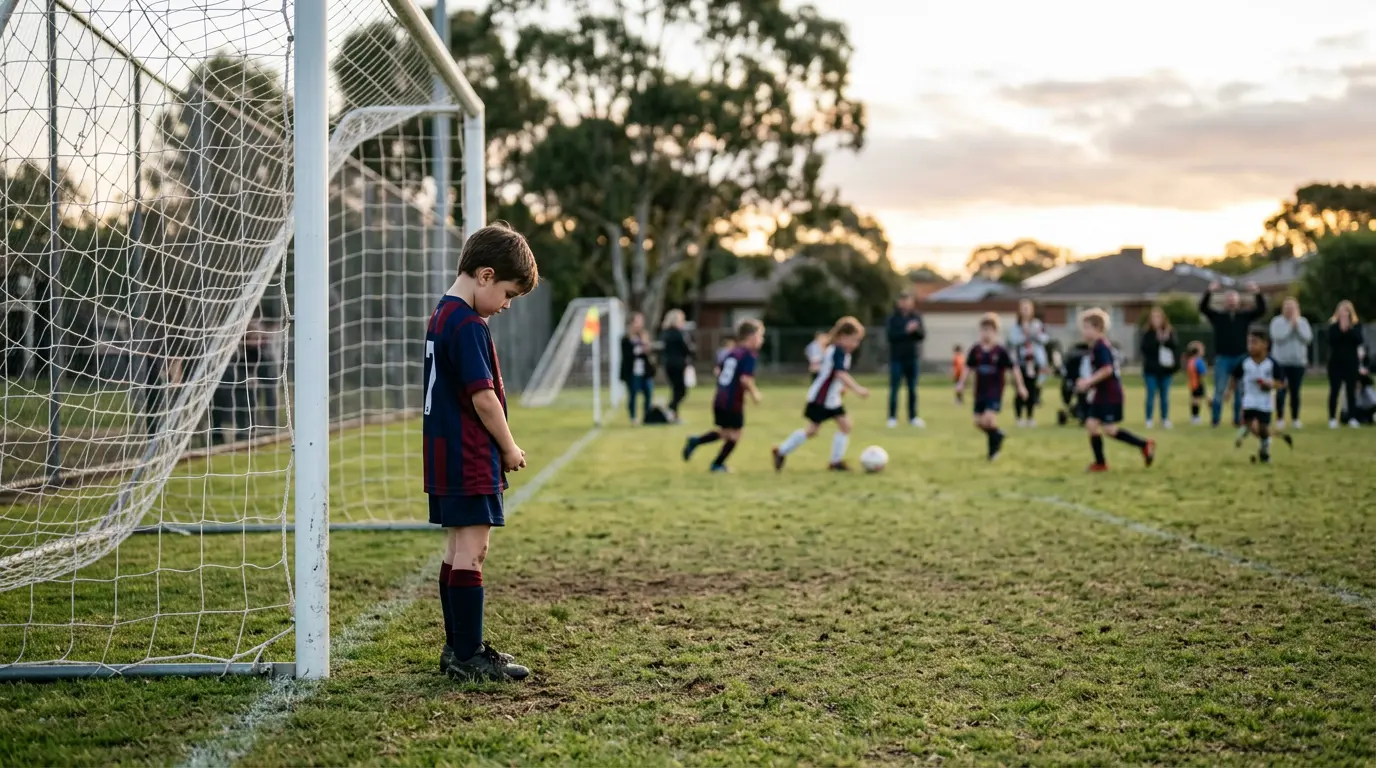
Your nine year old plays a forward pass. The ball is intercepted. The other team breaks and scores. From the sideline you can see them change. The shoulders drop. The next ten minutes they are jogging without intent. They do not call for the ball. They do not track back. By half time they are looking at the grass.
You know what comes next. The car ride. The silence. Maybe the tears.
This is one of the most common things parents bring to junior football and one of the least talked about. The child whose game collapses after a single error.
The first thing to know: this is age-typical to about 11. The capacity to mentally bin a mistake and reset is a frontal-lobe skill that is not fully wired in primary-school children. They cannot do what an adult can do because the architecture is not there yet. Telling them to "shake it off" is asking them to use a part of the brain that does not function the way yours does.
The second thing to know: what you do in the next 24 hours matters more than what the coach says at half time. Most of the work happens off the pitch.
What rumination is doing
When a child makes a mistake and freezes, they are not sulking. They are running the mistake on a loop. The brain is replaying the moment and predicting that the next moment will be the same. This is called rumination. It is age-typical and it reduces with cognitive maturation. By 13 to 14, most children have started to develop the capacity to interrupt the loop on their own. By 16, most can do it consistently. Until then, they often need an adult to help.
The window where intervention works best is not during the rumination. It is afterwards.
In the moment: what does and does not help
When a child is mid-game and locked in a rumination loop, your influence from the sideline is limited. Things to skip:
- Yelling instructions. They cannot hear you. Their attention is inside their own head.
- "Get back into it." A command for a brain that cannot follow it.
- Mock disappointment, head-shaking, hands on hips. The child sees this and adds your reaction to the loop.
Things to do, or to suggest the coach can try:
- Move them somewhere different on the pitch for two minutes. New position equals new task. The brain has to reset.
- Have the coach name something completable. "Win the next throw-in." Not "play your normal game." A small task interrupts the loop.
- If the coach knows the child well, sub them off for five minutes. A short bench shift is not punishment; it is a hard reset that primary-school brains usually need from the outside.
The coach response in the 60 seconds after a mistake matters more than parents typically realise. If your child has the same coach for several seasons, this is a worth-the-conversation topic. Not as a complaint. As context. "Our kid struggles to bounce back from one mistake. Anything that lets them switch tasks for two minutes works wonders."
On the way home
This is the highest-impact 15 minutes you have all week.
The default move most parents reach for is the post-game review. Replay the moment. Ask "what happened there?" Suggest what they could have done. Some parents do this at game level, some go play by play. All of it is bad for a child who is already ruminating.
Silence outperforms any review.
The drive home is for water, music your child likes, and small things. If they want to talk about the game, you listen and reflect, you do not solve. If they do not want to talk, you do not talk. Their brain is still running the loop. The most useful thing you can do is not feed it more material.
If they bring up the mistake, do not minimise. "It was not that bad" sounds like you do not understand. Try: "Yeah, that one stung. The whole game has those." Acknowledgement, then a wider frame. Do not stay long.
The next day they will have moved on. Most will. Do not bring it back up. If they want to talk later in the week, you listen then.
Practising the next-play mindset at training
The "next play" idea is overplayed in adult sport but has value at junior level if it is practised at training, not preached at games.
Ask the coach: in small-sided games, can the team be told that every error has a 5-second rule? You make the mistake, you say one thing in your head ("next play"), you keep going. No standing still, no head down. Practice it explicitly, with the coach calling it out the first few weeks.
What you are training is not effort. It is the muscle of letting go. By doing it dozens of times in a low-stakes session, the brain starts to associate "I made a mistake" with "I keep playing" rather than "I freeze". This is one of the few places where deliberate practice of a mental skill works at primary-school age.
When to look beyond the sideline
The pattern is age-typical. The fix is mostly time and the home and coaching response. But there are signs the issue is bigger than developmental.
If your child cannot let go of a mistake for more than 24 to 48 hours, week after week, that is unusual past about age 9. If a single mistake at football is leading to refusing to attend school the next day, sleep disturbance, or generalised anxiety beyond the sport, that is a sign to chat with your GP. There is no rush. Two to three weeks of pattern is the threshold. A single rough fortnight can happen to any kid.
A GP referral does not mean a diagnosis. It means a professional in the room helping you and your child pick up tools you may not have. Sport psychologists, child psychologists, and family GPs all see this presentation often. None of it is exotic. None of it is a verdict on your child or your parenting.
The handful of related places to look
Pre-game nerves are different from in-game collapse, but they often coexist. If your child is also visibly anxious before kick-off, a pre-performance routine for a nervous kid is the closer fit. The broader emotional development picture is in Emotional development from 5 to 16. For the post-mistake meltdown specifically, Your kid loses it after mistakes covers that variant. Two related pieces on the drive home: the car ride home for the broader principles, and the silent drive home for what to make of it when your kid will not talk.
Raising Children Network has the best plain-English resources on rumination and emotional regulation in children. Their guide on understanding and managing emotions is worth bookmarking.
The recap
A child who collapses after a single mistake is running rumination, not sulking. It is age-typical to about 11 and reduces with cognitive maturation. In the moment, give the brain a small task. On the way home, silence beats review. At training, practise the next-play muscle. If the pattern lasts more than two to three weeks, a GP chat is reasonable. The whole thing is about giving the child time and tools while their brain finishes wiring.
Your nine year old gets in the car. The first thing they hear is the song they like. You do not say anything about the game. Most of the work has already been done by you not doing the thing every parent reaches for first.