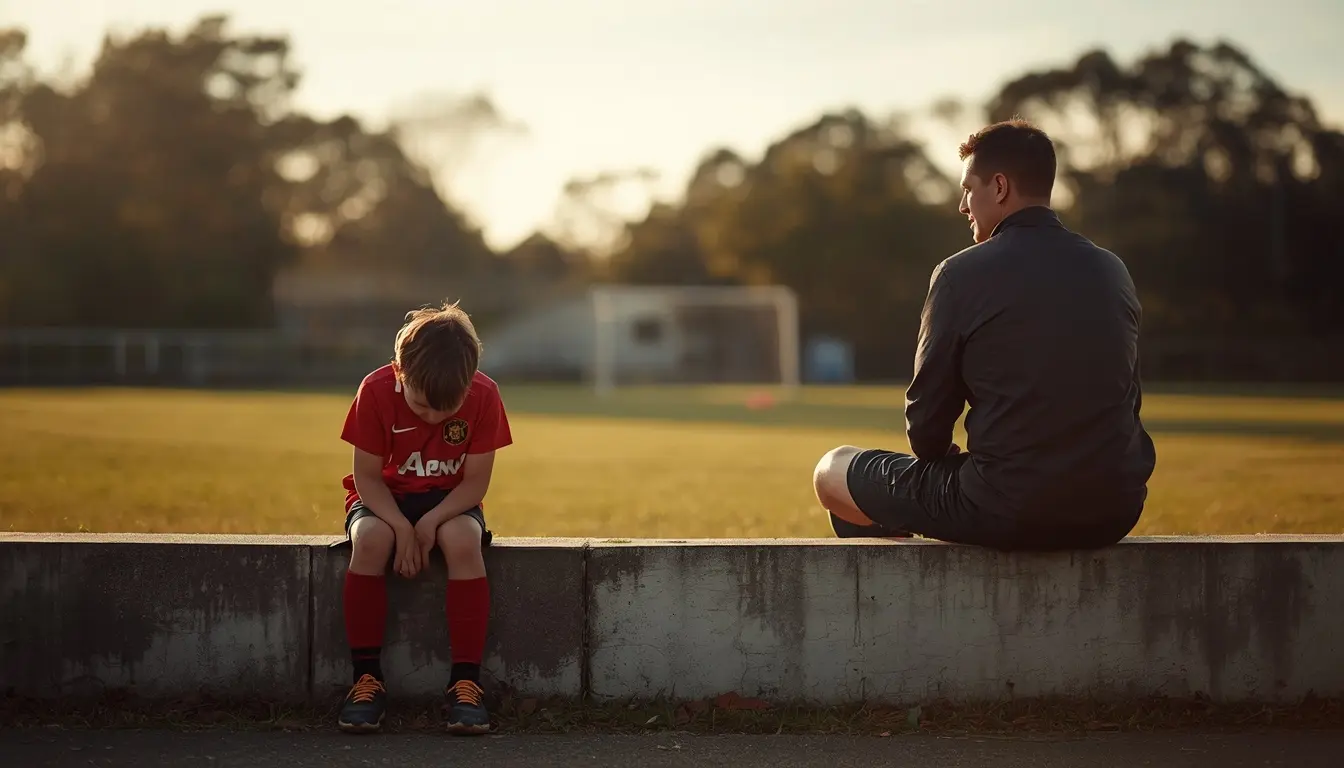
Your kid misses an open goal at U8s. They burst into tears on the pitch. Your kid lets in a soft one at U11s and slams their boot into the post on the way off. Your kid sits in the back seat after a U13 game and refuses to speak for forty minutes.
If any of this sounds familiar, this is normal developmental territory. Big emotions after mistakes are part of how kids 5 through 16 are wired, and expecting adult-level recovery from a 9-year-old is biologically unrealistic. The brain circuitry that handles emotional regulation does not finish developing until well into the late teens. What is in front of you in the kitchen doorway is not a character problem.
There is a sequence that helps in the moment without making it worse. There is also a short list of things not to say that you might be saying right now without realising. The instinct to fix it is the trap.
What is actually happening
A junior football mistake is not a small event for a kid who cares. The combination of public visibility, teammate reactions, scoreboard impact (real or imagined), parent presence on the sideline, and the kid's own internal narrative produces a load that an adult would call overwhelming. The kid does not have the language to call it that.
What you are seeing in the meltdown is not the mistake. It is the load. The mistake was the trigger. The crying, the boot in the post, the silent drive home, the storming off to the bedroom: that is the discharge of the load.
If you treat the meltdown as the problem and try to make it stop, you stop the discharge. The load stays. It comes out somewhere else, usually later, often as something that looks unrelated.
The in-the-moment sequence
This is what to try, in order.
Step one. Be present, do not speak yet. Sit near them, in the car, at the boot of the car after the game, on the wall outside the clubrooms. Do not talk yet. Do not ask what happened. Do not start fixing. Your nervous system being calm and physically near them lends regulation. This is co-regulation and it is the most effective tool you have. The presence does the work.
Step two. Name what you see, briefly. "That looked hard." "Big feelings." Five words, no more. The naming gives the kid permission to have the feeling and confirms you are not mad at them. Do not name the cause. Do not name the play. Just the feeling.
Step three. Wait. Often longer than feels comfortable. The discharge has its own pace. Adults intervene too early because the kid's distress is uncomfortable for the adult. Sit through it.
Step four. Quiet acknowledgement when they look up. "You really wanted to get that one." "I saw how hard you tried." Specific to the kid, not to the result. Not "you played great", because they know they did not.
Step five. No problem-solving today. None. Not "let's work on it at training Tuesday". Not "I think the keeper was off his line". Not "your coach should have substituted earlier". The conversation about the mistake, if it is going to happen at all, is for 24 hours later when the load has cleared. Most of the time it never needs to happen.
That is the whole sequence. It looks short. The hardest parts are step three (the waiting) and step five (not coaching).
Things not to say
These come from the same well-meaning instinct. They land as dismissal, every one of them.
- "Don't worry about it." Translates to: your feelings are not valid.
- "It doesn't matter." Translates to: I do not understand what football means to you.
- "You're being silly." Translates to: I am embarrassed by you in front of others.
- "Toughen up." Translates to: you are weak.
- "It's just a game." Translates to: I have not paid enough attention to know what this means to you.
- "Everyone makes mistakes, get over it." Translates to: I am tired of dealing with your feelings.
None of them are bad parents talking. All of them are panic. The kid's distress is uncomfortable. The instinct is to make it stop. The shortcuts above all make it stop in the short term and reinforce the load in the long term.
Why "wait until tomorrow" works
The 24-hour rule is not arbitrary. It maps to how the kid's brain consolidates emotional memory. A conversation about a mistake while the kid is still in the load lands as criticism on top of distress. The same conversation 24 hours later, in a calm moment, lands as helpful reflection.
If the conversation never happens, that is also fine. Most learning at junior football ages happens through repetition at training and play, not through verbal coaching from parents. Your job is not to teach the football lesson. The coach does that. Your job is to be the calm place the kid comes back to.
Age makes a difference
Six to nine year olds: the meltdowns are bigger and shorter. Often loud, often immediate, often completely gone in 20 minutes. Co-regulation works fast at this age. Sit, name, wait, hug if invited.
Ten to twelve year olds: the meltdowns get more internal. Less crying, more silence, more bedroom door slams. The waiting gets longer. The 24-hour rule becomes more important because the kid is processing privately.
Thirteen plus: emotions go underground. The signs are short answers, not coming out for dinner, no longer wanting to discuss any game. Connection becomes harder, presence still works. Quietly available without forcing conversation. Watch for sleep, appetite, and school changes that go past two weeks; that is when general moodiness becomes something to ring the GP about.
When to be concerned
Big feelings after a tough game are normal. The signals that point past normal and toward needing help are persistence and spread. Specifically:
- Distress that does not ease within a day or two and continues across the week
- Refusing to go to training when previously they wanted to
- Sleep changes (trouble falling asleep, waking, nightmares about football)
- Appetite changes that last
- School engagement dropping
- Withdrawal from friends inside or outside the team
- Talking about themselves in a way that goes beyond a bad game ("I am rubbish at everything", not "I played badly today")
If two or more of these last more than two weeks, the conversation is with your GP. The GP will connect you with a child psychologist or recommend a school counsellor referral. RaisingChildren.net.au has parent-targeted guidance for the general principles, and Beyond Blue's support service is available 24/7 for parents who want to talk it through with a counsellor.
A note from one parent to another
This article was written from the parent's side of the kitchen table, not the doctor's side of the desk. We are not psychologists. The general principles here are well-established but the specific kid in front of you is unique. If something does not feel right, talk to your GP first.
Football is supposed to be one of the places kids learn to handle setback. They do not learn that by being shielded from the feeling. They learn it by feeling it with you nearby, not fixing it for them.
The library has a sister piece on the routine that helps most kids regulate emotions around sport. Read that one when you have the bandwidth to think about a system rather than just the next match.