You walk to the touchline with your chair. Your kid is on the pitch already. The opposition coach is yelling at his under-10s. A teenager in a fluoro shirt has the whistle. A few parents you know are setting up their chairs near yours. Today you're a spectator.
You're going to do this thirty Saturdays a year. Some of those Saturdays will be fine. Some will not.
Most clubs put up a poster near the canteen at the start of the season. They say something like:
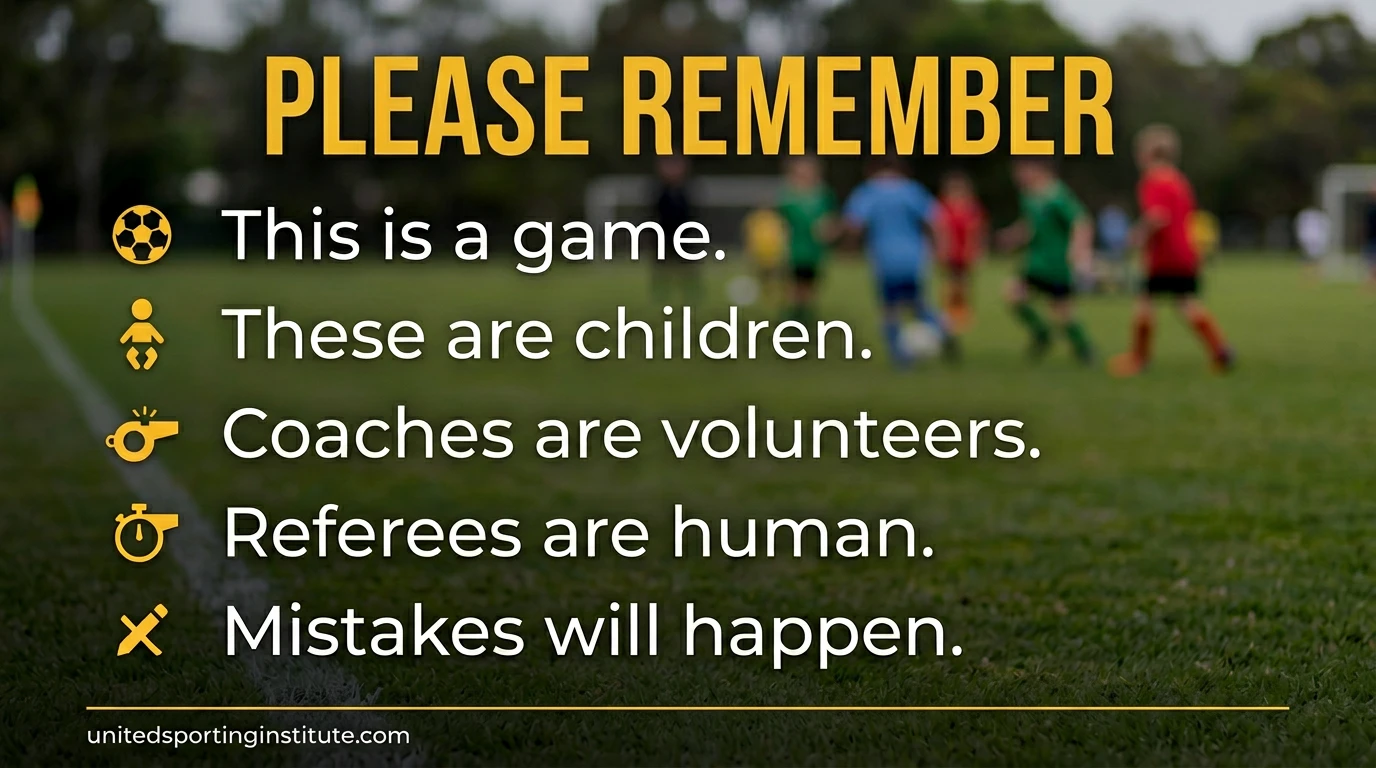
This is a game. These are children. Coaches are volunteers. Referees are human. Mistakes will happen.
Five lines. The whole thing in five lines. The rest of this is the bits the poster doesn't have room for.
The five lines, in real life
It's a game. Not a final, not a trial, not your second chance at the career you didn't have. A 9-year-old is running around in front of you because they like kicking a ball with their friends.
These are children. The kid who just missed in front of an open goal is 8. He'll have forgotten by the time he's eating his orange. The kid yelling at her teammate is 11 and has never had to handle pressure like this before. None of them are small professionals.
Coaches are volunteers. Most junior coaches are parents. They put their hand up at the start of the year because no one else did. They did a coaching course over a weekend and now they're in charge of fourteen kids and forty parents. They aren't paid. They use their own evenings to plan training. The "useless coach" you're cursing is someone's dad on his fifth night this week away from his other kids.
Referees are human. Most junior referees are teenagers, often 13 to 17. They earn a small match fee to stand on a field and be yelled at by adults. They miss calls. They get calls wrong. They are someone else's child.
Mistakes will happen. Players miss. Coaches make the wrong sub. Referees blow the wrong call. Other parents say things they shouldn't. You will, too. The question is what you do next.
That's the headspace. Now what to actually do with it.
The official rules in two sentences
When you signed your child up on PlayFootball, you ticked a box agreeing to follow Football Australia's Member Protection Policy and your state body's Code of Conduct. You can read all the official wording at Football Australia Statutes and Regulations if you like. It's the rulebook, but it's written for officials, not parents.
The plain version: don't abuse anyone, don't use racist or otherwise discriminatory language, don't get in the way of the game, don't go onto the field, don't drink at the ground, don't film other people's kids without permission. Each one of those can land you a written warning, a ground ban, or worse.
You probably weren't planning to do any of them. So far so good.
Where you stand
Stay on your team's side of the field. Outside the technical area, which is the rectangle near the bench where the coach and subs sit. Parents don't go in. And stay behind any spectator line marked on the ground.
If you can't see a line at an away ground, ask the home club where to stand. Better than being moved by the referee in front of your child.
Don't coach. Anyone's kid.
You don't coach. The coach coaches. That's the rule.
When your kid has to listen to the coach, listen to you, and think for themselves all at once, they freeze. When the coach says "hold the ball" and you yell "pass," they panic and pick wrong. Sideline coaching is the parent behaviour coaches complain about most. Football Australia's junior guidelines and most state body policies tell parents not to do it at any age, and the youngest grades are stricter still.
Cheer effort. Clap good play from any team. Stay quiet on the technical stuff.
If your child wants to talk about the game, the car ride home is the moment, not the touchline.
The thing nobody tells you about the sideline
This one isn't in any rulebook.
Parents on the sideline talk to each other. About the coach, the ref, the other team's number 9, that loud dad three chairs down. And mostly, they agree with each other. Even when somebody is being unreasonable. Even when the loud dad is wrong.
Why? Because you're going to see these people every Saturday for the rest of the season. Your kid is friends with their kid. Disagreeing makes you the odd one out. So you nod and say "yeah, kids these days" or "yeah, the ref's hopeless" and move on, even when you don't really think that.
It's understandable. It also has a cost.
The loud dad stays loud because nobody pushes back. The kid being yelled at hears the parents around him laughing about it instead of being uncomfortable about it. The teenage referee hears six adult voices when only one of them was really yelling. Your own kid sees you go along with stuff you wouldn't go along with anywhere else, and learns that on the sideline, the rules are different.
You don't have to be the sideline enforcer. Nobody wants to be that person. But you don't have to nod along either. "Yeah, kids" is a fine answer when "yeah, the ref's a clown" doesn't sit right. Move your chair if you need to. Stay quiet on the bit you didn't agree with. Small things. The kids around you read everything.
The unwritten rules
These aren't in any rulebook either. They're what the other parents are watching for.
Wait five seconds before reacting. Bad call against your kid? Count to five. By five, you usually no longer want to say anything.
Stay quiet while they play. Their brain is loaded already: the coach, their teammates, the ball, their last touch. Adding your voice on top jams the signal.
Your child can hear you. So can theirs. Voices carry. The thing you mutter about the other team's number 9 will reach his mum. Assume your voice is on a microphone.
Don't sit with the opposition parents. It looks bad even when it isn't.
Be careful with photos and video. Film your own kid. If someone asks you to stop, stop.
Don't wander toward the bench during the game. "Quick question for the coach" mid-match isn't on. Save it for after the whistle, or send a message later.
Wait 24 hours before raising a complaint. If you're upset about selection or playing time, sleep on it. Most clubs ask for this anyway.
Don't be the parent everyone hears but nobody knows. If every parent on the sideline can pick your voice but couldn't pick your face out of a lineup, you're already in trouble.
When something actually needs reporting
For unwritten stuff, walk away or have a quiet word later. For the official stuff, there's a path.
Every Football Australia-affiliated club has a Member Protection Information Officer (MPIO) who handles behaviour complaints. Ask the club secretary who it is. Above that sits your state body. Above that sits Sport Integrity Australia for the most serious matters. For online abuse like group chats and social media, there's the eSafety Commissioner.
If you'd rather get cross-sport advice or just understand what counts as a complaint, Play by the Rules is the joint Australian Sports Commission and state government site that covers all of this for community sport.
One quick thing on Working With Children Checks. If you're just a parent watching your kid play, you don't need one. The check is for people in roles that put them in direct contact with children: coaches, managers, club officials. Spectators have to follow the club's child-safe policies, but the check itself isn't required. This catches a lot of parents out.
What it costs to get it wrong
Penalties under the Football Australia framework include written warnings, ground bans for set periods, suspension from the club, and being expelled. State bodies have given lifetime bans for racist language and serious referee abuse. Sport Integrity Australia matters can spread across all sport, not just football.
When a parent earns a ground ban, the kid carries it. The child sees the parent escorted off. Hears about it from teammates. Plays the rest of the season knowing the parent isn't allowed at games. That cost lands on the child, not the parent.
The short version
This is a game. These are children. Coaches are volunteers. Referees are human. Mistakes will happen.
Cheer effort. Stay behind the line. Don't coach. Don't yell at the ref. Stay quiet while they play. Don't nod along to things you don't actually agree with. If something needs reporting, talk to the club's MPIO or use Play by the Rules.
That's the sideline. The rest is detail.