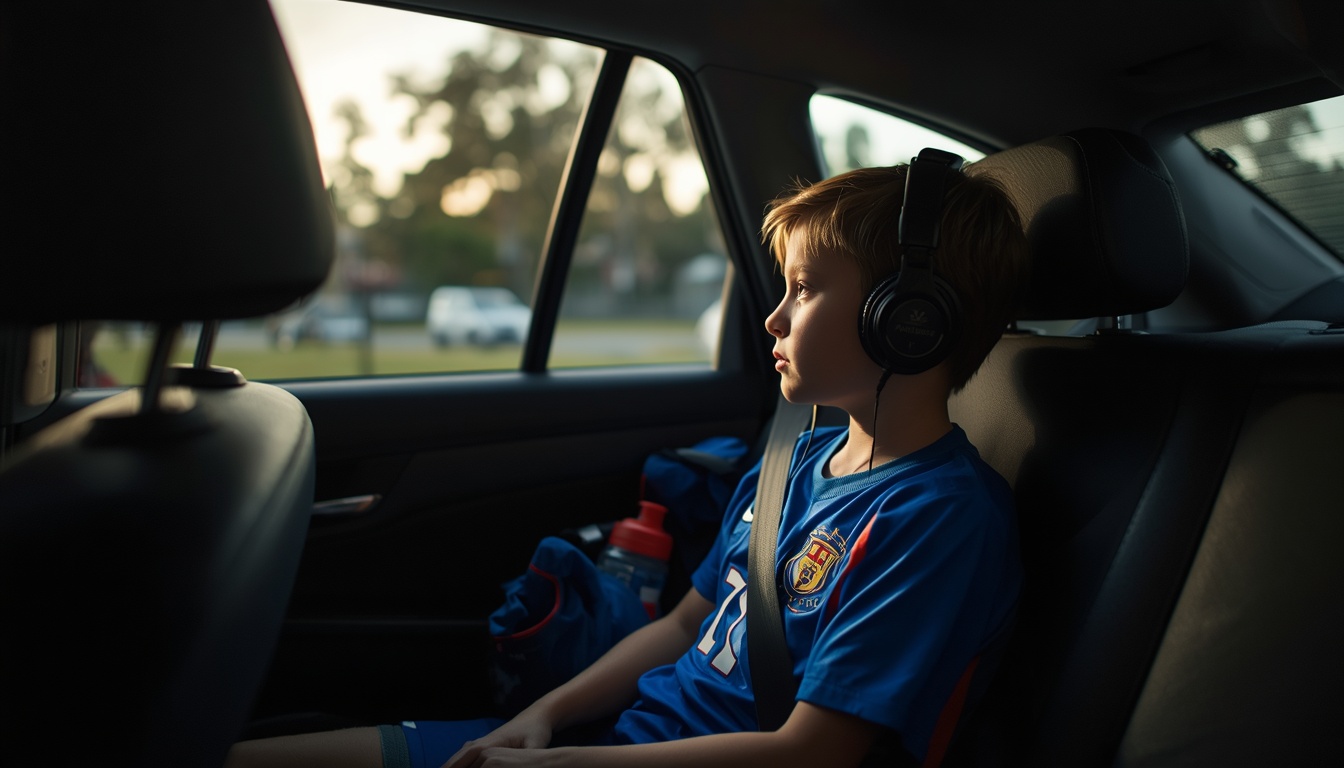
You've just sat through 60 minutes of unhappy U10 football. Two own goals, three missed passes, and one sideline parent (not yours) who needed a long quiet word from someone. Your kid walks to the car ahead of you, headphones already on. They get in. They don't look at you. They don't speak. You open your mouth to say something, and whatever you were going to say dies before it gets out.

You drive home.

The drive home is the part of junior sport nobody runs a clinic on. Nobody hands you a script. The default is whatever you grew up with, which for a lot of Australian parents is a steady stream of "you should have done this, you could have done that, here's what your coach should be telling you." Most of us don't notice we're doing it.

A pair of American coaches called Bruce Brown and Rob Miller have spent about thirty years asking college athletes the same two questions. The first: what's your worst memory of playing youth and high school sport? The most common answer was the ride home from games with my parents. The second: what did your parents say after a game that made you feel great? The most common answer was four words. I love to watch you play.

That finding is repeated in coaching guidance everywhere because it never stops being true. Kids don't want a debrief on the drive home. They want their parent to be a parent again, not a second coach. The drive home is where a sport parent either resets back into mum or dad, or doesn't.

Why the silence isn't aimed at you

When your kid won't talk after a tough game, the easiest read is they're sulking, or angry, or shut down because of something you did. Sometimes it's that. Mostly it's not.

After a game that mattered to them, kids are tired in a way that's not just physical. The bit of their brain that handles disappointment, frustration, and self-control has been on for an hour, and it needs to come back online. Adults are the same after a hard meeting or a long drive. We don't expect a debrief in the first five minutes.

The silence is the recovery. It's not aimed at you. It's also not the moment to fix it.

What lands like a question, but isn't

Even careful parents have a list of questions ready as the kid gets in the car. Most of them are not questions at all.

"Why didn't you take that shot in the first half?" That's a critique with a question mark on the end.

"What was your coach thinking with that sub?" That undermines the coach, and the kid hears it. Junior coaches are mostly volunteers, mostly other parents, and the one instructional voice the kid is supposed to listen to is theirs. Second-guessing the coach in the car teaches the kid the coach isn't worth listening to.

"Did you see that handball they got away with?" Now you've taught the kid the result was the ref's fault.

Each of these feels supportive in your head. Each lands as a small message that your kid's value to you in this moment is hooked to the thing they did or didn't do on the pitch. Raising Children Network puts it directly: shouting "How could you miss that?" or "Can't you run faster?" sends a different signal than "Great shot, better luck next time" or "Keep going, you're almost there." Tone and body language matter as much as the words.

The drive home is the same conversation, just at a lower volume. Same signals.

The one phrase

The Brown and Miller finding is probably the most quoted line in junior sport parenting because it does an enormous amount of work in four words.

I love to watch you play.

It says nothing about the result. It says nothing about the shot they missed. It says nothing about whether you were proud or disappointed. It tells the kid that the act of them being out there and you being there to watch is the thing. The scoreline is not the thing. Their performance is not the thing.

Which is what kids actually want to hear, because they already know how the game went. They don't need a recap. They need their parent.

Why this matters past one drive home

If it was one car ride, it wouldn't matter. It's the pattern.

The Australian Sports Commission's own data on junior participation says lifelong attitudes to sport form in the early years, and if the experience is negative, kids tend to avoid sport. Participation drops sharply from age 13. The drop has many causes (school workload, screens, friends doing other things), but parent behaviour is on the list. When the ASC looks at teen barriers to sport, involvement of other parents, including favouritism, is one of the recognised reasons.

The drive home isn't one chat. It's about thirty chats a season for ten or twelve seasons. If the pattern is critique, the kid learns that getting in the car is the worst part of the game. If the pattern is "I love to watch you play, what do you want for dinner," the kid learns that the car is where the game ends.

What to actually do

Five things, none of them complicated.

Have snacks in the car. A kid who's just played 60 minutes is hungry, and food fills silence in a way nothing else does.

Let them put music on. Their music, not yours. The car becomes their space for ten minutes, not a debrief room.

Don't ask about the game. If they want to talk about it, they will, often two or three hours later when they're playing FIFA or eating dinner. Let them bring the conversation to you.

Save your "I love to watch you play" for when you do say something. Not as a template, just as the thing you mean. Said once, in the car or at home, after most games.

Save the coaching commentary for never. The coach already had the conversation. Your job in the car is parent, not assistant coach.

The line back to the rest of it

The drive home is one of the small habits of being a sport parent that nobody trains you for, the same way nobody told you about the unwritten sideline rules or what to actually watch when your U7 plays. The car is where the game ends, and how it ends shapes whether the kid wants to come back next week. The car ride home article covers the conversation side; this one is about the silence side. Most weeks, silence and snacks are enough.

The drive home is one of about a hundred small things nobody hands you a manual for as a sport parent. USI Parents Library is the manual we wish we'd had when we started, written by parents who've made the mistakes already. The full library is free to read.