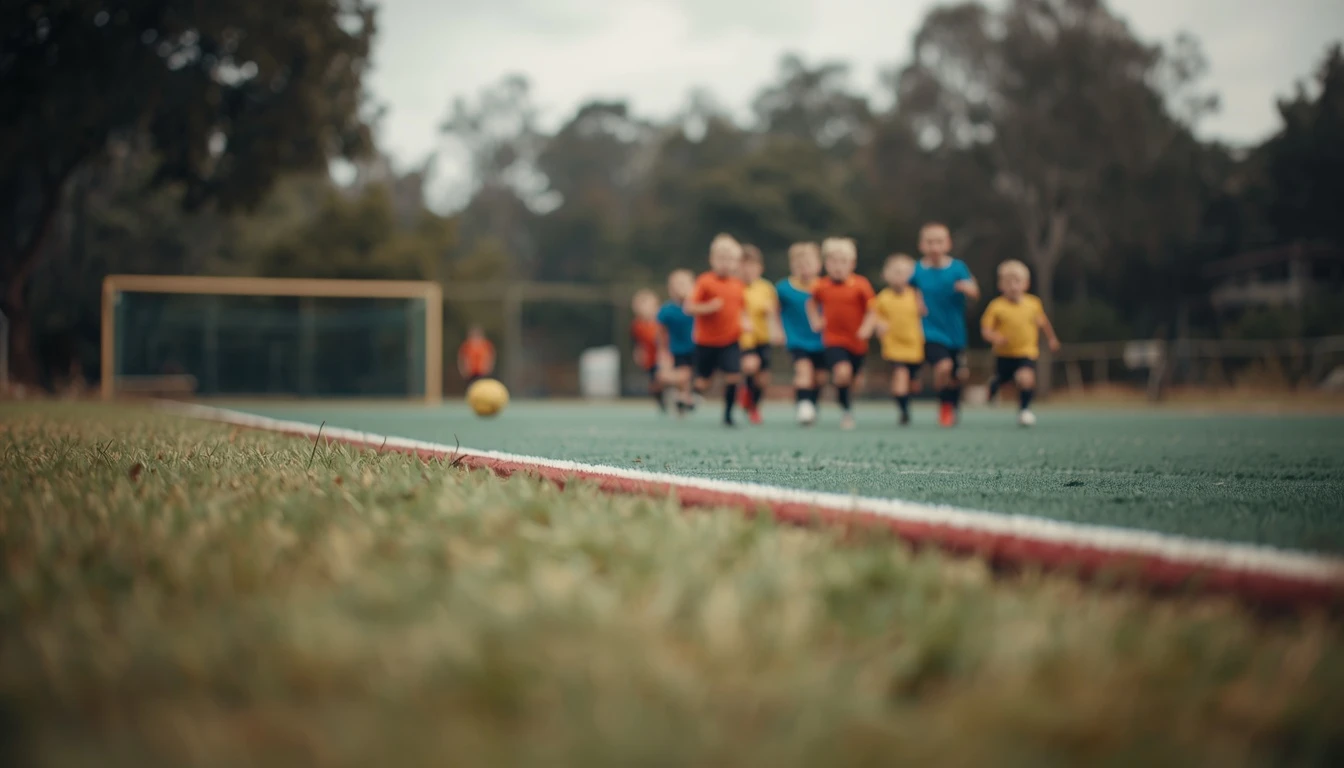
You're standing on the sideline holding a coffee that's gone cold. Your kid is somewhere in the middle of a small pitch with seven other 6-year-olds, all running at the ball at once. Every now and then she looks up across the grass to find your face in the crowd. You wave. She turns back.

Nobody is in position because there are no positions. Nobody passes. Someone falls over. Someone scores. Someone else cries. Someone is looking at a butterfly. The whole thing lasts twenty minutes.

You came here to support your kid. You don't know what you're watching.

This is for you.

What U7 actually is

U7 in Australia is not a small version of the football you see on TV. It's a different game.

Under the Football Australia National Football Curriculum, U7 is played 4 against 4. Small pitch, about 30 metres by 20. Small goals. No goalkeeper. No offside. Rolling subs. The ball goes back into play from the sideline by being kicked or rolled, not thrown.

There are no league tables, no grand finals, no premierships. Officially. Plenty of clubs and parents act like there are anyway, but the rulebook says no.

If you've been watching your kid's matches and quietly thinking "this isn't football," you're right. It isn't. It's something else, designed for 6 and 7-year-olds. Judged by Premier League standards, it'll always look chaotic. Judged by what it actually is, a learning environment for very small humans who are out there for the joy of running, it makes a lot more sense.

The thing nobody told you about the bunch

Every U7 game has a moment where all eight kids end up in a tight cluster around the ball, kicking each other's shins. Parents watching call it the beehive, or the bunch, or "what on earth is going on."

Coaches don't try to coach it out at this age. They wait. The reason is that spatial awareness, knowing where the open space is, knowing to stand somewhere the ball might come, develops later. At 6 and 7, brains aren't ready for it yet. Asking your child to "spread out" is a bit like asking them to do their tax return.

It looks like nothing is happening. A lot is happening. They're learning that the ball is hard to get, that other kids want it too, that being faster matters, that falling over is fine, and that someone will eventually come to help. That's the curriculum.

If your kid is in there, sweaty, red-cheeked, occasionally getting kicked by accident, occasionally getting a touch on the ball, and laughing in between, they are exactly where they're meant to be.

The three things worth watching

Forget winning, forget scoring, forget "did my kid play well." At U7, those questions don't have useful answers. Here are three things you can actually look for, and none of them require you to know football.

Effort. Did your kid chase back when they lost the ball? Get up quickly when they fell over? Go in for a 50/50 instead of pulling out? Call for the ball from a teammate? Effort is visible at any age and on any pitch. You don't need to know the rules to spot it. And if there's one thing 6-year-olds can give you in spades, it's effort, as long as they're enjoying themselves.

One moment of skill, or trying to. It might be a touch that didn't run away from them. A turn that worked. An attempt to dribble past someone instead of just kicking the ball forward. Don't look for clean execution. Look for the attempt. The attempt is the development. The clean version comes later, sometimes years later.

One moment of decision-making. Did they look up before they kicked? Did they pass to the kid in space rather than the kid being marked? Did they go for the loose ball instead of standing back? Decision-making at U7 is mostly imperfect, but the moments where they tried to make a choice are the moments their football brain is being built.

That's the three. Effort, an attempt at skill, an attempt at a decision. Take one of each into the car, and you have something specific to say after the game.

Watching what they do without the ball

This one's a bit more advanced, but it's the single biggest tell of how a child is starting to read the game.

When the ball is at the other end, what does your kid do? Stand still and watch? Wander? Walk back toward their own goal? Look at the coach? Look at a butterfly? Look at you?

There's no right answer at U7. But the kid who starts to move with the play, even badly, even in the wrong direction sometimes, is starting to think about football. Not yet a footballer. Starting to think about football. That's a real moment. The first time you spot it, you'll feel it.

What they probably told you, that isn't true

A few things parents at U7 commonly believe, that aren't quite right.

"What position does my kid play?" Under the FA Curriculum, U6 to U8 has no fixed positions. Every kid rotates through everything. Asking the coach what position your child plays tells them you think this is 11-a-side football, which it isn't. The right question, if you want to ask one, is "what is my kid working on at training right now?"

"He never scores, the other kid always scores." At U7, goals are mostly a function of who is bigger and faster this year. The biggest 6-year-old in the team scores the most goals. By U13, the size gap closes and the kid who learned to pass and read the game is often well ahead of the kid who used to score everything. Your kid being the smallest in the team this year is information about this year, not about the next ten.

"She doesn't run after the ball." Could be a few things. She might be shy. She might be hanging back deliberately. She might (rarely, but it happens) be reading the space and waiting. None of those are problems at U7. If it's a pattern across a season and she's not enjoying herself, that's worth a quiet conversation. One game where she didn't chase isn't.

"He's behind the others." Football age groups in Australia run by calendar year. A kid born in January is up to 11 months older than a kid born in December in the same age group. At U7, that's huge. By the late teens it has mostly evened out. If your kid is born late in the year and looks "behind," they very often aren't. They're just younger.

When they score, and turn to find your face

You'll know the moment when it happens. They'll kick the ball, the ball will go in, and the very first thing they do, before they smile, before the coach claps, is look up to find you on the sideline.

What they want to see is you, smiling at them, hand up.

They aren't checking if you're proud. They're sharing the moment. You're the person they want to share it with. The joy is in the sharing, not the goal. Same thing happens after a tackle, a save, a good touch, a pass that worked. They look for you.

Be there. Not on your phone. Not in conversation with another parent halfway through. Just there.

It costs you nothing to look up. It means more than you can imagine.

What to say after the game

Pick one of the three things you watched for. Mention it specifically. "I liked the way you got back to help defend in the second half" beats "you played well" because it's evidence. They know you actually watched.

The next move is silence and a snack.

If they want to talk, they'll talk. If they don't, the car ride home article covers the rest. The headline version: don't fill the silence.

The short version

U7 is 4v4, no positions, no offside, no league tables. The bunch is normal. Watch for effort, one moment of skill, and one moment of decision-making. Goals at U7 don't predict much. Don't ask what position they play. Stay quiet on the sideline. Pick one specific thing to mention afterwards, and let them lead the rest. And when they look for your face, be looking back.

That's the whole watching guide for the U7 parent. The rest is yours. They're 6 once. Enjoy your Saturday morning.

If you want a deeper read on how children develop at this age, Raising Children Network has good general guidance, and we'll have more on this in upcoming articles.

The football system was never built to explain itself to parents, especially not the curriculum that runs the U7 game in front of you. We started United Sporting Institute because the practical version is what parents actually need on a Saturday morning. Every article in our library is free right now with email signup at unitedsportinginstitute.com. No card, no expiry.