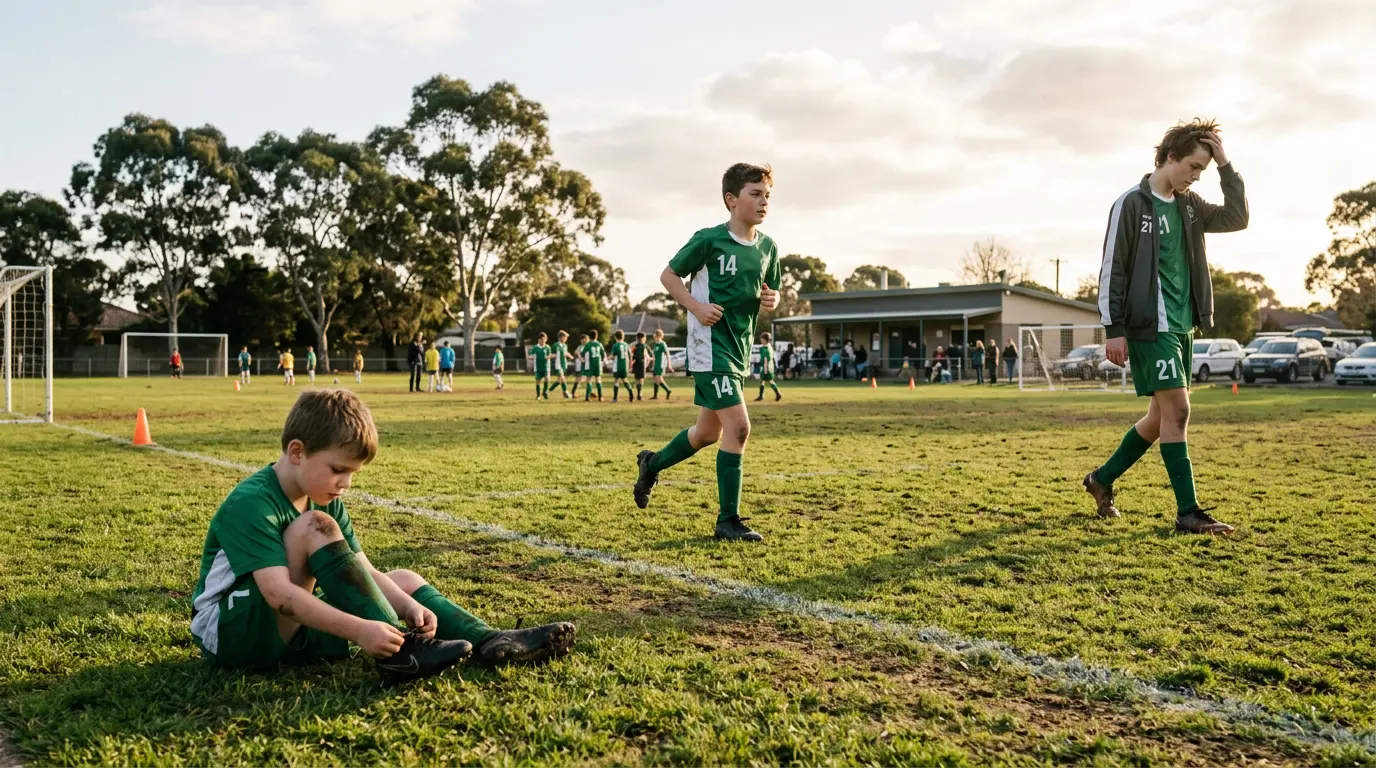
Your 11 year old came home from a Saturday game and walked straight to their room without saying a word. Your 7 year old, on a different Saturday, cried for fifteen minutes in the car because the team did not win. Your 14 year old sat through a whole car ride home and you could not work out whether they were angry, embarrassed, or fine.
Same parent. Three different children. Three completely different emotional registers, each one perfectly normal for the age they are.
The mistake most parents make is reading their child's reaction as a personality trait, when most of what they are seeing is a developmental phase. The 7 year old who melts down at every loss is not soft. The 11 year old who goes silent is not sullen. The 14 year old who will not engage is not rude. They are at three different points on a developmental curve that has been mapped in detail, and what each one needs from a parent is different.
This article walks the curve from 5 to 16, what is normal at each stage, what is worth paying attention to, and the points where the right move is not parenting harder but quietly asking for help.
The three phases that matter
Sport psychology research consolidates childhood emotional development into three phases relevant to junior sport, drawing on the foundational work of Erikson and Piaget and the body of more recent neuroscience that has built on it.
Mid-childhood, roughly 5 to 9. Children are concrete thinkers. They believe what adults tell them. Their sense of self is mostly built from the immediate feedback of the people around them. They feel emotions intensely and briefly. A bad game on Saturday is forgotten by Sunday. A coach's praise on Tuesday is remembered for weeks. Emotional regulation in this phase is largely external: a calm adult in the room is what regulates the child, not the child's own internal process.
Early adolescence, roughly 10 to 13. The shift starts. Children begin to compare themselves to peers in detail. The opinion of teammates begins to matter more than the opinion of the coach. They become more self-conscious, more inward, and noticeably less likely to tell a parent what is going on. Emotional reactions can be more intense than they appear on the surface. A child this age who shrugs after a tough game may be processing more than they look like they are.
Mid to late adolescence, roughly 14 to 18. Identity becomes the main developmental task. The question is no longer who am I in the family or who am I in the team. It is who am I, and football is one of several places where that question gets answered. Peer judgement reaches its peak intensity around 14 to 16, then gradually moderates as the prefrontal cortex matures.
These are not strict age boundaries. A given 11 year old can read either as mid-childhood or as early adolescent depending on the day. Use the phase descriptions as orientation, not as targets.
What the brain is doing while this is happening
The single most useful fact for a parent to hold across this whole window is one that neuroscience has been clear on for two decades.
The prefrontal cortex , the part of the brain that handles judgement, impulse control, and emotional regulation , is the last region to fully mature. The wiring is not complete until the mid twenties. A 2023 review in Social Development summarised the consensus: structural and functional development of prefrontal regulation circuits continues well past adolescence, and there is a measurable gap between when emotions are felt and when they can be regulated.
Functional MRI studies show that adolescents aged 12 to 14, when asked to regulate an emotional response, display increased amygdala activity (the emotional centre firing strongly) and reduced prefrontal activity (the regulating system not firing strongly enough) compared to adults asked to do the same task. This is not a personal failing. It is observable neurology. Your 13 year old's emotional intensity after a bad game is not theatre. It is a body in a developmental window where the feeling system is running faster than the regulating system.
This gap is largest in the 12 to 14 window. By 15 to 17, the gap narrows but is still meaningful. By the early twenties, most people have closed it. A 2025 study (AMMS Journal) that measured decision-making, emotional regulation, and risk avoidance across adolescent age bands found that older adolescents (15 to 17) significantly outperformed younger adolescents (12 to 14) on all three measures.
What this means in practice: the same situation that produces a manageable reaction in a 16 year old produces a much larger one in a 13 year old. The 13 year old is not overreacting. They are reacting at full capacity for their age.
The peer-and-rejection axis at 12 to 14
There is one more research finding that matters more in the football context than most parents realise.
Adolescents are significantly more sensitive to social rejection than adults are. A 2010 study using a controlled social-rejection task (Sebastian et al.) found that overall mood dropped significantly after experiencing ostracism in young adolescents aged 12 to 14, and state anxiety rose in the same group. The same task produced no measurable mood or anxiety change in adults.
This is the age band where being left out of a goal celebration, not picked for a drill group, or noticing teammates' WhatsApp chat without them in it can land with disproportionate weight. The adult brain reading the same situation files it as minor. The 13 year old brain files it as significant. Both are accurate readings for the brain doing them.
Combine this with the previous research finding that adolescents place a higher value on social rewards than adults. The peer group is the dominant emotional environment for a 12 to 14 year old. What teammates think weighs heavier than what parents think, by quite a lot. This is not bad parenting. It is a developmental window doing its job. The parent is still essential , they just stop being the primary social mirror for a while.
What sport is actually doing for them across these years
Before going into what to do at each age, the broader context matters. The research is consistent that organised sport participation is genuinely beneficial for emotional development through this whole window, not just neutral or recreational.
A 2019 study of 940 Spanish children aged 6 to 12 measured social-emotional intelligence across five dimensions (intrapersonal, interpersonal, adaptability, mood, stress management). Children participating in organised sport scored significantly higher on every dimension than non-participants. Effects were stronger for girls in interpersonal and mood scores, stronger for younger children in intrapersonal intelligence.
For adolescents, brain imaging research published in 2025 found that regular sport participants showed significantly higher prefrontal cortex activation than non-participants, and that this activation correlated positively with both emotional intelligence and rule consciousness. The mechanism is plausible: sustained training that requires regulating impulses (no shoving, no arguing with the referee, no tantrum after a missed shot) appears to build the very circuitry that does that regulating.
The implication is not that sport is therapy. The implication is that your child's emotional struggle through football is not a sign football is hurting them. The struggle is often where the development is actually happening.
What is normal at each stage, and what to do
Ages 5 to 7. Big feelings, brief feelings. Crying after a loss. Wanting to quit and play, in the same session. Fierce loyalty to one teammate and rejection of another, swapping by the next week. A coach's offhand comment lodged for months.
What works. Match their emotional intensity in the moment, but do not exceed it. The job is to be a calm, present body, not a problem-solver. After the meltdown passes, name the feeling out loud once ("That was disappointing"), then move on to something physical: snack, drink, walk. They do not need a debrief at this age. They need their body settled.
What to skip. Long conversations about emotions. Trying to teach them resilience by talking about it. This age learns resilience by experiencing manageable disappointment with a calm parent nearby, not by being talked through it.
Ages 8 to 10. Beginning to compare themselves. They notice who is fastest, who scores most, who the coach picks first. Capable of carrying disappointment for longer. The emotional volume drops slightly but the duration increases.
What works. Start asking what they thought of the game, before telling them what you thought. Listen for the worry under the answer. A child this age who says "it was fine" with a half-shrug is often saying something is bothering them but they have not got language for it yet. A useful follow-up is "anything that was harder than usual today?" Open question, no answer required.
What to skip. Comparison talk. Even gentle comparison ("Did you see how Jamie tracked back?") lands as a deficit at this age. The comparison they need is themselves a year ago to themselves today.
Ages 11 to 13. The shift. They go quieter. The car ride home becomes harder to read. They process emotions inwardly for longer before they will share. They may show distress through irritability, withdrawal, or being suddenly fine and then suddenly not fine. Peers move into the centre of their emotional life. What teammates think starts to weigh more than what parents think.
What works. Give them the first ten minutes of any post-game time in silence unless they start talking. Music, food, window. If they start the conversation, listen more than you talk. Resist the urge to comfort, to fix, or to teach. The presence is the thing. Specific observations land better than general praise ("Your second touch under pressure looked sharp on the second half") because general praise reads as parental obligation at this age, and they have started screening for that.
What to skip. The Saturday-night debrief. The "let's talk about what happened today" sit-down. The text from the sideline mid-week reminding them of what to work on. The "I just want what is best for you" closer at the end of any conversation.
Ages 14 to 16. Identity work. Football is one of several places where the question "who am I" is getting asked. The emotional intensity from the early-adolescent phase begins to settle for some, continues for others. Peer judgement reaches peak intensity around 14 to 16. They are working out, in real time, whether being a football player is part of who they are or just something they used to do.
What works. Stop coaching them, completely. Stop asking specific football questions. Start asking general life questions and let football show up if they want it to. If they raise football, treat it the way you would treat them telling you about a film they liked: interested, curious, not invested in the outcome. The relationship is the work at this age, not the football.
What to skip. Pushing them to commit harder. Making the case for staying in. Hinting at college applications or scholarship possibilities to motivate them. Drawing comparisons to other kids who "kept going." The harder you push at 14 to 16, the more you are signalling that their decision matters to you, which makes the decision harder for them.
The signals that say this is more than a phase
A normal developmental low and a mental health concern can look similar at first. The difference is duration, breadth, and how the child is functioning in other areas.
Four weeks is the rough threshold. A child who is flat, withdrawn, or distressed in a way that lasts beyond a month is no longer in a passing dip. A change in mood that shows up at school and with friends as well as at football is broader than football. A change that affects sleep, appetite, schoolwork, or relationships at home is functional impairment, not just an off patch.
When any of these patterns shows up, the first move is a chat with the GP. They will know what to assess and where to refer if needed. The GP is the bottleneck in the right direction: nothing is committed to, but a professional has heard the description and can advise. In Australia, headspace.org.au is the national youth mental health service for ages 12 to 25 and is free at point of contact. Beyond Blue and Lifeline are the broader supports.
Do not raise these resources with the child as a threat. Do not tell them "if this keeps up, I am going to take you to the doctor." The framing is "I have been worrying a bit, and I want to chat to someone about how to support you better. I am going to book an appointment for myself first." This frames help-seeking as something adults do, which is a much healthier model than framing it as a thing that happens to children when adults run out of ideas.
What to skip across the whole window
A few moves that backfire at every age between 5 and 16, despite being well-intentioned.
Solving their feeling. Children do not need feelings solved. They need feelings witnessed.
Telling them how to feel about something. "You should be proud of yourself" lands as a directive, not a permission. Specific observation is better: "I noticed you did not give up after that second goal went in."
Reassuring them too quickly. "It will all be fine" closes the conversation before they have finished having it.
Catastrophising on their behalf. The 9 year old who says "I am the worst player in the team" does not need to be told that they are not, in detail, with statistics. They need someone to say "that is rough" and then sit with them for a minute.
Promising a fix. Particularly for older children. The promise that something specific will change tomorrow ("I will speak to the coach", "we will look at another club") gets remembered, and an unkept promise weighs heavier than the original problem did.
The recap
Mid-childhood, 5 to 9: big feelings, brief feelings, regulation comes from the calm adult in the room. Early adolescence, 10 to 13: the shift inward, the rise of peers, the gap between emotional intensity and regulatory capacity at its widest. Mid to late adolescence, 14 to 16: identity work, peak peer sensitivity, the parent's job is the relationship, not the football.
The prefrontal cortex matures into the mid-twenties. The brain doing your 13 year old's processing is not the brain doing your own. The neuroscience is not a parenting excuse. It is a context that makes the right response easier to choose: be present, do not overshoot the emotion, and trust that the development is doing its work even when the surface looks rough.
Four weeks of flat, withdrawn, or distressed is the line where the right move stops being parenting harder and starts being a chat with the GP.
Your 7 year old will be over it by Sunday morning. Your 11 year old will start telling you about it on Tuesday, sideways, while you are driving them to somewhere unrelated. Your 14 year old may not tell you about it at all, but they are working it out anyway, and your job is to be the person they can come back to when they are ready.