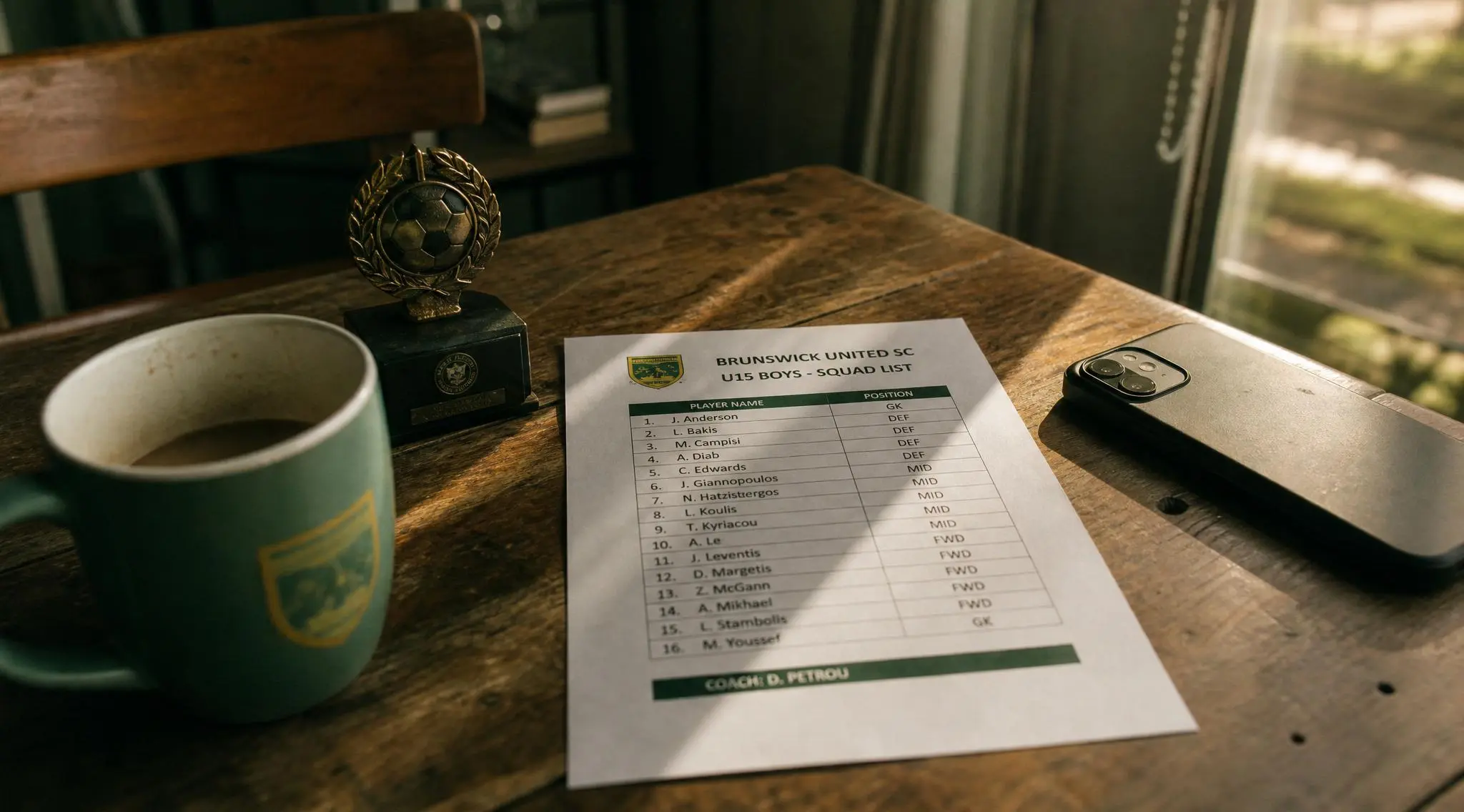
It is Tuesday at 6.47pm when the email comes through. The subject line says 2026 Squad Announcement. You open it before your child sees you open it.
Your eyes do the thing eyes do with a list. They scan for one name. They find it, or they do not.
Either way, the next thing you do is start counting. How many kids on the list. How many you recognise. Whether the kid who lives two streets over is on there. Whether the kid your child trains with twice a week is on there. You are looking for a pattern your brain is half-aware of, and you will not find it in the names.
The list is a list. It tells you the outcome of a decision. It does not tell you how the decision was made. And in junior football in Australia, that decision is shaped by something the panel may not have named to itself.
There is a single question that, if asked, exposes most of what the list will never tell you. Most parents do not ask it. The ones who do, walk away with information that changes what they do next.
This article is the question, four kinds of answer you might receive, and what to do with each.
What the list says, and what the list will not
The list says who. It does not say why.
It does not say which selectors were in the room. It does not say what they were looking for, in what order, with what weight. It does not say whether they had a maturity correction in their training, or whether they had ever heard the words "relative age effect" said out loud.
Most of all, it does not say the one thing you would need to read the list properly. The birth months of the squad they picked.
A squad picked through a fair process and a squad picked through an unconscious bias toward bigger kids will look identical on a name list. Same number of names. Same age category. Same email format. The only thing that separates them is data the list does not include.
This is not paranoia. It is geometry. You cannot tell from the names whether the panel saw your kid, or saw their birthday.
The pattern, briefly
In Australian junior football the age group is built by calendar year. A child born in January can be up to eleven months older than a child born in December in the same squad. At U10 to U13, eleven months of growth shows up as height, speed, balance, and how hard they are to knock off the ball. By the late teens, the gap closes. By senior football, the bias often inverts. The late developing kid, if they stay in the game, comes through with technique built under harder conditions than the early developer ever faced.
That pattern has a name and a research literature. It is called the Relative Age Effect. The full story, the global numbers, and the senior-level inversion are in The late developer: why it might be the best thing that ever happened. Read that article if you have not. The rest of this one assumes you have.
The question is what to do with the result you are holding right now.
The question to ask
Here it is.
What does the birth-month spread of the picked squad look like, and how did the panel account for it?
That is the whole thing. One sentence. Said calmly. Sent in writing if you cannot say it in person.
It works because it tests two things at once. The first is whether anyone on the panel knows that selection at junior level is biased by birth quarter. The second is whether, if they know, they did anything about it on the day they picked your kid's squad.
You can soften the opening to suit the relationship. Three forms, depending on how the trial closed.
Polite. "Thanks for running the trial. To understand the cohort make-up, could you share roughly what the birth-month spread looks like across the picked squad, and how the panel thinks about that?"
Firm. "Is the panel aware of relative age effect, and how is it accounted for in this pathway?"
Data led. When no answer comes back, you can do a partial version yourself. Many associations publish the previous season's training squad. Cross reference what you can. You will not get the full picture, but you will know more than you did this morning.
These are not progressive demands. They are options.
Four kinds of answer
The answer you get tells you most of what you need to know about the program.
Answer A. "We saw mostly first half kids in the squad, but we balanced where we could." The panel knows. They have the lens. They are working with the bias rather than ignoring it. This is the most reassuring answer, regardless of whether your child got picked. It tells you the program has pathway staff who read the research, and your late quarter kid has a fair next look in twelve months.
Answer B. "We picked the best players we saw on the day." Day of trial only. No maturity correction. No birthday awareness. Common in associations and clubs without pathway staff. It is not malice. It is the absence of a frame. If your kid was on the borderline of selection and is Q3 or Q4 born, this answer tells you the bias did the picking and the panel did not see it.
Answer C. "What's RAE?" The panel has not encountered the literature. The pattern is operating without their awareness. Programs in this state are not bad programs, but they are running blind to the single most documented selection bias in junior sport. Your child's next twelve months at this club will not include any adjustment for it.
Answer D. "That's not something we discuss" or no response at all. The panel knows and is not willing to engage. Usually means the result was shaped by factors the parent will not get visibility into. Politics, history with families, club preference for known kids. The lack of answer is the answer.
The Australian numbers
You are entitled to know that this is not a foreign research problem.
Football Australia's own talent pathway has been studied. In 2023 a research team that included a co-author from Football Australia's Medical Department published a study of 54,207 youth football players eligible for the National Youth Championships. Of those, 12,527 were female aged fourteen to fifteen and 41,680 were male aged thirteen to fifteen. The finding was direct. The bigger the talent pool selectors were picking from, the higher the probability they picked a first half born player. Each additional 760 players in the pool meant a one per cent higher chance of selecting a first half born kid. The bias scaled with the size of the pool.
Two further findings from the same study matter.
The first is gender. Relative age effect was more pronounced in the male sample than the female sample. It is present in girls' selection, but with less weight than it carries in boys' selection. If you are reading a girls' squad list, the lens still applies, but not as strongly.
The second is the inversion. Market value research across 11,738 European youth male players shows the odds ratio of Q1 versus Q4 selection at 3.1 at U18, dropping to 2.7 at U19, 2.6 at U20, 2.4 at U21, 2.2 at U22, and 1.8 at U23. By U21, U22 and U23, Q4 born players carried higher market values than Q1 born. The bias the system applied at twelve had unwound by twenty-two. The late quarter kid was, by then, the more valuable player.
The picked squad is a snapshot. The career is the chart.
What each answer means for your family decision
If your kid was picked. Read Answer A through D and decide which one you got. If you got A, the program is worth what you are paying for it. If you got B or C, the picking went your child's way this time and you cannot count on it next time. Selection is not validation. The list may have said yes about your kid's birthday more than about your kid's game.
If your kid was not picked. The decision this week is not really about the result. It is about whether the program is run by people who can see the lens or cannot. If you got A or some version of it, stay another year. The next look will be fairer than this one was. If you got C or D, the next look will be the same look. That changes the maths on whether to stay, move, or pause.
If your kid was borderline. Training squad. Development squad. Next year. Treat the answer as feedback about how the panel reads your child today, not a verdict on who they will be at sixteen.
The broader literature on which way this resolves over the years, including the senior level inversion, sits in the late developer piece linked above and in how selections actually work at rep level.
After the email
The list arrives on a Tuesday. You scan for the name. You take a breath. You ask the one question.
The answer tells you about the program. The years tell you about the player.
That is the order.