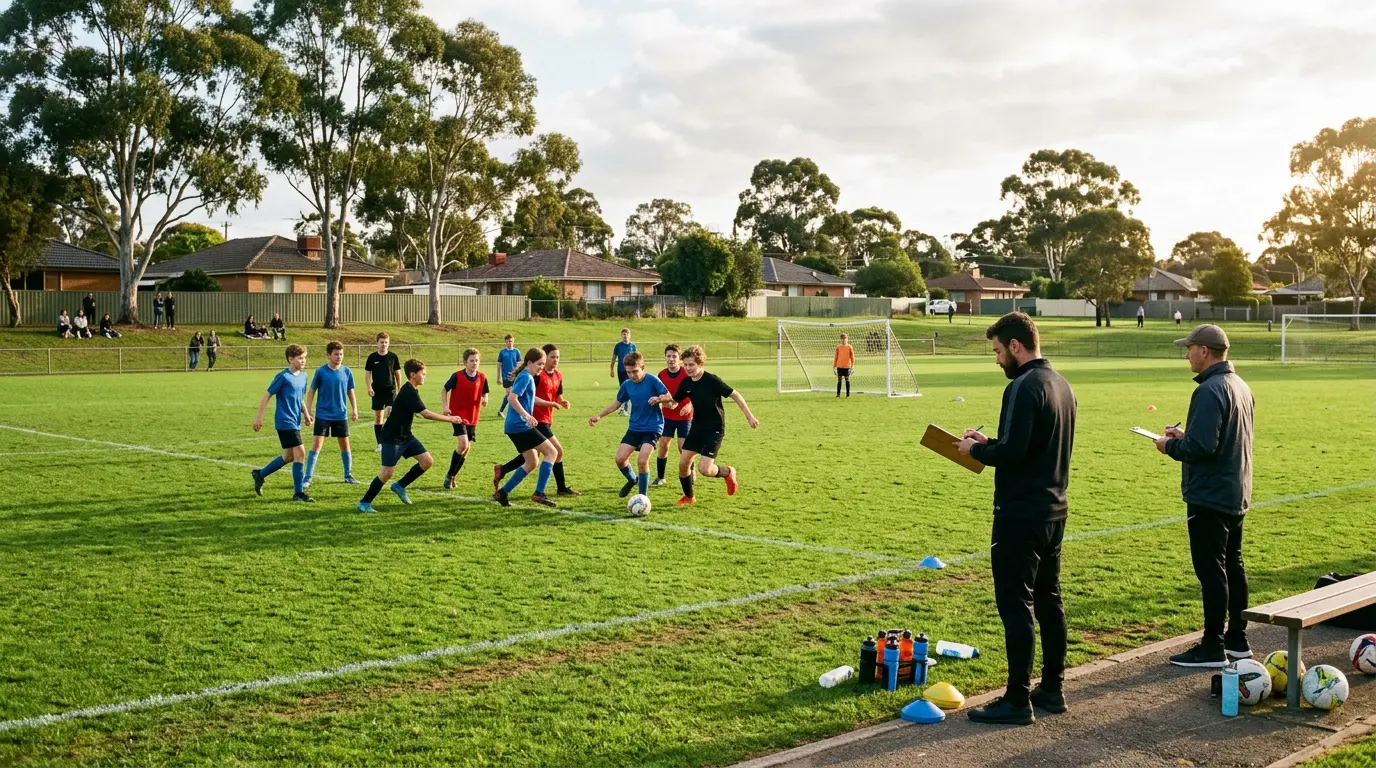
The email arrives on a Tuesday afternoon. It tells you the date, the venue, what to wear. It does not tell you what the selection actually is, who decides, or what happens after.

Your 11 year old reads it over your shoulder and walks away. They do not ask anything. They will not ask. They will think about it every night until trial day.

That silence is the part nobody warns you about. It is also the part that does most of the damage, in households where this never gets named.

You drive home from a trial with a kid in the back seat who did not get picked, and you do not know what to say, because you did not understand what just happened. The next year, you drive home from a trial your kid did get picked at, and you feel a relief that frightens you, because the relief is about you, not them. The point of this article is so you do not have to learn it the same way.

Here is what no one tells you. Trial selection is not really about your kid. Most of what you are feeling in the lead-up is yours. The part that helps your kid is the small part. The part that hurts them is the part that is yours leaking onto theirs.

A study of 773 parents of young athletes published in 2019 found that 98 percent of them had experienced anger during youth sport competitions, and that the most reliable trigger was a sense of unfairness from coaches, officials or other parents. Researchers at the University of Hungary, working with the Parental Stress in Sport Scale, found that the single largest source of parental sport stress is what they call deselection anxiety: the fear that a child will be cut, and the fallout from that. Not the cut itself. The fear of it.

You are reading this because you are in the fear part. The trial has not happened yet. Nothing has gone wrong. And yet your shoulders are tight and you have rehearsed three different versions of the consoling speech you do not want to have to give.

This article is about two things, and only two things. What rep football actually is, so you can stop guessing and stop projecting. And what your job actually is in the three weeks before the trial, so the kid you love does not have to carry the weight of the parent you are being.

The first thing nobody tells you: most "rep" is not rep

This is the bit that ends most kitchen-table arguments before they start.

Your kid plays in their club's A team. The other parents at the BBQ call it rep. You call it rep. The coach maybe even calls it rep. It is not rep.

Rep football is when a panel selects players from across multiple clubs into one team that wears the colours of an association, a zone, or a state. Different clubs, one shirt. A trial. A panel. A list. The kid earns a place in a team made of strangers. That is the thing.

What your club calls A, B and C is something else. It is grading. After registration, the club groups players by level into the strongest team in each age group, then the next, then the next. Your A team is the strongest team in your club. The kid in the A team at the next club along may be a stronger player than your A team striker, or weaker, or about the same. You do not know. The association can re-grade in the first three rounds of the season if a team got placed in the wrong division. That is the only outside check.

Champion of Champions sounds like rep too. It is not rep either. The winning team in your association's top division plays the winning teams from other associations in a state tournament. Same kids, same club shirt, same coach. No panel, no trial. It is a club championship that crosses postcodes.

Hold this in your head, because it changes the conversation. When the parent at the school pickup says their daughter is in rep, ask which one. Most of them mean A team. A few mean Champion of Champions. Almost none of them mean what this article is about.

The cost of getting this wrong is real. Parents make decisions about extra coaching, about pulling their kid out of one club to chase another, about whether their kid is a "good footballer" or a "lesser footballer", based on a category they have not understood. The kid then carries the weight of that decision. The parent calls it ambition. The kid calls it pressure.

What rep actually is, and where the road actually goes

Two roads. They run in parallel. Most kids are on neither, and that is the most ordinary outcome there is.

The talent road. This is the formal pipeline into elite football. The first formal step is the Junior Development League. JDL was called SAP until recently. The girls' version was GSAP. Ages U9 to U12, with some clubs running U13 in 2026. It is run by NPL clubs and by associations aligned with NPL or A-League academies. Eastern Suburbs FA aligns with Sydney FC, for instance. Three sessions a week. Thirty-six to forty weeks a year.

Then the invoice arrives. Somewhere between $1,500 and $2,000. You read it twice to make sure you read it right. That is not a season fee in the normal sense. That is a third tier of household budgeting. For a lot of families it is the difference between yes and no, before any conversation about talent.

Past JDL, the road runs through NPL Youth or the Boys/Girls Youth Leagues, U13 to U18. Then Football NSW's Talent Support Program at Valentine Sports Park, fortnightly matches, three boys teams (Blue, White, Yellow) and three girls teams (Yellow, Black, Blue), plus eight regional hubs. Then state teams for the Emerging Socceroos and Emerging Matildas Championships, which used to be called the National Youth Championships. Then the national age-group teams: Joeys, Junior Matildas, Young Socceroos, Young Matildas. Football Australia picks them.

Note for 2026: the Association Youth League (AYL) is being removed from the Football NSW competition structure for 2026 and 2027. Some associations are filling the gap with their own Talent Development Programs. Nepean's NFATDP is one. If your kid was on the AYL track, the path has changed under their feet, and your association's office is the place to ask what comes next, in writing.

The community road. Players stay with their club but get selected for their wider area at carnivals and championships. Northern NSW Football zones, like Hunter Metro, North Coast and Illawarra, have run zone reps continuously. Football NSW reintroduces an Association Championships in 2026. It will be the first true association rep competition in NSW since 2011. Fourteen years gone. If your kid is on this road, they are partly making history this year.

Most kids are on neither road. They register at the local club, get graded into A or B or C, and play the season. That is normal. That is the centre of the bell curve. Most kids who do play rep never go past association or zone level, and that is also normal. Football is the world's most popular sport because most of it happens at this level. Not because of the elite end.

This is the part of the article most parents need to read twice. The talent road is real, and small, and expensive. The community road is real, and bigger, and almost free. The local club is real, and biggest, and the place where most futures in this game are quietly happy.

How the trial actually runs, hour by hour

Here is what nobody walks you through, but every parent figures out the hard way.

Trial dates appear on association social or the website. You fill out an Expression of Interest form: kid's name, date of birth, current club, position, level. Email back with date, time, venue. Your kid asks once if they have to go. They want you to say no. You do not say no. They are not really asking.

On the day, your kid checks in at a fold-out table. They get a number. Sometimes inked on the back of the hand. Sometimes a coloured bib. Sometimes nothing at all. If they came in club gear, the coaches may ask them to swap into something neutral. The cut is meant to be blind. The selectors want to see a player, not a club.

The trial runs as small-sided games and short skill stations. Coaches stand on the sideline with clipboards. There is no public scoring, no scoreboard, no commentary. There is no "you did well" from the head coach at the end. There is rarely a smile from the head coach at the end. They are not being unkind. They have a job and they are doing it.

The list shrinks across multiple sessions. Some kids are not invited back after day one. Fewer return after day two. Late candidates get added if a coach wants to take a second look at someone they missed. Each day is a partial cut, not a final decision. The kids feel the partial cuts emotionally as final cuts. The parents feel them as confusing. Both responses are normal. Neither is correct.

The final list goes back on social, or arrives by email, or both. The selected and the unselected get the same email with a different paragraph. There is rarely a phone call. The phone-call expectation is from television, not from how rep selection actually works in 2026.

JDL at the bigger clubs has moved away from the one-off trial day. Northern Tigers, NWS Spirit, Sutherland Sharks now run a multi-month identification process. Invitations to train with current JDL players. Separate trial sessions. Watching kids at their club games, where the kids do not always know they are being watched. The cut is real. It is just spread across weeks instead of crammed into one Sunday. This is harder on parents in a different way: the answer never comes. There is no trial day to anchor the wait around.

One timing rule worth knowing if you are in NSW. Football NSW does not allow outdoor trials or training on any Saturday in October, November or December. That window is reserved for futsal players to access pitches. Trials still happen in that window, on Sundays and weeknights. If a coach quietly schedules a Saturday outdoor session in that window, that is not a thing they are allowed to do. You can decline, and you should know the rule is on your side.

What you can actually do if it goes wrong

Most parents who feel something went sideways at a trial say nothing. They drive home, they vent to a partner, they decide football is political, they move on. Then they tell their kid, indirectly and without meaning to, that the system is rigged. The kid then carries that belief for the next eight years. It is the cheapest, easiest, most damaging gift a parent can give a child in junior sport.

Here is what they did not realise. There is somewhere to take it.

If your kid was not selected and you want to know why, you can ask the association for the selection policy. Northern NSW Football publishes theirs (the April 2024 Representative Team Selection Policy). It gives you a written appeal right within seven days, heard by a panel of three. Football NSW associations have analogous policies. Ask your association's office for theirs in writing. Most parents never do. The ones who do tend to find that the answer they get back is not the answer they were going to argue with at the BBQ. It is usually more useful, and sometimes uncomfortable.

If something happened that goes beyond a selection dispute, a coach yelled at a child in a way that crossed a line, the trial process treated kids unfairly, you saw something you cannot un-see, you have somewhere to take that too. The Football Australia Member Protection Framework. It is the complaints pathway for conduct, child safety, harassment and discrimination. It sits in the Football Australia governance and statutes index. It is independent of selection appeals. You do not need a lawyer. You need the will to write the email.

These rights are real. Most parents never use them. They are worth knowing about anyway, because the moment you might need them is not the moment you want to be reading a regulations PDF.

One thing the rules are not. They are not the FA NPL Player Roster Principles. That document governs senior men's NPL rosters: visa player limits, U23 minimums, goalkeeper nationality. Junior selection conduct is not in there. If anyone tells you it is, they are wrong, and you can quietly move past the rest of what they say.

The three weeks before, which is mostly your job, not theirs

The trial is in three weeks. Your 11 year old still has not asked you about it. They are thinking about it every night.

This is the part most parents get wrong. They think their job in these three weeks is to get the kid ready. They sign up for an extra training. They drill in the backyard. They have the talk about effort and consequences. They mean well. They are also accidentally telling the kid that this trial is more important than the kid is. The kid, smelling that, locks down.

Your job in these three weeks is the opposite. Your job is to make these three weeks ordinary. Same dinners. Same screen time. Same bedtimes. Same Sunday morning. The trial is a thing they are doing on a Sunday in three weeks. It is not who they are.

The mistake most parents make is to talk about it too much, or to go silent. Both make the kid feel worse. Too much makes the trial enormous in their head. Silence makes them think you are disappointed already. The middle is small, light, intermittent.

A short check-in once or twice a week. "Looking forward to the trial?" not "are you ready for the trial?" Listen, do not solve. If they want to skip the conversation, let them. They will come back to it. They always do.

Stay off the technical analysis. Their training is set. The coach has the plan. Your sideline coaching just adds noise. The week-before specifics are in the week before a trial: the schedule that works.

The deeper truth in these three weeks is that you are managing yourself, not them. The PSSS deselection-anxiety research finding earlier in this article points at exactly this. The parent's fear of the cut is bigger than the kid's fear of the cut, because the parent has more years of identity invested in it. Your job is to keep that identity off the kid's plate. The kid only has eleven years of self. They cannot carry both.

If you find your shoulders tight at the thought of it, that is the fear talking. Notice it. Do not pass it on. Take it for a walk. Tell your partner. Write it in a notebook. Do not bring it to dinner.

Trial day, the parent version

Be there. Be quiet. Sit with other parents but do not hold court with them. Selectors notice parents. A composed parent on the boundary is a small positive signal. A shouting parent is a meaningful negative. Your kid does not need to know that for it to be true.

Do not coach from the sideline. Do not whisper instructions during water breaks. Do not signal disappointment with body language. They are watching, even when it looks like they are not. A folded-arms parent at trial costs a kid more confidence than three missed first touches.

After the trial, do not ambush the head coach. Wait for the formal communication. If you have a process question, like when does the next session run, when will we hear, email the association in writing, not the coach in person.

If the email comes back with the gentler paragraph, the "thank you for trialling, we will be in touch about next year" paragraph, that phrasing is a code. What each variant actually means is in what they say versus what they mean: the selection code.

The recap, kept short on purpose

Most "rep" is not rep. Club A, B, C is grading. Champion of Champions is a club tournament that crosses postcodes. Real rep has two roads. The talent road runs JDL into NPL Youth, then TSP, then state, then national. The community road runs through association and zone teams, with FNSW's Association Championships back this year after fourteen years away. The trial mechanic is EOI, number on the hand, small-sided games, partial cuts, list back on social. Your rights live in state body selection policies (NNSWF gives a 7-day appeal) and the FA Member Protection Framework. They are not in the NPL Roster Principles.

Your three-week job is not to make the kid ready. It is to make the three weeks ordinary. The fear of the cut is mostly yours. Carry it for them, do not pass it to them.

Your 11 year old gets the email. They look at you. You shrug, kindly. You go and put the kettle on. The trial is in three weeks. You both know. Neither of you needs to make it bigger than it is. They are doing the work. You are clearing the path.