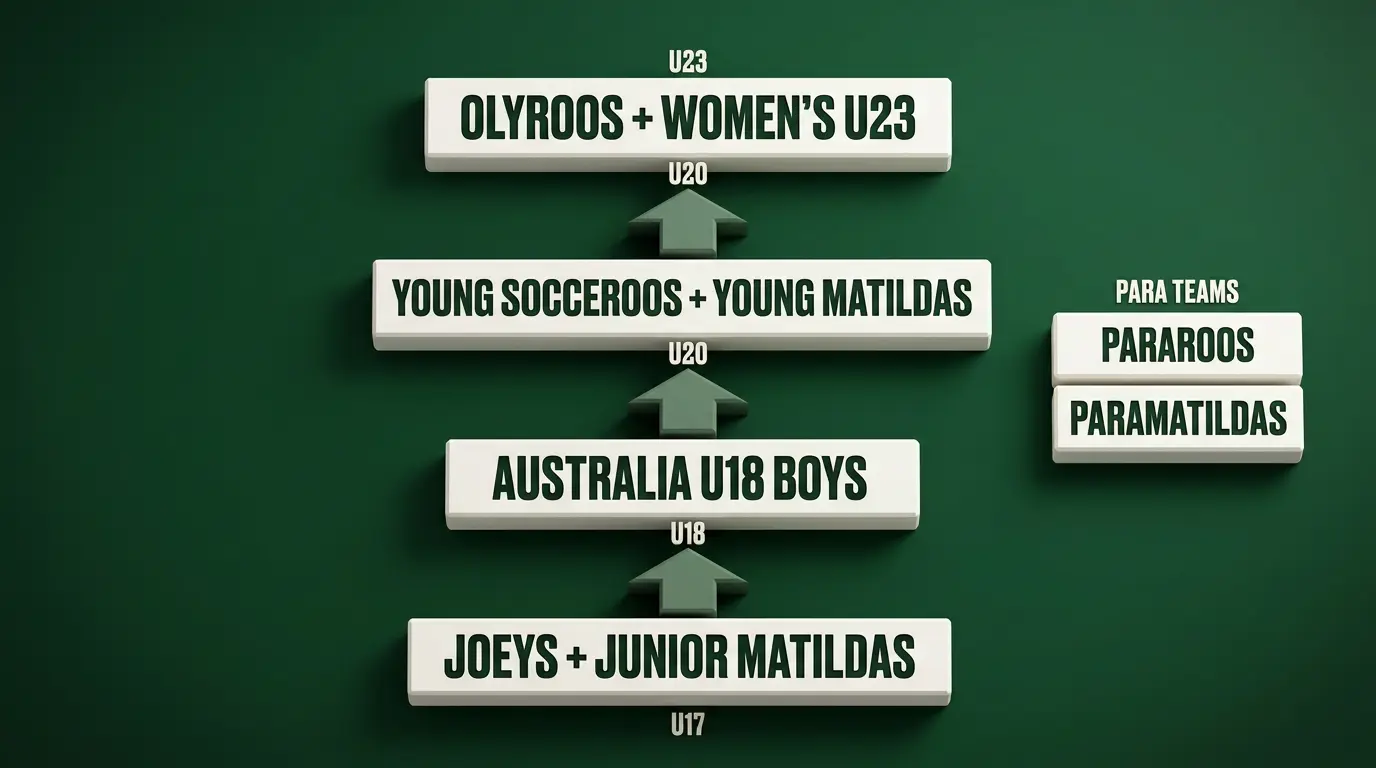
Your kid mentions the Junior Matildas or the Joeys. The names come up on the news during Asian Cup season and disappear in between. Here is what each one actually is. Australia runs four main junior national football teams: the Joeys (U17 boys), the Young Socceroos (U20 boys), the Junior Matildas (U17 girls), and the Young Matildas (U20 girls). Above them sit the Olyroos (U23 men's, the Olympic team) and the women's U23 squad. Below them sit the Australia U18 boys squad, which sits between the Joeys and the Young Socceroos and plays exhibition tournaments like the UEFA Friendship Cup. Australia also runs separate national teams for athletes with disabilities: the Pararoos and the ParaMatildas. The pathway to any of these teams runs through state body programs, A-League youth squads, and the annual CommBank Emerging Championships carnivals. The route is narrow. Queensland's own figures suggest roughly 1 percent of state academy players eventually reach national team representation. Here is what each team is and how a player actually gets noticed.
The four main junior national teams
The Joeys are Australia's U17 men's national team. Currently branded the Subway Joeys for sponsorship, the team competes for the AFC U-17 Asian Cup, which is the qualification tournament for the FIFA U-17 World Cup. The U-17 World Cup expanded to an annual tournament from 2024. The Joeys played their 2026 AFC U-17 Asian Cup campaign in Saudi Arabia in April and May, opening with a 4-0 win over India.
The Young Socceroos are Australia's U20 men's national team. Currently branded the Subway Young Socceroos. The team competes for the AFC U-20 Asian Cup (qualifier for the FIFA U-20 World Cup, every two years) and from 2026 the ASEAN U-19 Boys' Championship, formerly the AFF U-19 Championship, the regional ASEAN tournament. Australia's 2026 Young Socceroos squad was drawn into the ASEAN tournament group in Indonesia.
The Junior Matildas are Australia's U17 women's national team. Currently branded the CommBank Junior Matildas. They compete for the AFC U-17 Women's Asian Cup, which qualifies teams for the FIFA U-17 Women's World Cup. The 2026 AFC U-17 Women's Asian Cup was played in China in April and May 2026. Australia finished second in their group after a 5-0 loss to Japan, qualifying for the quarter-finals.
The Young Matildas are Australia's U20 women's national team. Currently branded the CommBank Young Matildas. They compete for the AFC U-20 Women's Asian Cup, which qualifies teams for the FIFA U-20 Women's World Cup. The 2026 AFC U-20 Women's Asian Cup was held in Thailand from 1 to 18 April 2026.
The sponsorship branding moves over time. Subway and CommBank are the current naming-rights sponsors. The team identities, the selection process, and the Football Australia administration are constant.
Above them: the Olyroos and the women's U23s
The Olyroos are Australia's U23 men's national team and operate as the country's Olympic men's football squad. Olympic football is U23 with three over-age player allowances per Olympic squad. The Olyroos compete for Olympic qualification through the AFC U-23 Asian Cup, which doubles as the Asian qualifying tournament for the Olympic Games. The team head coach role was held by Tony Vidmar for four years until he stepped down in early 2026.
The women's U23 squad operates similarly as Australia's Olympic women's pathway, though the women's selection often draws players directly from the senior Matildas squad given the limited national-team scheduling. The full Olympic women's tournament is open age, unlike the men's U23 restriction.
The U23 layer is the visible bridge between junior international football and senior national-team selection. A player who is in the Olyroos squad at 22 may already be in an A-League first team and pushing for Socceroos consideration.
Between them: Australia U18 boys
Australia runs a U18 boys squad that sits between the Joeys (U17) and the Young Socceroos (U20). It is not a permanent AFC tournament team, but it is a real squad that plays friendlies and invitational tournaments. The Australia U18s competed in the UEFA Friendship Cup in Switzerland in 2025, drawing players from the Young Socceroos AFC U-20 Asian Cup squad and from breakthrough performers in the A-League Men season. There is no consistent equivalent U18 women's squad named under a single branding, though Football Australia runs women's youth training camps in the same age band.
Separately: Pararoos and ParaMatildas
The Pararoos are Australia's national football team for men with cerebral palsy, intellectual disability, deafness, or other qualifying physical or intellectual impairments. The team competes in IFCPF tournaments (the international body for CP football) and represents Australia at the Paralympics where applicable. The squad operates as a national team across all senior ages, not specifically as a junior pathway.
The ParaMatildas are Australia's women's equivalent for athletes with comparable disabilities. Both teams are administered by Football Australia and sit alongside the senior Socceroos and Matildas as part of Australia's national team identity.
For a parent of a child with a disability whose interest in football is serious, the Pararoos and ParaMatildas exist as a pathway. Specific eligibility, selection, and competition entry rules sit with Football Australia's Disability Football department.
The tournament cycle that matters
The AFC U-17 Asian Cup runs every two years and qualifies four AFC nations for the FIFA U-17 World Cup. The U-17 World Cup moved to an annual format from 2024 with 48 teams. The AFC U-20 Asian Cup runs every two years and qualifies four AFC nations for the FIFA U-20 World Cup, which remains biennial.
For women, the AFC U-17 Women's Asian Cup and the AFC U-20 Women's Asian Cup are the qualification routes for the respective FIFA U-17 Women's World Cup and FIFA U-20 Women's World Cup.
The ASEAN regional tournaments (ASEAN U-19 Boys, ASEAN Women's Championship, ASEAN Women's Futsal Championship) provide additional competitive matches between AFC tournaments. Australia entered the AFF (now ASEAN) confederation in 2013 and participates regularly.
The Olympic men's football tournament is the U23 event qualified through the AFC U-23 Asian Cup. Olympic women's football is open age and the Matildas qualify through Asian qualifying.
How a player actually gets noticed
The pathway runs through state-body programs first. A player at NPL Junior level in NSW, FQ Academy in Queensland, or NPLW in any state plays in their state representative team selected by their state body's technical staff. State representative teams gather at the annual CommBank Emerging Championships, Football Australia's national junior carnival held across boys and girls editions and multiple age groups.
The CommBank Emerging Championships is where Football Australia scouts observe players in head-to-head competition between states. From these carnivals, selectors identify players for national team training camps. Camps lead to squad selection for AFC and FIFA windows.
The 2026 CommBank Emerging Championships included international teams for the first time: Vietnam's U15 women's national team and Japan's JFA Academy U15 men's team competed alongside Australian state teams, raising the standard against which Australian players were measured.
The realistic numbers
Football Queensland's own published figures give the clearest picture of the funnel. About 3,000 players sit in the FQ Academy system at any given time, drawn from 85,000 club-based players in Queensland. About 100 boys and 100 girls per year reach Queensland state teams. Approximately 10 percent of those eventually progress to national team representation. That math sits at roughly 10 boys and 10 girls per year from Queensland reaching some level of national team selection, out of a state academy system of 3,000.
The same broad ratios hold in other states. The honest answer for a parent: getting noticed for the Junior Matildas or the Joeys requires being one of approximately 1 percent of advanced-pathway players in the country at the right age. The other 99 percent of NPL Junior or NPLW or FQ Academy players develop excellent skills, play strong competitive football, and do not reach national team selection. That is not a failure. That is the structure of the Matildas pathway and the Joeys pathway in Australia.
Boring procedural close: three things to check
Your state body's youth pathway page, which lists the trial dates and selection criteria for the state representative team in your child's age group. The Football Australia news section, which announces every junior national team squad before each AFC and FIFA tournament window. The CommBank Emerging Championships event schedule for the year ahead, which tells you when the national carnival happens and which state teams attend.
If a coach tells you your kid could play for the Joeys, ask what the next selection window is and how to be at the trials that lead to it. The Joeys do not appear out of nowhere. They are picked from a visible pathway that runs through state representative football and the CommBank Emerging Championships. Knowing the pathway is the first step in deciding whether the commitment is one your family wants to make.
Squad announcements appear on the Football Australia news page before each AFC and FIFA window. For broader context on the senior pathway above these junior teams, the article on NPL explained covers the men's tier structure including the Australian Championship. The article on the realistic odds at each pathway level gives more detail on the funnel from grassroots to national representation. The article on U9 to U12 pathway programs covers the development stage before junior international consideration becomes realistic.