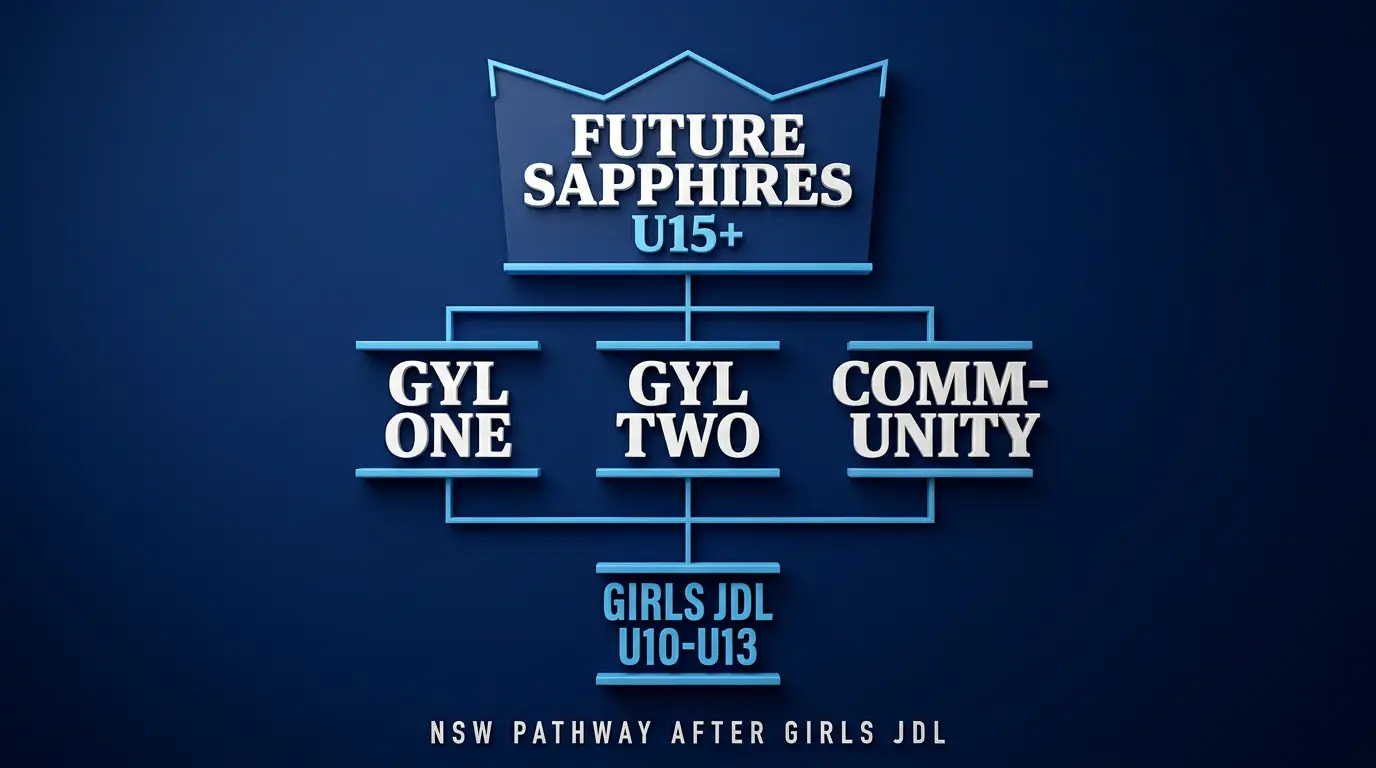
She is in her final season of Girls Junior Development League. U13, the last age group inside the program. The 2026 season will end around August, and after that the program ends for her age band. You are sitting at the kitchen table with the next form. Trials for the 2027 season start in October. You do not know what she is trialling for.
The U14 NSW pathway after Girls JDL is one of three club-tiered options. She can trial for a club playing in Girls Youth League One, which is the top tier of Football NSW girls youth football. She can trial for a club playing in Girls Youth League Two, which is the second tier. Or she can step back to community girls football. Below that, the elite Future Sapphires program sits over the top of the whole pathway, but it is U15 and above and not a direct next step from JDL. The decision at U13 is which club to trial for, not which competition tier.
The U14 map
There are 14 clubs in Girls Youth League One and 14 clubs in Girls Youth League Two. Both leagues run U14, U15, U16 and U18 age groups. Both run a round-robin season where each club plays every other club twice and the top four contest a Championship Series at season end. The structure is the same. The clubs differ.
Below the two GYL tiers sits community football, which is association-level competition. Most NSW associations run girls-only U14 divisions. If she is not aiming for the GYL tier, this is where she will play, and it is a legitimate level of football. Many girls who play community football through U14 to U18 enjoy long careers in the senior women's competitions later.
There is no NPL Youth competition for girls beyond GYL One and GYL Two. The "NPL1" and "NPL2" terms still used at the sideline are legacy shorthand from before 2022. See the article on NPL1 vs NPL2 for girls in NSW for the structural detail.
Youth and senior were decoupled from 2025
This is the change most parents have not registered. Before 2025, a club's senior tier determined its youth offering. If a club played in NPL Women's senior, its youth program was at the matching tier. From 2025, Football NSW separated the licences. A club can now play NPL Women's senior football but run a Girls Youth League Two youth program, or the reverse.
The two-year Club Standards and Benchmarking licence period locks the 2025-2026 GYL One and GYL Two clubs in place. Promotion and relegation between the two tiers will not happen at the end of 2025. It will happen at the end of 2026 for the first time.
What this means for your daughter: the headline tier of a club is no longer a reliable signal of the quality of its youth program. A GYL Two club with a strong head coach and a real U14 to U18 pathway can develop a player better than a GYL One club with weaker continuity. The five components in the Club Standards framework are planning, delivery, anticipated outcomes, club championship results, and additional performance indicators. The club's score across those five drives the tier. On-field results alone do not.
The cap and what it covers
The 2026 capped Player Registration Fee for both Girls Youth League One and Girls Youth League Two is $2,692 inclusive of the Football Australia National Registration Fee, the Football NSW Capitation Fee, the Football NSW Insurance Fee, and the club portion. Both tiers charge the same cap.
The cap covers training across the season, matches across the season, the apparel pack, medical coverage at matches with a Level 1 Sports Trainer present at minimum, and the end of season presentation. Clubs cannot layer separate Coaching Levies, Facilities Levies, or Club Administration Fees on top. This is the same protection that applies in Girls JDL, scaled up for the older age band. See the JDL registration fee cap explainer for the equivalent rule in JDL.
If a GYL club is quoting more than the cap, that is a breach. Read the Football NSW Circular before signing the registration form.
Future Sapphires comes later
Future Sapphires is the Football NSW elite development program that sits over the top of the entire club system. It is run by Football NSW directly, at Valentine Sports Park, year round across about 40 weeks. The program delivers a minimum of four training contacts a week to selected players. It is for U15, U16 and U18 age grades.
Future Sapphires is not a U14 option and not a direct next step from U13 GJDL. It also is not entered through a club. Selection is through the Football NSWTalent Support Program and Talent Development Scheme matches in conjunction with Football Australia. Future Sapphires replaced the Football NSW Institute, which closed at the end of 2024.
The relevance for the U13 decision: a girl whose ceiling is the Matildas does not need to be in a GYL One club to get to Future Sapphires. The program sits above the club tier and selects from across the system. Picking the right club for the next two years is about coaching, environment, and pathway visibility, not about whether the club has Future Sapphires badging.
What separates a strong GYL program from a weak one
The framework score is opaque to parents. The five components are real, but the scorecards are not published. What is observable, and what you should compare across two or three clubs before signing the form, comes down to four things.
Head coach tenure. A coach in their third or fourth season at a club has had time to build a real U14 to U18 pathway. A coach hired in October to start in February has not. Ask each club how long the U14 head coach has held the role. The answer tells you what to expect from continuity.
Coach qualifications. Football Australia requires the Head Coach in a Girls Youth League program to hold a minimum C Diploma. The Head of Youth, if the club operates one across all youth teams, should hold a B Diploma. Some clubs go beyond the minimum and employ AFC or UEFA accredited coaches. Higher qualifications do not guarantee a better coach, but missing the minimum is a red flag worth asking about.
Player retention. A club that retains nine or ten of its U13 players into U14 has a working pathway. A club that loses half its U13 squad each year does not. Ask the club directly how many of last year's U13 players are continuing into U14 this year. If the answer is vague, that is the answer.
Trial process. A club that runs open trials over two or three sessions, with feedback to families before offers, is operating professionally. A club that runs one closed session and emails decisions without context is not. Both are inside the rules. Only one of them is the development environment you want your daughter inside for the next two to four years.
What to ask in writing before the trial
Email each club she is trialling for. Phone calls are not the record if anything goes wrong later. Ask:
- Which tier do you currently hold for Girls Youth League and what is your 2026 to 2027 licence position?
- Who is the head coach for U14 and what are their coaching qualifications?
- How many of your U13 players this year are continuing into your U14 program next year?
- What is your published 2026 fee for U14 and is anything proposed outside the Football NSW capped Player Registration Fee?
- What happens if she trials and does not get a U14 spot?
The five answers tell you whether the club is operating inside Football NSW rules, what the coaching environment is, how stable the player group is, and whether the club has a back-up offer if she misses the cut. Compare the answers across two or three clubs side by side.
Boring procedural close
Trial dates for U14 Girls Youth League placement are usually advertised on each club's website from August or September of the U13 year. Some clubs run open trials, others run invitation-only sessions following recommendation from JDL coaches. The standard format is two to three sessions over a fortnight, then call-backs, then offers.
Her current JDL coach will have an opinion about which clubs she should trial for. Ask them directly. JDL coaches see the pathway up close and they know which U14 environments would suit her best technically and developmentally.
If she trials and does not get offered a GYL One spot, that is not the end of the road. The Girls Youth League Two clubs run trials slightly later. Community girls football at U14 runs trials in October to November. The Future Sapphires pathway is selected from across the system, so a strong development environment at any tier preserves her option to be picked later.
Re-verify the published 2026 capped Player Registration Fee against the Football NSWCircular before signing anything. The next Football NSW Circular release window is November 2026.