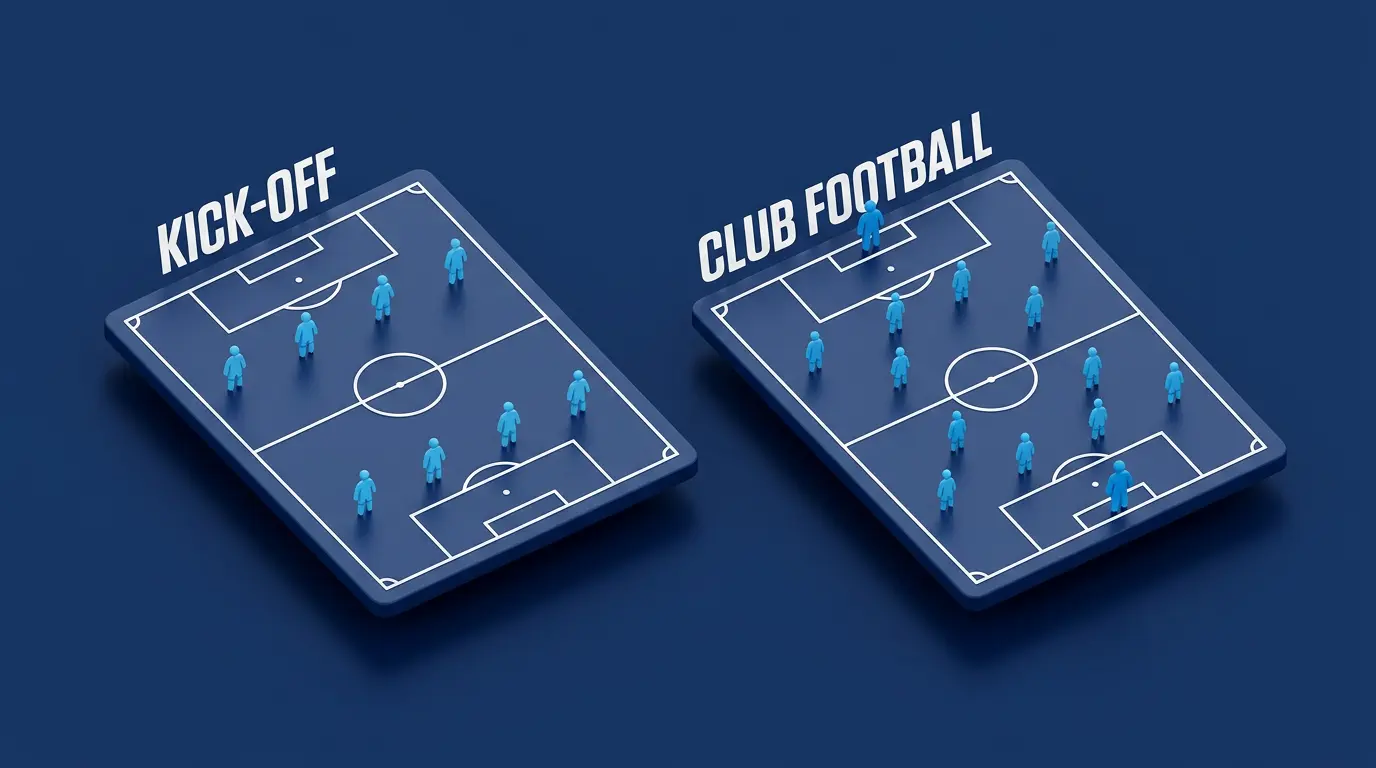
You sit down at the kitchen table to register your six-year-old for football. The club's page opens. There it is in front of you: MiniRoos Kick-Off in one section, MiniRoos Club Football in another. Your kid is six. They have never played. You click Kick-Off because the word "introductory" appears in the description. Then you scroll and see Club Football has 4v4 fixtures on Saturday mornings and starts in February. You pause. Are these two different things or two ways to register for the same thing? The page does not tell you. You email a friend whose kid plays. They tell you their daughter "did Kick-Off when she was four, now she's at the Club." So there is an order. You go back to the page. You still cannot work out from the page itself which one you should be clicking.
Here is what is going on. MiniRoos Kick-Off is an introductory program of weekly 45 minute sessions, designed to spark the love of football in kids aged 4 to 11 who are new to the sport. MiniRoos Club Football is the year-round club competition, with weekend small-sided matches against other clubs, for the same age range. Both are run under the MiniRoos brand. Both operate under Football Australia's framework. The names you may have seen with Coles in front of them, like Coles MiniRoos and Coles MiniRoos Kick-Off, are the same programs. Coles is the naming-rights sponsor, like Hahn for the Australia Cup. The substance is the same.
Your child does Kick-Off if they have never played football, or they have played for one season and want a low-stakes way to keep going. Your child does MiniRoos Club Football if they have decided they want a proper season, a regular team, and matches every Saturday morning from April to September.
The two programs in one paragraph
Kick-Off is a six to eight week block, typically. Sessions run for 45 minutes. The coach, often a parent who has done a short MiniRoos course, sets up small-sided games and simple drills in a circle of activities. There is no competition outcome. Your child runs around, kicks a ball, makes some friends, gets a participant pack with a shirt, a ball and a certificate, and you walk away with a sense of whether they want to keep playing. Some clubs run two or three Kick-Off blocks across the year: pre-season, mid-year, post-season. Football West, for example, runs pre-season (January to March), winter (April to August), and post-season (October to December) blocks.
MiniRoos Club Football is the season your friend's daughter is now in. Your child is placed in a team of seven to twelve players at the start of the year. They train one or two evenings during the week. They play a fixture on Saturday morning. They wear the club kit. The season usually runs April to September in NSW and Victoria, and through the dry season elsewhere. The competition is small-sided, not 11-a-side, which is what adults play. The format steps up by age. U6 and U7 play 4v4 on a tiny pitch with no goalkeepers. U8 and U9 play 7v7 on a quarter-size pitch with goalkeepers. U10 and U11 play 9v9 on a half-size pitch. At U12, most clubs move to 11-a-side, though some leagues hold 9v9 at U12 with Football Australia's blessing.
What Kick-Off costs and what you actually get
Three components make up the Kick-Off fee. Football Australia takes a $30 component, which covers the participant pack, program insurance, and central support. The state state body takes a $5 component, which goes towards a free MiniRoos coaching certificate for whoever is running the session at your club. The club then sets a variable component on top, which covers their facility hire, equipment, and the coach's time. The total you pay depends on the club and the length of the block. The figures range widely, but the bracket most parents see is between $80 and $150 per child for a full Kick-Off block.
The participant pack arrives by post within two to six business days of registration. Each child receives a MiniRoos shirt, a size-appropriate ball, and a certificate at the end of the block. The shirt is theirs to keep. The ball is theirs to keep. If three weeks pass without the pack arriving, the contact point is your state MiniRoos Program Officer at the state body, not the club.
When the year actually runs
Saturday morning football in NSW and Victoria runs April to September. The first match is usually mid-April, the final round is early September. Pre-season trainings start in late February or early March, the trial cycle for graded teams runs through March, and the squad list locks the week before the season starts. Northern climates run differently. Queensland and the Northern Territory run dry-season football roughly March to September, with a shorter pre-season. Tasmania often starts a few weeks later than NSW. If your child needs Kick-Off before the season starts, register in January or February. If they want to slot straight into Club Football, the deadline is typically late February.
Kick-Off itself runs in blocks across the year and is more flexible than the Club Football calendar. The pre-season Kick-Off block in NSW typically runs January to March. The mid-year block runs around the school holidays in July. The post-season block runs October to December. A six-year-old who decides in August they want to try football does not have to wait until next April. The next Kick-Off block is somewhere on the calendar.
Why your six-year-old plays 4v4 and not 11-a-side
Football Australia's national curriculum decided years ago that small-sided games produce better players at this age than 11-a-side. The reasoning is mechanical. On a smaller pitch with fewer players, your child touches the ball more often, makes more decisions, has more shots, and scores more goals. Confidence forms. Skill develops. The boredom of standing in defence on an 80 metre pitch waiting for the ball to come anywhere near them does not happen.
The format steps up by age band, deliberately. U6 to U7 stays at 4v4, halves of 15 to 20 minutes, on a pitch around 30 metres by 20 metres, no goalkeepers, no offside. U8 to U9 moves to 7v7 with goalkeepers, halves of 20 minutes, on a pitch around 40 to 50 metres long. U10 to U11 moves to 9v9, halves of 25 minutes, on a pitch around 60 to 70 metres long. The size 3 ball used at U6 to U7 moves to size 4 from U8 onwards. The progression is built so the U11 player stepping up to U12 11-a-side has a body of small-sided experience behind them, making the bigger pitch feel like a natural next step instead of a shock.
Coles MiniRoos and MiniRoos are the same thing
You may see Kick-Off advertised as Coles MiniRoos Kick-Off on Play Football, as Coles MiniRoos on Football Queensland's site, and as plain MiniRoos Kick-Off on Capital Football's page. These are not three programs. They are one program with a sponsor name attached in some places. Coles has held the naming rights for several years. The fee, the structure, the participant pack, and the curriculum are identical across the country.
A parent registering through the Play Football platform with a Coles logo in the corner is registering for the same Kick-Off your friend's daughter did at a club that does not show the Coles branding on the front page. The administrative back end at the state body and Football Australia is the same.
Which one your child should do
If your child has never played, do Kick-Off. The structure is gentler, the financial commitment is smaller, the participant pack gives them something to take to school, and you find out within six weeks whether they actually want to play. If they hate it, you have spent $80 to $150 and a few Saturday mornings, not a season fee.
If your child has played one season already and is asking for more, register them straight into MiniRoos Club Football at the club nearest to you. You skip the introductory layer because they have already had their introduction. Save your Kick-Off slot for a sibling who has not played yet.
If your child is somewhere in between, ask the local club whether their Kick-Off program runs alongside their Club Football competition during the winter. Some clubs run both in parallel and let parents move between them after a few weeks.
How to register without getting it wrong
The registration starts at the same place either way. Open Play Football, the platform Football Australia runs nationally. Search by your postcode. The page returns the clubs and Kick-Off programs near you. Each result is clearly labelled MiniRoos Kick-Off or MiniRoos Club. Pick the one your child needs, complete the standard Play Football profile if it is your first time, and pay the fee. The platform issues an annual Play Football registration that covers either program. Insurance is included. The Service Fee of 1.98 percent on top of the subtotal is shown to you before you pay.
If the program shows as full, register interest at the club. Most clubs run multiple Kick-Off blocks across the year and add players from a waitlist as places open. If you cannot find a Kick-Off program near you at the right time, contact your state MiniRoos Program Officer through your state body's website. They keep a current list of clubs running blocks and can point you to one you did not find online.
The first thing you do tomorrow is open Play Football, type your postcode, and look at what your nearest club is offering for the coming season. The choice between Kick-Off and Club Football is right there on the page once you know what the two are.