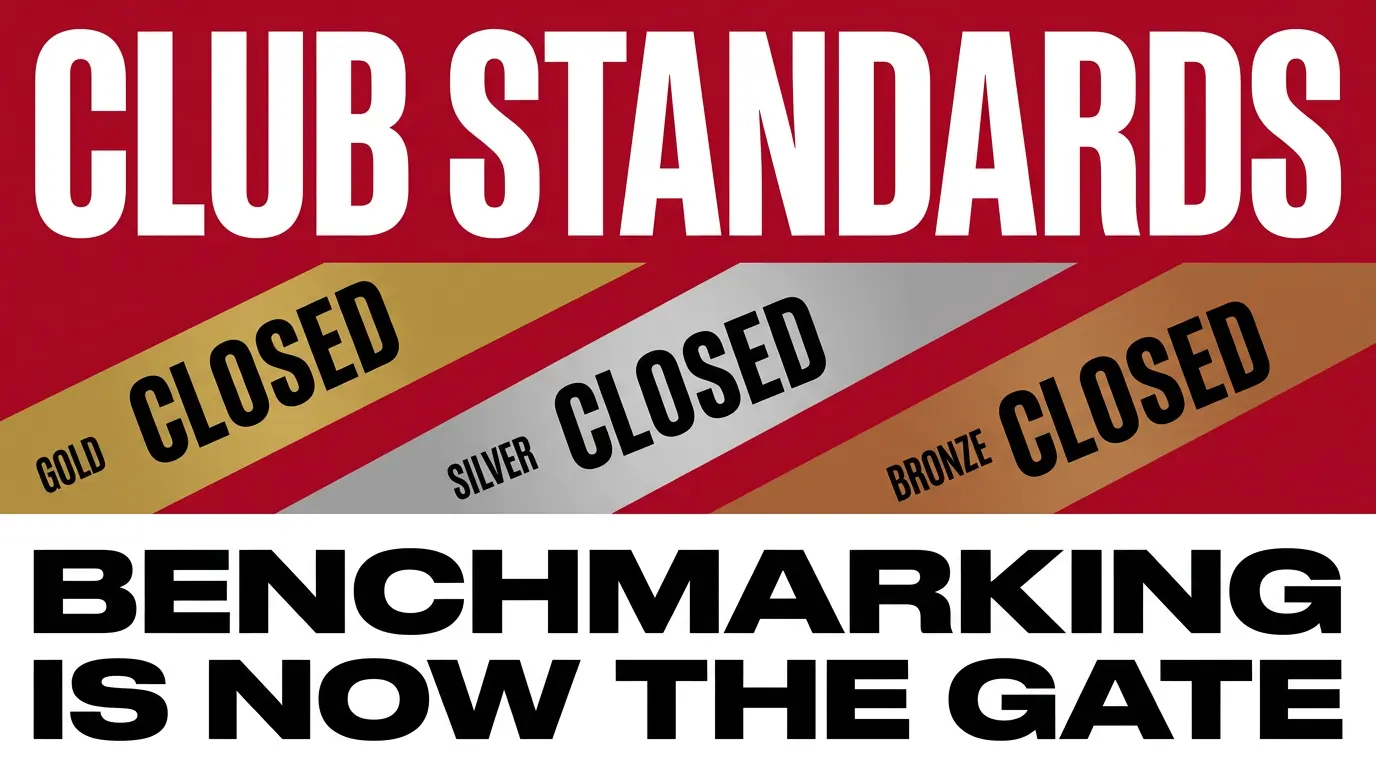
Last March, an email landed in roughly four thousand inboxes across NSW. The wording was bureaucratic. The effect was not. Each family learned, in a single paragraph, whether the local football club they had registered with would be a Gold, Silver, Bronze, or Development Committed program for the coming season. Most parents had no idea the rating existed. Most still do not. The rating is now the single most important thing happening in junior pathway football in NSW, and almost nobody outside the licensee clubs is talking about it. Your child's chances of getting into a Junior Development League program, the cost you pay if they get in, who can coach them, and even whether they can trial in the first place, are now governed by a public scorecard your club is being audited against every season. Here is what that scorecard actually does, and what it means for your family.
What the framework is and why it exists
The Football NSW Club Standards & Benchmarking framework is a quality assurance system that scores every JDL club annually across Planning, Delivery, and Outcomes. It started as a pilot in 2024 across what used to be called SAP (the Skill Acquisition Program, which had run since 2012). In 2025 it became Tier 1 delivery when SAP was rebranded to the Junior Development League. From 2026 it expands again to cover Girls' Youth Competition clubs as well, not just JDL.
The clubs that pass get one of four badges: Gold, Silver, Bronze, or Development Committed. Football NSW has stated publicly that every JDL program should hit Silver as a minimum. In 2025, the average Delivery score across all licensee clubs rose from 58% (Bronze territory) to 67% (Silver territory), a 9% jump in one year. Overall framework scores improved by an average of 18% from 2024 to 2025.
That improvement is real, and the framework's stated purpose, raising the quality of every JDL environment, is defensible on its face. Most parents would agree that better coaches, better facilities, and better-run programs benefit their kids. The question is what the system trades away to deliver that quality. Three things, mostly: where your kid can go, who can coach them, and what the price tag looks like.
The boundary lockdown
This is the change parents in NSW notice first.
From 2025 onwards, JDL licensees can only register players from their allocated geographic boundary. There are eight boundary zones across the state: North, East, West, South, Riverina, Southern, Western, plus the metro splits. Each zone has roughly four associations grouped into it. Your child must live in the same zone as the club they want to join. If they do not, the club is fined $2,000 per breach.
Three exceptions exist, and they are narrow. First, if you are a Life Member of the club, or have been a player, director, or committee member there for at least ten cumulative years, your child can register regardless of where you live. Second, if your child was already registered with that club's SAP or GSAP team in 2024, they can stay. Third, Football NSW can grant a discretionary exemption "on genuine merit," but the bar for that is set internally and not published.
The practical effect: if your seven-year-old's best mate plays at a JDL club one suburb over but in a different boundary zone, your kid cannot trial there. The club that was your local growing-up footy club cannot recruit your kid if you have since moved. The boundary is now the registration gate, not the trial result.
The coaching lockdown
The 2026 League Compliance schedule, published in the Football NSW Club Standards & Benchmarking Framework 2026 information pack, introduces hard non-negotiables. Each breach docks the club two points off its assessment score, to a maximum of ten points lost. There are eleven non-negotiables, and several of them shape what your child's coaching actually looks like.
Clubs must train three times a week, 60 to 75 minutes minimum per session, across a 36-week season. Clubs must NOT engage private providers or external coaches to run the JDL program. Coach contracts must be on file. Every coach must be registered on PlayFootball. The club must have a Working With Children Check policy, a Child Protection Policy, a Member Protection Information Officer, and a Game Time Policy in place. The club must hit 75% attendance at Football NSW Club Capability Building workshops. Facilities must include a fenced pitch, player change rooms, and toilets.
Coaching qualifications are tied directly into the assessment. The Head of JDL needs an FA B Diploma minimum (A Diploma recommended). The Head Coach for each age group needs at least a C Diploma. The Assistant Coach needs Foundation of Football minimum. The published minimum coaching qualifications in JDL are now the floor that licence holders must clear. Any coach without those credentials reduces the club's score, and from 2026 in the Boys' Youth League, any coach without at least a C Diploma contributes zero points toward the club's Technical Qualifications score for U13 through U18.
The trade-off here is real. Coach quality goes up, on average. But the local academy coach with twenty years of unaccredited experience can no longer help out at your child's JDL program. The club is locked into a Football NSW-accredited talent pool, no matter how skilled the external option might be. If your gut is telling you the brilliant unaccredited coach next door should be allowed to step in, the framework's answer is no, regardless. Your club gets sanctioned. The full picture is in your JDL club cannot outsource coaching or mandate extra paid sessions.
The pricing lockdown
This is the third squeeze, and the one that hits the family budget directly.
For 2026, Football NSW has set a capped Player Registration Fee of $1,998 for Mixed JDL (U9 to U12) and Full Time Girls JDL (U10 to U13). Part Time Girls JDL is capped at $889. The 2025 cap was $1,736, so the 2026 figure represents a 15 percent annual increase. That cap includes everything the FA National Registration Fee, the Football NSW Capitation Fee, and the club's own portion. Apparel must be included (jacket, pants, training shirt, shorts, socks, polo, kit bag, playing kit). Video analysis, GPS units, end-of-season functions, and a Level 1 Sports Trainer at every match must all sit within the cap. Clubs cannot levy a "Facilities Levy," a "Coaching Levy," or any other surcharge. The full breakdown is in the JDL registration fee cap.
That cap protects you from gouging. It also creates a problem for clubs that genuinely cannot deliver the program at that price, which pushes them out of the licence pool. Fewer clubs can run JDL programs at the cap, the licence pool consolidates to bigger, better-resourced clubs, and the boundary rule above means your geographic options shrink in parallel. Two forces compounding.
The appeals route, and where it ends
If a club thinks its assessment score is wrong, the framework has a published appeals process. Eight working days to request a review. Football NSW takes eight working days to respond. Three working days to escalate to the Independent Appeals Assessment Panel, appointed by the Legal and Grievance Committee. The panel has fourteen working days to decide. After that, in the framework's own words, "the determination of Football NSW is final and binding. There is no further right of appeal."
That matters because the assessment is what decides which clubs hold the JDL licence next year. A bad score with no appeal route means the club loses the program. Your child's pathway disappears even if you never knew there was a scorecard.
What this means for your child
The framework is not a conspiracy. It is a deliberate consolidation of a previously fragmented program into something Football NSW believes can be benchmarked against international standards, and the participation numbers behind it (4,330 JDL players, 65 programs across NSW) are small enough that consolidation is plausible. The trade is the openness of the old SAP system for the quality of the new JDL one.
Three things follow for your family. If your child is under nine and you live in a boundary zone with multiple strong JDL clubs, your options are widening, not narrowing. If you live in a zone with one or two struggling licensees, you are stuck unless one of the three exceptions applies to you. If your child is in a club that just got a Bronze or Development Committed rating, the medium-term question is whether that club will hold the licence at all in two years. Ask the club directly what their plan is to move up the scale.
When the parent next to you on the sideline says the system feels different from how it was three years ago, they are not wrong. It is. The official documents are public, including the Football NSW JDL Parent Information Guide for March 2025, and reading them is the first step toward understanding what is actually being asked of your club, and of your family.
What to do this week
Find your club's current rating on the Football NSW JDL Clubs page. If you cannot see it, email the club secretary and ask. Find the boundary zone your home address falls into and confirm which licensees you are eligible for. If you are considering a JDL trial for next season, the deadlines are tight, and the trial dates are set centrally by Football NSW, not by individual clubs. Knowing the rules before trial day matters more than it used to.