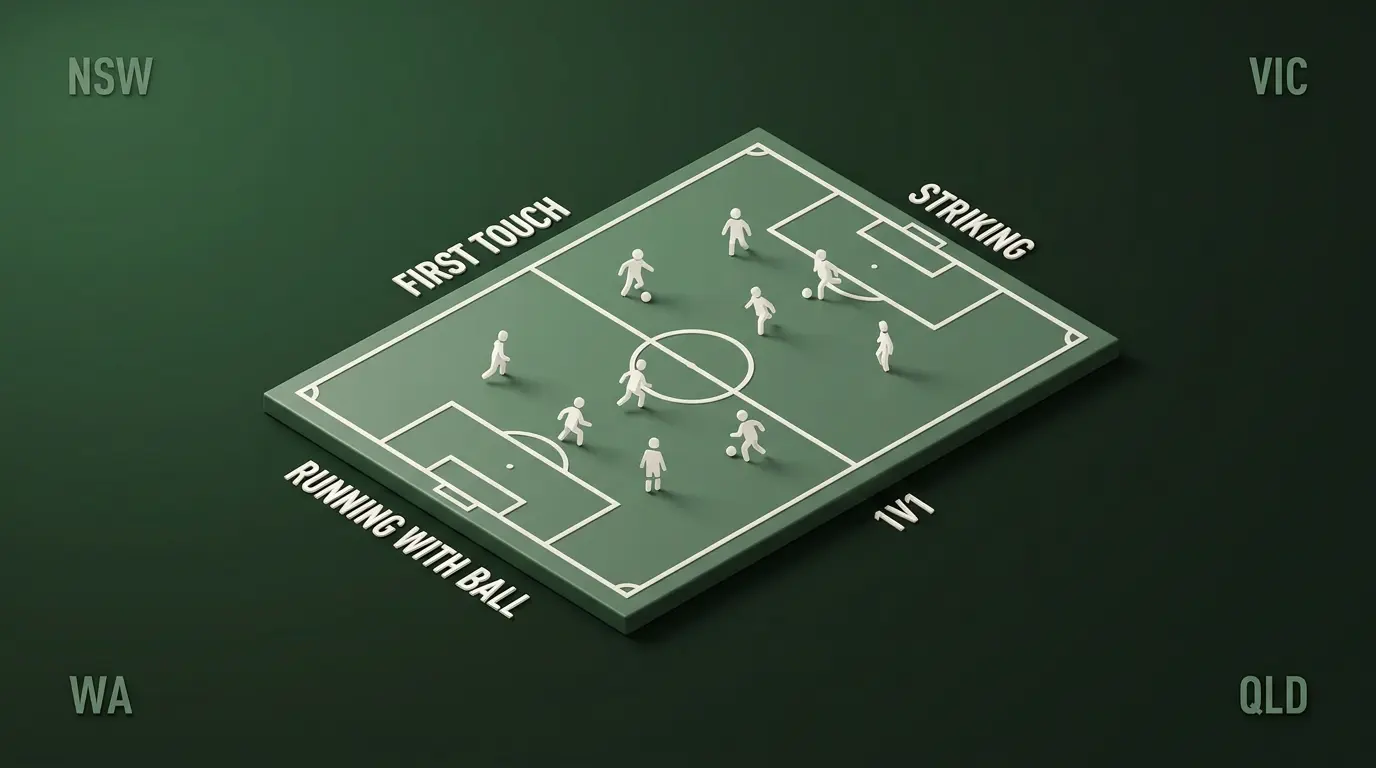
You hear "SAP" at training pickup. Other parents nod like they know what it means. The full name is the Skill Acquisition Phase. It is a Football Australia developmental concept for kids aged 9 to 12, focused on four core skills: first touch, striking the ball, running with the ball, and 1v1. The phase is the same nationally. The programs that draw on it have different names depending on which state you live in. NSW used to call its SAP program just "SAP" with a separate Girls SAP, called GSAP. In 2025, NSW rebranded both to Junior Development Leagues, called Mixed JDL and Girls JDL. Victoria, Northern NSW Football, Football Tasmania, and Football South Australia still call their programs SAP. Football Queensland calls theirs FQ Academy. Capital Football has a SAP Pathway League for U12 and U13 only. Football West does not run a SAP-equivalent at all for U9-U12. Football NT has no formal SAP-type program. Here is what the phase is, what your state actually offers, and what you should know before signing your nine-year-old up.
The national phase versus the state programs
The Skill Acquisition Phase, as Football Australia defines it in the national curriculum, is the developmental window between ages 9 and 12 where children's bodies and brains are at peak readiness for learning fine and gross motor skills in a football context. The phase concept is universal across Australia. Football Australia's National Coaching Curriculum describes the phase the same way no matter which state body delivers the actual program. The four core skills the phase targets are first touch, striking the ball, running with the ball, and 1v1. Football Australia's own framework states these four skills cover 95 percent of any outfield player's actions when in possession of the ball.
The phase is a concept. The programs are the implementations of that concept. Each state body builds its own version with its own brand, structure, age range, fees, and trial process. The result is that "SAP" means different things in Sydney than it does in Hobart than it does in Perth. A parent who moves interstate finds that the program their child was in last year has a different name, different structure, or in one state does not exist at all.
The four core skills, in one paragraph
First touch is what your child does the moment the ball arrives at them. Striking the ball is every kick they make: passing, shooting, clearing, crossing. Running with the ball is the dribble, whether through space or under pressure. 1v1 is the contest with the player nearest to them, attacking or defending. Football Australia's view is that if a child masters these four skills between ages 9 and 12, the more complex tactical and team-shape elements that come at U13 and beyond can be built on top of solid technique. If the four skills are not built during this window, recovering them later in a player's career is significantly harder.
State-by-state: what your state actually calls it in 2026
The picture changes year by year. The 2026 status across the nine state bodies sits like this.
Football NSW. JDL stands for Junior Development League. The program runs in two streams: Mixed JDL for boys and girls together, and Girls JDL for girls only. Both replaced the older SAP and GSAP programs in the 2025 season. JDL covers U9 to U12 inside a wider competition framework that extends to U18. Players go through a trial in October-November and play a 2026 season starting February.
Northern NSW Football. SAP. The Northern NSW Football SAP runs at U9 to U12 with trials in October of the prior year and training from February to September. Gala Days are scheduled throughout the year against other SAP programs in Northern NSW. The geographic scope covers Hunter, Central Coast, Northern Rivers, and Mid North Coast regions.
Football Victoria. SAP. Football Victoria describes its SAP as a part-time program designed as an add-on to club training rather than a replacement for it. Players continue with their community club and attend SAP sessions on top. The age range covers U9 to U12.
Football Queensland. FQ Academy. Rebranded from SAP, FQ Academy is the only program in Queensland recognised by Football Australia as Queensland's official advanced pathway. It runs Junior teams U9 to U12 and Youth teams U13 to U18. About 3,000 players sit within the FQ Academy system across the state at any given time, drawn from approximately 85,000 club-based players in Queensland. The system runs Advanced Centres in seven regions plus a Metro program in South-East Queensland.
Football South Australia. SAP, with a Summer SAP variant that runs in Term 4 and feeds into the FSA Development Centres for U11 and U12 the following year. The FSA Development Centres provide 18 additional training sessions and game experiences for identified players.
Football West. Football West does not run a SAP-equivalent for U9 to U12. The Football West Junior Development League is a U13 to U16 competition, not a U9 to U12 development program. Players aged 9 to 12 in WA play in the Coles MiniRoos system at their community club. Identification and grading for the next tier happens at U12, with U12 MiniRoos positions determining U13 league placements from 2026 onwards. Talent identification happens through Football West Academy nominations separately, but there is no SAP-named program at this age band.
Capital Football. SAP Pathway League. Capital Football runs SAP for U12 and U13 only, not the typical U9 to U12 range. Games run every second Tuesday. The older age band is a Capital Football specificity.
Football Tasmania. SAP. Football Tasmania hosts the annual National Skill Acquisition Festival each year, which brings together SAP programs from across the country.
Football NT. No specific SAP-equivalent program is documented. Football NT is currently collaborating with Football Queensland on pathway development as of December 2025, with FQ providing technical and operational support to build the Territory's junior infrastructure. For a child aged 9 to 12 in Darwin or Alice Springs, the practical answer in 2026 is community club football, not a SAP-named program.
What it actually costs
Across all states that run SAP-equivalent programs, the bracket parents see is between approximately $1,500 and $3,000 per season on top of the base club registration fee. The actual figure varies widely by state, by club, and by the level within the program. FQ Academy fees differ across Bronze, Silver, and Gold accredited clubs. NSW JDL clubs have a cap on registration fees set by Football NSW, with separate caps for Mixed JDL and Girls JDL. NNSWF SAP fees are set per association.
The hidden costs sit alongside the direct fee: kit (often a club-specific compulsory package), travel to two or three weekly training sessions, travel to weekend games or gala days that can be hours from home, and the time committed by a parent across two or three evenings a week and a weekend day. The total cost in time and money is materially larger than a community club season.
Geographic boundaries and why they matter
Most state SAP programs operate with geographic recruitment rules. NSW's 2026 JDL framework limits each JDL licensee to recruiting only from players whose home ground sits within the assigned JDL Player Boundary. Sutherland Sharks FC, for example, requires JDL players to reside within the Sutherland Shire. FQ Academy operates Advanced Centres in defined regions with their own catchment zones. These boundary rules exist to spread talent geographically and to stop a single club from sweeping up every talented child in a metropolitan area.
If your home address sits on the wrong side of a boundary line, your child cannot trial for a club that is otherwise closer than the one they are eligible for. Check your state body's boundary map before you register for trials.
The October decision
SAP and JDL trials happen in October and November of the prior year, not at the start of the season. By the time your child's community club season ends in September, the next SAP cohort has already been selected. A parent whose child shows promise during a community season cannot register for SAP that same year. The decision to try has to be made in advance.
The trial process at most clubs runs across two sessions. The first is open. Selected players are invited back for a second session, usually within a week or two. Final squads are announced before the school holidays end. The 2026 cohort was selected in October and November 2025.
Girls programs run as separate streams in most states
Girls JDL in NSW. Girls SAP in Northern NSW Football. Girls Summer SAP in Football South Australia. Girls programs within FQ Academy. Football Victoria runs separate Girls SAP. Capital Football runs mixed. The girls' stream exists because the talent pool size is smaller and the pathway considerations differ, including the eventual route to the Junior Matildas, the Young Matildas, and A-League Women academies. The fee structure, training load, and trial process are broadly similar between the boys' and girls' streams in each state. The difference is the playing roster and the dedicated technical staff.
What SAP actually leads to
The pathway runs SAP, then state youth team or NPL Juniors, then possibly NPL seniors or A-League youth squad, then possibly Junior Matildas or Joeys at U17, Young Matildas or Young Socceroos at U20, then possibly a senior contract somewhere.
Each step has fewer places. Football Queensland's own published figures give one way to think about the funnel. About 3,000 players in the FQ Academy system. About 100 boys and 100 girls per year reach Queensland state teams. About 10 percent of those eventually progress to national team representation. That math sits at roughly 10 boys and 10 girls per year from Queensland reaching the national team pathway out of a state academy system of 3,000.
The same broad ratio holds in other states with comparable populations. The honest message for parents: SAP places a child on the visible pathway. It does not guarantee anything beyond the next step.
Boring procedural close: three things to check
Your state body's SAP or JDL or FQA page, bookmarked and read before you talk to anyone at a club. The trial date for your zone, written down for October-November of the year before the season you are aiming for. The actual fee, disclosed in writing by the club before you commit to a trial, including any compulsory kit cost, travel expectations, and number of training sessions per week.
If a coach hands you a trial flyer for SAP at your seven-year-old, ask what age band the program actually serves in your state. The age range that "SAP" covers is not the same everywhere. Capital Football's SAP starts at U12. WA does not run SAP at the U9-U12 age band at all. Knowing what your state offers, rather than what a friend in another state told you about, is the first step on the talented player pathway.
For broader context, Football Australia's own description of the Skill Acquisition Phase on Play Football covers the four core skills in more technical detail. The article on U9 to U12 pathway programs walks through the pathway above SAP into the next tier. The article on the realistic odds at each pathway level gives more detail on the funnel from SAP to national representation. The article on what JDL actually is in NSW covers the NSW-specific implementation in more depth. The article on full-time or part-time girls JDL covers the commitment options for daughters specifically.