You sit at the kitchen table on a Tuesday evening. Your kid played their first match at the weekend. Something happened. You are not sure how serious it is yet. Maybe the coach yelled at the kids in a way that crossed a line. Maybe the fixture moved at the last minute and three families could not make it. Maybe the referee made a call that left a parent on the other team standing two metres from your child screaming. You want to do something. You open your laptop and you do not know where to start. Email the club. Email the association. Find your state body. Call Football Australia. There are four possible places and you have heard of three of them only because you read the back of a Play Football receipt.
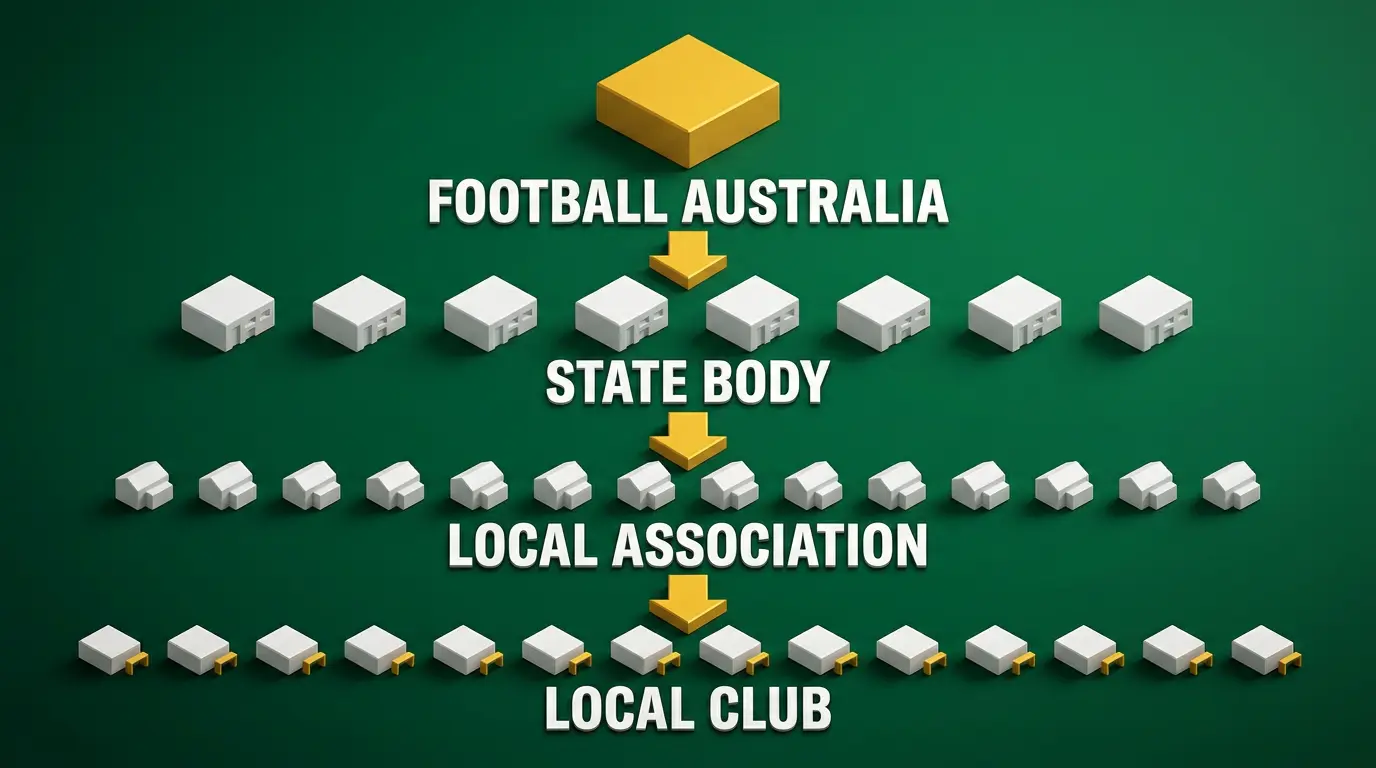
Here is the structure underneath the sport your kid is now part of. Football in Australia operates on four levels in most states. Your local club sits inside an association, the association sits inside the state state body, the state state body sits inside Football Australia. In NSW this is fully four levels: club, association, Football NSW or Northern NSW Football, and Football Australia. In Victoria from 2026, the association layer was absorbed into Football Victoria, which administers all competitions directly. In Queensland from 2021, the association layer was replaced by Football Queensland regional offices. In the ACT, Capital Football has always run competitions directly without an association layer. The other states sit closer to the NSW model. Each level handles different things. Each one is where you take different problems. Once you know which level owns the problem you are trying to solve, you stop getting passed around.
The four levels in one breath
Football Australia is the national governing body. It sets the policy, runs the national teams (Socceroos, Matildas, Joeys, Junior Matildas), administers the Play Football registration platform that every player in Australia uses, sets the National Registration Fee, and owns the Member Protection Framework. It does not run your kid's competition or pick your kid's coach.
The state state body is the layer your fee shows up on most prominently in your Play Football receipt. There are nine of them across eight states and territories: Football NSW, Northern NSW Football, Football Victoria, Football Queensland, Football South Australia, Football West, Capital Football, Football Tasmania, and Football Northern Territory. NSW is the only state with two state-level bodies, divided geographically. Your state state body runs the top state-level competitions including the National Premier Leagues, manages player and coach registrations into Play Football, takes care of insurance for clubs and players, and runs the talent identification programs.
The local association is what sits between your state body and your kid's club in NSW and similar states. Football NSW alone works with 16 metropolitan associations, 15 regional associations, and 3 branches. Yours is the one that runs the actual competition your child plays in. It sets the local fixture schedule. It manages referees. It administers MiniRoos centres on Saturday mornings. It deals with the day-to-day operational reality of football in your suburb.
Your club is at the bottom and is closest to your child. Volunteers run it. The club has a committee, a treasurer, a registrar, and a head coach or director of football. The club owns the kit, the equipment, and the relationship with the ground (the council, usually). The club retains the smallest share of your registration fee, typically under $100 per junior player after the three layers above are paid, to cover ground hire, training equipment, volunteer admin, and the head coach's costs if there is one.
Where each layer's money goes, in one paragraph
Open your most recent Play Football receipt. There is a four-component breakdown on it. The Football Australia component is the National Registration Fee, $18 for junior players in 2026 and $42 for adults. The state state body component is set by the state body each November. For Football NSW in 2026 the adult state body component is $106. The association or zone component is set by your association. In Sutherland Shire, for example, the SSFA component on an adult registration is $50. The club component is everything else. The four lines sit on every receipt because every Australian player registers through Play Football, the national platform Football Australia runs. The 1.98 percent service fee on top is the platform fee, charged on every transaction.
What the club does and does not do
Your club owns the relationship with your child. The club picks the team your child plays in, picks the coach, runs the trainings, handles the kit, communicates the fixture for next Saturday, and decides whether the canteen is open. The club does not write the rules your child plays under. The rules come from the laws of the game (IFAB internationally, Football Australia in Australia) and from the competition regulations your association or state body has set on top.
If your problem is about your specific team, playing time, the coach, training quality, kit, communication, or the parent next to you on the sideline, the club is where it starts. Email the club registrar or president. Be brief, factual, and clear about what you want to happen. Give them a chance to fix it.
What the association does in NSW (and what replaced it in Victoria and Queensland)
In NSW your local association runs your competition. The association decides whether your U10 team plays in Division 1 or Division 3. The association schedules the fixture. The association assigns the referee. The association handles disputes between clubs at the local level. The association charges the levy you see on your Play Football receipt because it has staff, a board, and grounds to coordinate.
In Victoria from the 2026 season, this layer was removed. Football Victoria now administers all competitions directly, regional and metropolitan. Regional players in Victoria pay fees directly to FV and no longer pay separate association fees. The change was announced in FV's 2026 fee circular and is now in effect.
In Queensland from 2021, the association layer was replaced by FQ regional offices. Each FQ regional office has a local administrator and a quarterly committee, reporting up to Football Queensland centrally. The reforms targeted governance, administration, competitions and affordability.
In the ACT, Capital Football has always run competitions directly. There is no association layer there to remove because there was never one to begin with.
The other states sit closer to the NSW model with associations still in place.
What the state state body does
Your state body owns the top end of football in your state. It runs the National Premier Leagues. In states with junior development programs at the state level, the state body runs them. The state body holds the insurance that covers every registered player. The state body negotiates with the state government about voucher schemes, ground access, and emergency funding. The state body publishes the fee circular each November that tells every club what they need to charge next season for the state component.
If your problem has been at the club, you have followed it up with the club, and the club has not resolved it, the next step is the state state body if there is no association layer above the club where you are. In NSW, the next step is the association. In Victoria and Queensland, the next step is the state body directly.
What Football Australia does
Football Australia sets the national policy under which everything else runs. The Football Australia website holds the Statutes and Regulations index, the Member Protection Framework, the National Code of Conduct and Ethics, the National Disciplinary Regulations, the Concussion Policy, and the National Spectator Code of Behaviour. Football Australia runs the Play Football registration platform that every club and every parent uses. Football Australia administers the National Registration Fee that sits on every receipt.
Football Australia does not run your kid's competition. Football Australia does not pick your kid's coach. Football Australia very rarely talks to individual parents directly.
The framework with teeth: where you take a problem
Football Australia's own complaints procedure is explicit: handle things at the lowest level first, escalate up only when the lower level has not followed the proper process. The complaint about the coach who yelled goes to the club first. If the club does not respond or follows the wrong process, the complaint goes to the association in NSW or the state body in Victoria, Queensland and the ACT. Football Australia itself only handles matters at the national level, or the most serious matters at a state level that have already been escalated through the right channels.
Reading this in reverse: emailing Football Australia about your six-year-old's referee will not produce the outcome you want, because Football Australia will refer you back down the chain. The structure is real, but the rules only work for you if you start at the right level.
The MPIO at your club: the first person to know
Every club should have a Member Protection Information Officer, or MPIO. The MPIO is the person within the club whose role is to provide information about your rights, responsibilities, and options for raising a member protection concern. If you do not know who the MPIO at your club is, the club registrar should be able to tell you. If your concern is about child safety, welfare, harassment, or anything that touches on the Member Protection Framework, the MPIO is the first point of contact. They are not a substitute for the police if a criminal matter is involved. They are the first informed person within the club's structure who can help you work out what comes next.
Football Australia's National Club Licensing Regulations require licensed clubs to have or have access to a child safeguarding officer or MPIO within their administration. Many community clubs share an MPIO at the association level. Your association's website should list theirs if your club has not appointed one of its own.
If you want to read further, the article on the Member Protection Information Officer at your club goes into more detail on what they do and how to find yours. The article on the Football Australia complaints process covers what FA's complaints process actually covers and what it explicitly does not. And the article on what the club actually does with complaints walks through what happens when you raise something at the club level.
Boring procedural close: three things to know
The website of your local association in NSW, or your FQ regional office in Queensland, or Football Victoria directly in Victoria. Bookmark it. The contact email for your club's committee, which is usually published on the club website's About page. Save it. The complaints page on your state state body's website. Find it before you need it.
You will not need any of these most weekends. But the Tuesday evening when something has happened and you do not know where to start, you will not be hunting around. You will already know which level owns the problem you are trying to solve.