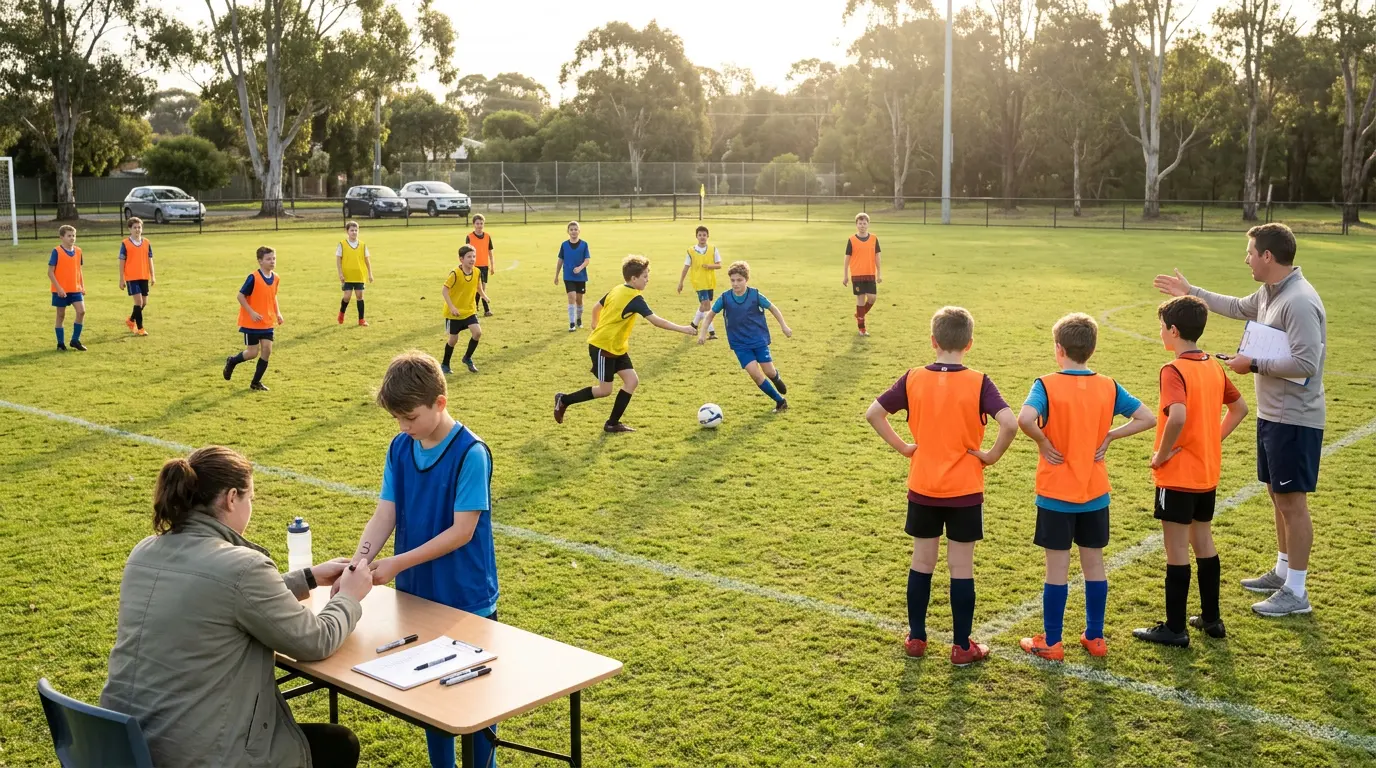
Your 12 year old has a trial on Sunday. You will be on the sideline. They have asked you not to come, then quietly checked the night before that you are coming.
You will sit on a folding chair, watch a small-sided game with twenty-eight other parents on three sides of the pitch, and try to read the future from the back of your child's head. Most parents in that situation watch for goals, because goals are the obvious thing. They go home thinking their kid had a good day or a bad one based on whether the ball ended up in the net.
The selectors are not watching for that. There is a body of soccer-academy research that quantifies what they actually score. The gap between what most parents see and what selectors see is the difference between a productive car ride home and a quietly damaging one.
This article is what good play actually looks like to a parent watching from the boundary, what to talk about and not talk about on the way home, and the one thing that makes the post-trial conversation either useful or harmful, with no in-between.
What good play actually looks like
Junior football is mostly things that happen in the half-second before and after a player touches the ball. Most parents miss those moments because they are watching the ball.
A 2024 study in the Journal of Science in Sport and Exercise tracked under-12 trialists in a Scottish FA national selection programme using foot-mounted sensors during 9-versus-9 small-sided games. The metrics that distinguished selected from non-selected players were ball touches, time on the ball, and high-speed releases (how quickly the ball moved on after a touch). Not goals. Not flashy moves. Touches and decisions.
A separate longitudinal study published in the Journal of Sports Sciences in 2022, tracking U13 academy selection over multiple seasons, found that decision-making test scores predicted senior squad selection more reliably than physical or anthropometric measures. The study quantified it: U12 players in the top decision-making bracket had an 82.4 percent chance of being selected forward; the bottom bracket had 16.6 percent. Five times more selection signal in decisions than in size.
What this means for what you actually watch.
Watch for the first touch. The ball arrives. Does it stop where the kid wants it, or does it bounce away and force them to chase? A good first touch sets up a good next move. A loose first touch costs the next two seconds and usually costs possession.
Watch for the second touch. After receiving, how long does the ball stay attached to their feet before they decide what to do? Quick decisions buy time for teammates. Slow decisions give possession away under pressure. This is the metric the research above is measuring.
Watch what they do without the ball. The bulk of any junior's pitch time is spent off the ball. Are they showing for passes, scanning behind them, getting back when the ball is lost? The kid who is always "in the picture" is the kid the selector's pen keeps coming back to.
Watch how they carry themselves between activities. After a mistake, do they breathe and reset? In the queue for the next drill, are they standing up or hunched? Mistakes are unavoidable. What comes after is what gets noticed. A 2023 ethnographic study of an English category-2 academy followed 96 players over 25 weeks of red-amber-green grading and found that quarterly subjective ratings (the coach's overall sense of the player) predicted (de)selection more strongly than any single performance test. The "overall sense" is built from these between-drill moments more than from anything that happens with the ball.
You do not need a stopwatch or a clipboard. You will see these things if you watch the player rather than the ball. Try it for ten minutes and the game looks different.
What good play does not look like
Goals at trial. The fields are small, the keepers are mixed quality, and a hot-foot striker can score three against the weakest pool and not have shown the selector anything they care about. A goal is noted. It is not the headline.
Big touches and showy moves. The flashy step-over that ends in a turnover is more visible to a parent than the small clean control that ends in a pass. The clean control is what gets the tick.
Loud players. The kid shouting instructions to teammates at trial is often anxious, not confident. Quiet competence beats loud presence almost every time at this level. The selector is choosing teammates as well as players.
What not to do during the trial
This is where parents lose more selection signal than the kid ever does on the pitch.
Do not coach from the sideline. Selectors notice parents. A composed parent on the boundary is a small positive signal. A shouting parent is a meaningful negative, because the selector has to decide whether to invite that household into the squad culture for a season.
Do not whisper instructions during water breaks. The kid will play the next drill thinking about your instruction instead of playing.
Do not signal disappointment with body language. They are watching, even when it looks like they are not. A folded-arms parent at trial costs a child more confidence than three missed first touches.
Do not promise rewards for selection. The minute a child plays for an external prize, the decisions get cautious. They start playing for the result, not the game. Decision speed (the very thing the research above flags as the strongest predictor) drops in this state.
The car ride after, where most damage happens
The car ride after a trial is where parents undo the day's work, usually within ten minutes of leaving the venue. The kid has been processing emotion non-stop for two hours. The parent has been processing emotion for five days. Whoever talks first sets the tone.
Silence first. Drink, food, music, whatever the kid wants. They will start the conversation when they are ready, not when you are. Most kids will start it within fifteen minutes if the silence is genuine. They start it never if the silence feels like waiting.
If they ask how they did, say what you saw, not what you think will get them selected. Specific, observed, true. "Your first touch looked sharp on the second drill." "You worked back hard in the last fifteen minutes." Do not editorialise on whether it was enough. They are listening for that and they will hear it whether you say it or not.
If they say they played badly, do not argue. Listen. Ask what they thought went well anyway. Most kids walk out of a trial focused on the worst three minutes of two hours. Helping them find the rest is more useful than telling them they are wrong.
Do not tell them whether you think they will be selected. You do not know. The selectors do not know yet either; the panel meets later in the week and decisions are not finalised until that meeting. Telling a kid in the car that they will or will not be selected is fiction, even when said with confidence.
The deeper version of the after-trial conversation is in the silent drive home: what it usually means and what to do about it.
The recap
Good play at junior trial is touches, time on the ball, decision speed, off-ball movement, and composure between drills. The research is unambiguous that these predict selection more reliably than goals, athleticism or showy moves. What not to do at the trial: coach from the sideline, whisper at water breaks, frown across the pitch, promise rewards. The car ride after is where parents undo the day, usually within ten minutes, by speaking first instead of waiting.
Your 12 year old gets in the car. They scored once and gave the ball away twice. They also made about thirty clean first touches and worked back on every loss of possession. Those are the moments the selector noted. The kid does not need to know that. The parent does.
USI Library walks parents through trial day without trying to make them coaches. Phase 1 membership is free with just an email, no card, no expiry. Browse the full library at unitedsportinginstitute.com.