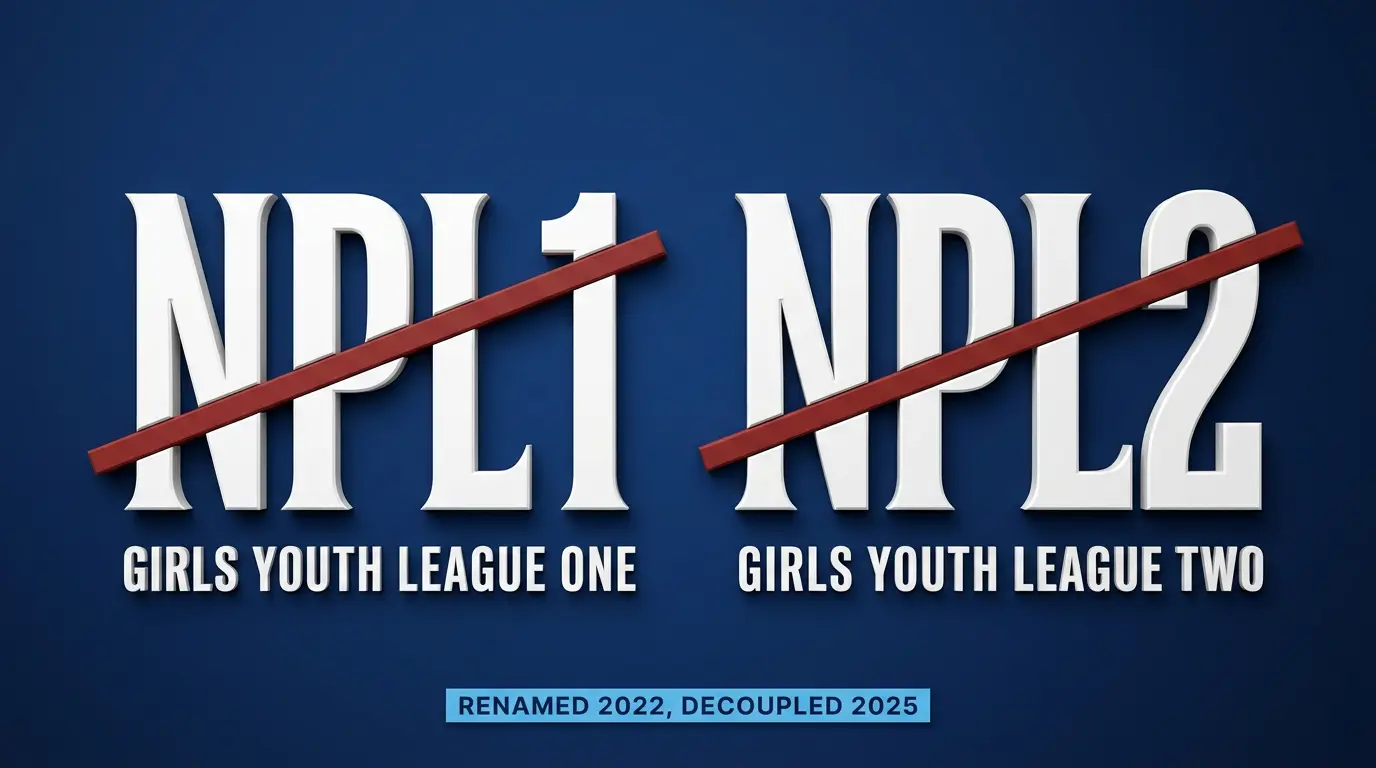
A parent at the sideline tells you her daughter is trialling for an NPL1 club. Another parent says NPL2. Both speak as though the numbers settle the question of which club is the better development environment for an eleven-year-old or a fourteen-year-old girl. The numbers do not settle anything anymore.
The official names of those competitions have not been NPL1 and NPL2 in NSW women's and girls' football since 2022. The senior tiers are now NPL Women's NSW at the top and Football NSW League One Women's below. The girls' youth tiers are Girls Youth League One and Girls Youth League Two. From 2025, the youth and senior competitions at the same club were decoupled, which means a club playing in NPL Women's senior can be running a Girls Youth League Two youth program, or the other way around. The headline tier of a club is no longer a reliable signal of the quality of its youth environment. Five things at the club itself matter more.
Where NPL1 and NPL2 come from
The terms are real. They just describe an older shape of the system.
Football NSW renamed its second-tier women's senior competition from National Premier League 2 NSW Women's to Football NSW League One Women's at the start of the 2022 season. The 2022 inaugural league name change was part of a broader review of state-level competition naming across Australia, and Football NSW was the first state body to move on the women's side. The Wikipedia entry for the competition records the rename plainly. Football NSW's own competition pages have used League One Women's exclusively since.
The girls' youth competitions had matching names before 2022 as well. The current Girls Youth League One and Girls Youth League Two replaced what older parents and coaches still call "NPL1 girls" and "NPL2 girls." The names changed. The conversational shorthand did not. A coach who has been in the system for ten years will still say NPL1 and NPL2 because that is how they entered the language. A parent reading the Football NSW website for the first time will only see GYL One and GYL Two.
There is no NPL Youth competition for girls in NSW beyond Girls Youth League One and Two. The girls' pathway from U14 to U18 consists of those two tiers plus the community football competitions run by associations. If a coach refers to "NPL Youth" for girls, they mean GYL.
Youth and senior were decoupled from 2025
This is the change that breaks the old shorthand most cleanly.
Before 2025, a club's senior tier broadly determined its youth offering. An NPL Women's club ran the equivalent youth program. A League One club ran the second-tier youth. The numbers lined up. NPL1 meant top youth and top senior. NPL2 meant second youth and second senior.
From 2025, Football NSW separated the licences. The Girls Youth League and the senior NPL Women's and League One Women's competitions are now licensed independently. A club's place in the senior pyramid no longer determines its place in the girls' youth pyramid. The August 2024 Football NSW announcement made the policy change explicit, in the same restructure that introduced the Club Standards and Benchmarking Framework and brought four A-League Women clubs into the Girls Youth Leagues from 2025/2026.
What this means in practice: when a coach tells you her daughter is at an NPL1 club, that statement no longer tells you what tier the youth team plays in. The club could be NPL Women's senior and Girls Youth League Two for youth. Or League One Women's senior and Girls Youth League One for youth. The senior and youth tiers move independently. Ask which youth tier the club holds, not which senior tier.
How tier movement actually works now
Movement between Girls Youth League One and Two from 2026 onward is governed by the Club Standards and Benchmarking Framework. The framework is built around five components.
The five are: planning, delivery, anticipated outcomes, club championship results, and additional performance indicators. Each component is weighted differently and scored individually. The accumulated total drives the licence offered for the next two-year period. Football NSW publishes the detail in the Girls Youth League Club Standards information pack.
On-field results alone do not move a club up or down. A Girls Youth League Two club that scores strongly on planning, delivery, and outcomes can be assessed for movement to League One independent of where its U14 to U18 teams finished on the table. A League One club that performs well on the pitch but weakly on the off-field measures can be assessed downward. The framework is designed to reward clubs that invest in coaching pathways, technical staff continuity, parent communication, player retention, and player development outcomes, alongside the headline results.
There will be no movement between Girls Youth League One and Two at the end of 2025. The 2025-2026 clubs are locked in across a two-year licence period. The first cycle of promotion and relegation under the new framework runs at the end of 2026. The competition pages on the Football NSW website state this explicitly.
The signal for a parent: a club's current tier reflects how it scored in the last licence assessment, not necessarily how strong its current youth program is. A club moving up in 2027 will be operating a strong youth program in 2026 to earn the score. A club moving down will be operating a weaker one. The tier today is a lagging indicator, not a leading one.
When a Girls Youth League Two club might be better
The 2026 capped Player Registration Fee for both Girls Youth League One and Girls Youth League Two is $2,692 in NSW. Same cap, same components, same scope. The development environment is not bought at a different price. It is delivered at a different club.
A Girls Youth League Two club may be the better choice for your daughter when the head coach has been there for three or four seasons and is genuinely investing in U14 to U18 player development. When the technical staff are stable and well qualified. When the club has a clear pathway from its Girls JDL or community program into U14 and from U14 up through U18. When the fixtures are at venues your family can sustainably travel to across a thirty-week season. When her best friends from JDL are going there and the social environment is right for her.
Tier alone does not measure any of these things. The framework measures them, but the framework score has not yet driven promotion or relegation. Until the end of 2026, the tier is a frozen photograph.
When Girls Youth League One is still better
Girls Youth League One remains the higher-density competition. Fourteen clubs play each other twice across the season, and the standard of opposition each weekend is on average higher. A girl developing in this environment plays against a wider range of strong U14 to U18 players. She is more visible to Football NSW pathway selectors. She has more chance of being seen for the Talent Support Program and Talent Development Scheme matches, which feed into the Future Sapphires program for U15, U16, and U18.
Girls Youth League One also includes the youth programs run by four A-League Women clubs. Central Coast Mariners FC, Macarthur FC, Newcastle Jets FC, and Western Sydney Wanderers FC entered the Football NSW Girls Youth Leagues and Senior Women's Competitions for the 2025/2026 season. These clubs sit in the youth pathway alongside the established NPL Women's clubs.
If a girl is performing strongly at twelve or thirteen and the family has identified the elite pathway as a serious goal, the higher-density environment at GYL One is genuinely valuable. The trade-off is whether she gets into a strong squad position at that club rather than sitting on a bench, and whether the coaching is materially better than what the equivalent GYL Two club is offering. A bench seat at a Girls Youth League One club develops a player less than a starting position at a Girls Youth League Two club.
How to compare two clubs side by side
Pick two clubs she could trial for. Open a document and answer the same six questions for each.
The head coach for U14, and their FA coaching qualifications. The technical director, and their qualifications. The retention rate of the U13 squad into U14 in the previous two seasons. The number of players the club has moved into Future Sapphires, the Talent Support Program, or state representative teams in the previous two seasons. The club's published position on the Football NSW youth and senior decoupling and what it means for their youth tier. Which family member runs trials and how they are conducted.
Tier name is the seventh line of that comparison, not the first.
The Football NSW Club Benchmarking Standards article on this site, found at the Football NSW Club Benchmarking Standards explainer, sets out the qualifications and responsibilities Football NSW requires of clubs in JDL and the Girls Youth Leagues. The same coaching minimums apply across both pathways. The published roles are the testable items in your comparison.
If a club declines to answer any of these questions in writing, that is a signal. The clubs taking the new framework seriously will publish their answers. The clubs trading on their tier alone will not.
Boring procedural close
Email the clubs she is considering. Use the six-question comparison. Compare the answers across two or three clubs side by side. Make the decision on coaching, environment, and pathway visibility, not on tier name.
Trial dates for U14 placement are usually advertised on each club's website from August or September of her U13 year. Girls Youth League One trials run first. Girls Youth League Two trials run slightly later. Community girls football at U14 runs trials in October and November. If a Girls Youth League One offer does not come, a Girls Youth League Two offer is not a downgrade in 2026 conditions. It is a different club with a different score in the framework.
Re-verify the framework details against the Football NSW Girls Youth League information pack before signing. The next licence assessment cycle runs at the end of 2026, and the league names and tier conditions can change again with the next Football NSW announcement.
The NSW next step at U13 article covers the pathway map. The Full Time vs Part Time Girls JDL article covers the earlier U10 to U13 decision. Read them together if you are inside the trial window.