She came home from training on Tuesday night, dropped her bag, and said it. She is eleven. She has played mixed football since she was six. She told you she does not want to play with the boys next year. You did not see it coming, or you saw it coming three months ago and hoped it would pass. Either way, the conversation is now sitting on the kitchen bench and you have a registration form to fill in for 2026.
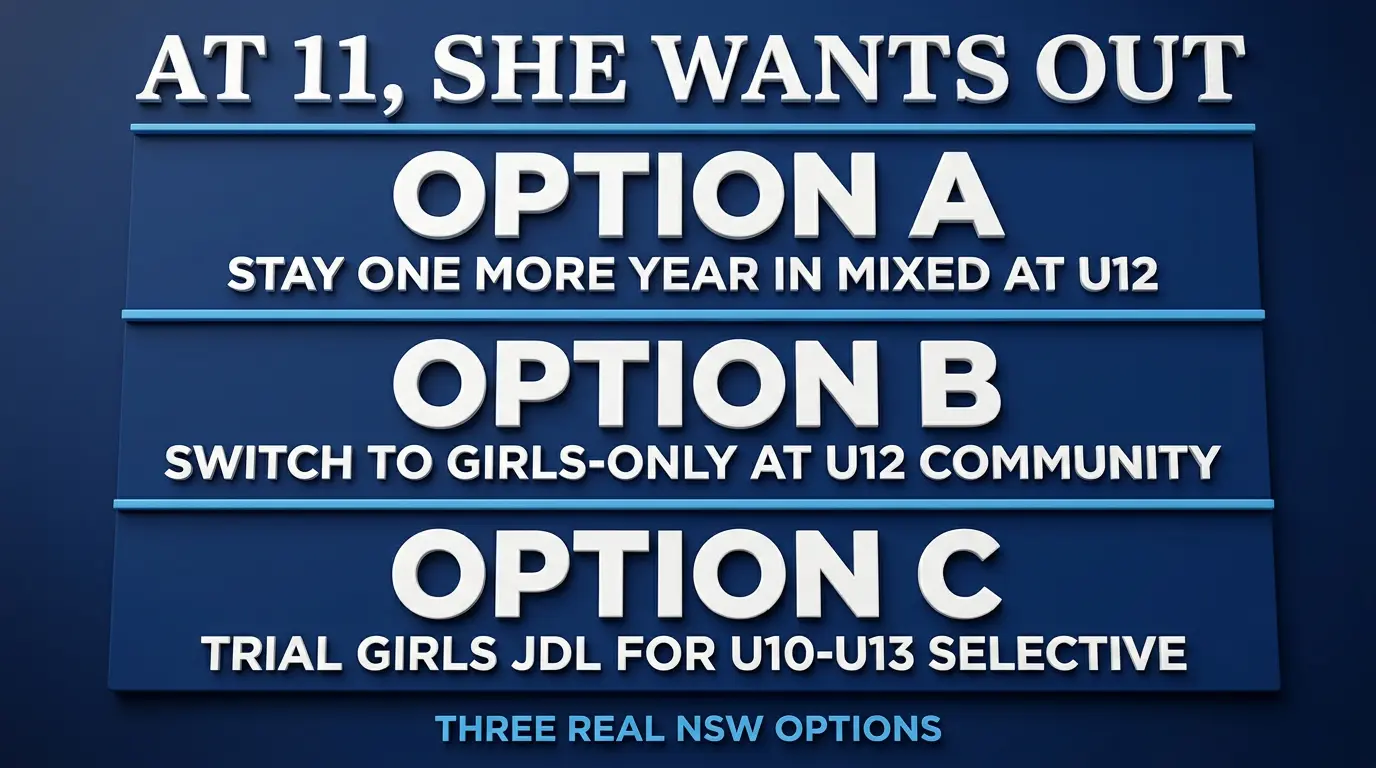
There are three real options in NSW at age eleven. She can finish one more season in mixed at U12, where everyone moves to single-gender football the year after anyway. She can move to a community girls-only team at U12, where your association runs one. She can trial for Girls JDL in 2026, which is the selective state-body program for ages ten to thirteen. The right option depends on how loud her "no" is, how strong a community girls-only option exists near you, and whether she is ready for the time commitment of JDL.
Why she might be saying it now
At eleven she is at the top of MiniRoos. NSW Mixed JDL plays 9v9 through U12. Community football in most NSW associations follows the same format. At U13 the game jumps to 11v11. The field gets bigger, the contact gets harder, and the speed step is real.
Football Australia's MiniRoos program covers ages five to eleven nationally. From U12 the format usually changes and the girls and boys games begin to separate naturally. Sutherland Shire, Football Canterbury, North Shore, Manly Warringah, and the Newcastle associations all run girls-only U12 divisions in their community competitions. Some smaller associations do not. The U11 girl who has been the only girl on her team has been carrying that situation since U6 in many cases.
What changes at this age is not the football. The football was always the football. What changes is the social experience around it. Eleven-year-old girls are starting to notice who they are training next to. They are starting to feel where they fit. A 2024 Aspen Institute State of Play report found that thirteen-year-old girls are about half as likely to be playing organised sport as boys the same age. The drop-off begins earlier than that. It often begins around eleven or twelve, when the question of whether sport feels like her space gets asked for the first time.
If she is saying she wants out, she is probably saying this is not feeling like her space anymore. Listen for that, not for whether the football itself is the problem.
Option A: finish one more season in mixed
The case for staying one more year is strong if she still likes her teammates and her coach. Friendships at this age matter. So does the rhythm of weekly training, Saturday games, and a coach who knows her.
Practically: everyone moves to single-gender football the year after anyway. U12 is the last season many girls play in mixed. By U13 community football in NSW typically separates girls into their own age groups, and the selective programs (Girls JDL, the youth leagues at U14) are already structured around the girls' game. If she finishes the year in mixed, the transition is one step, not two.
The risk: if she is genuinely uncomfortable now, asking her to push through one more year of an environment that does not feel right can be the reason she stops playing altogether. The honest test is whether she still looks forward to training. If she does, the case for finishing the season is stronger than the case for changing now. If she does not, do not finish the season because the calendar says to.
Option B: switch to a community girls-only team at U12
The case for changing now is strong if your association runs a girls-only U12 division.
Where it exists, this is the simplest move. Same club registration, same fee, same Saturday morning, different teammates. The match days run alongside the boys' competition. The training is at her own club ground. The cost is the same, the kit is the same, the parents are familiar. The change is the bench environment and the on-field experience.
Where it does not exist, you have a problem. Some associations only have girls-only competition from U13 or U14. In that case, this option is not really an option at U12, and you are choosing between finishing one more year in mixed (Option A) or stepping up to the selective program (Option C). Smaller associations often have one girls-only U12 team for the whole association, which can mean longer drives for training and games.
What to ask your association: is there a girls-only U12 division, how many teams are in it, where do those teams train, what is the standard like compared to the mixed competition she has been in. If the answers are vague or the website is silent, call the association directly. Email goes unanswered for weeks at this time of year.
Option C: trial for Girls JDL
The case for Girls JDL is strong if she is technically ready and the family can absorb the time and money.
Girls JDL is the Football NSW selective program for U10 to U13. Trials happen late in each year for the following season. There are two tiers: Full Time, where the JDL Club is her primary registration at a capped fee of $1,998 in 2026, and Part Time, where her primary registration stays at a community club and she adds JDL at a lower $889 cap. The full breakdown is in the article on Full Time vs Part Time Girls JDL.
JDL is not casual. It is three midweek training sessions plus matches across thirty-six to forty weeks of the year. It is a different rhythm to community football. It also means her teammates are selected, her coach has minimum qualifications, and her exposure to the Football NSW pathway begins. A girl who tries for JDL at U11 and does not get in can try again at U12 or U13. The trial process itself is informative even if she does not get a spot.
JDL is not a fix for the wanting-out problem. It is a development decision. If the reason she wants out is purely social, JDL might solve it because the team will be all girls. But if she is not ready for the training load, she will be unhappy in JDL too. Both questions need an answer before the trial.
The realistic odds at each pathway level puts the JDL pathway into honest perspective. Worth reading before she sits her first trial.
What to do this week
Sit her down. Say there are three options. Name them in one sentence each: stay one more year, find a girls-only U12 team at your club, or trial for the state selective program. Ask her which one she would pick if she had to pick tonight. Do not give her a long lecture. Eleven-year-olds make better decisions when the question is short and the options are clear.
Check your association website for the 2026 girls-only U12 page. If you find one, look for trial dates and ground locations. If you do not find one, send a one-line email to the association asking whether a U12 girls competition exists for 2026.
If she leans toward JDL, find your nearest licensed JDL Club. Trial dates are usually advertised on the club website from October. Note that not every JDL Club licenses at both Full Time and Part Time tiers. Some are Full Time only. The choice of tier sometimes makes the choice of club for you.
Do not let this drift. The forms close. The trial dates pass. If you do not name the three options this week and pick one with her, the default is whatever the club enters her in by mid-January, and that may be the mixed team she just told you she does not want to be on.