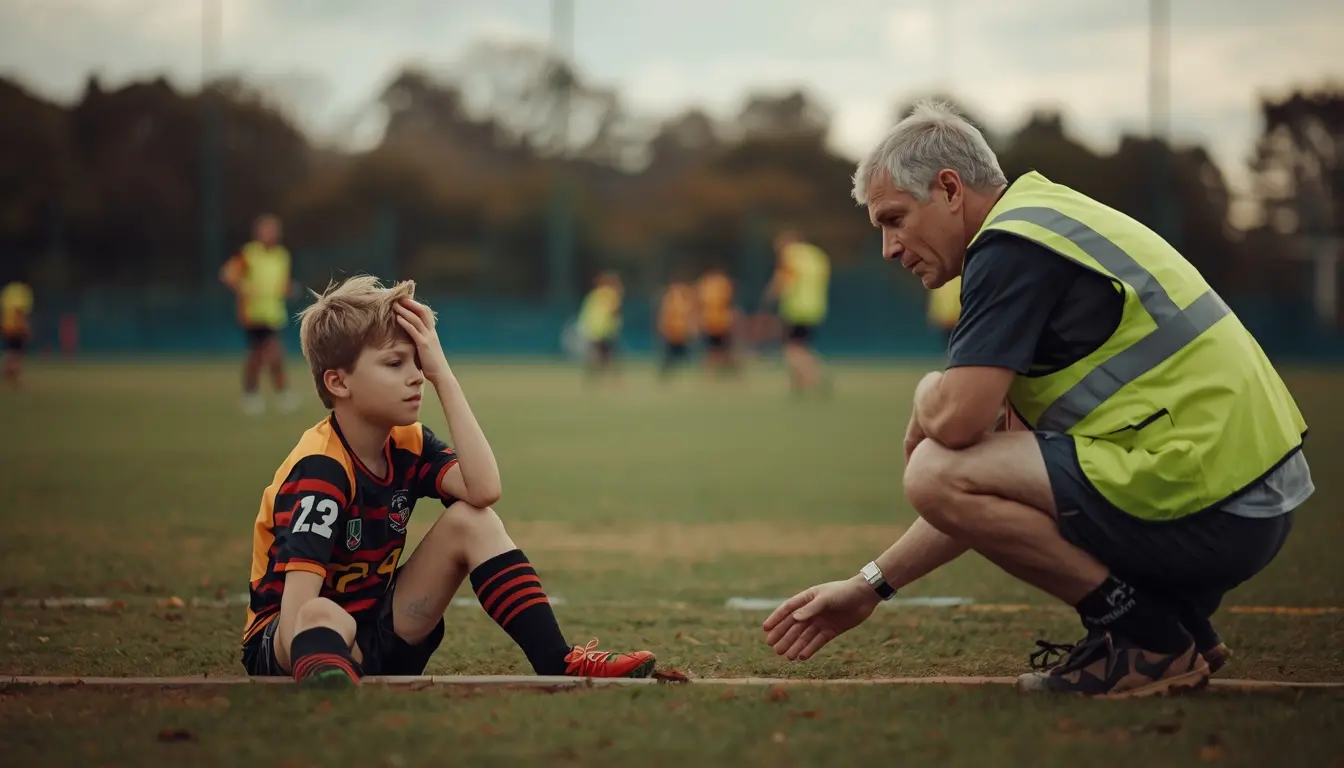
Your kid's head meets another kid's head at speed. They both go down. They both get up. Yours says "I'm fine," picks up the ball, runs back into position. The coach plays on. You watched the whole thing from the sideline and you don't know whether you're being too anxious or not anxious enough.
This is the moment most concussion advice doesn't help with. The TV picture of concussion is a knockout: a player on the ground, motionless, trainers running on. That happens in junior football, but it's the rare version. Most concussions in U7 to U18 community football don't involve the kid being knocked out. The signs are subtler, they appear in the first few minutes, and a 9-year-old who's just had their bell rung is highly motivated to convince you they're fine because they want to keep playing.
The first five minutes after a head knock is when the signs are clearest. Adrenaline hasn't yet masked the symptoms. The kid's autopilot hasn't kicked back in. What you see in those five minutes is what's actually going on. After that, things get harder to read.
This article is the recognition piece. It covers what to look for at the field. It does not cover what to do in the 24 hours after, the first week, or how return to play works. Those have their own articles in the library as they publish. USI is written by parents for parents, not by medical professionals. Everything below is the parent-to-parent translation of the Football Australia and AIS guidelines linked in this article. For diagnosis, treatment, and clearance to play, the call is your GP's, not ours.
The four-word rule that resolves every borderline call
The Australian Institute of Sport, which writes the national concussion guidelines for community sport, has a single line for parents and coaches who aren't sure.
If in doubt, sit them out.
That's the rule. Not "wait and see." Not "ask the kid if they feel okay." Not "if they can stand up and walk straight, they're fine." If you're standing on the sideline with the doubt in your chest, the answer is already given. They sit out the rest of the game.
The reasoning is in the Australian Concussion Guidelines for Youth and Community Sport. A child or teenager whose brain has been concussed and is sent back onto the pitch is at much higher risk of a second injury, including more serious ones. The cost of pulling a kid off who turns out to be fine is one missed game. The cost of leaving a kid on who turns out to be concussed can be permanent. The maths is not close.
What you're actually looking for
Football Australia publishes community concussion guidelines based on the AIS work, updated April 2025. They list the visible signs the way someone on the sideline would actually see them. Not in medical language.
In the first five minutes after a knock, watch for any of these:
- The kid lies motionless on the ground for a moment, even if they get up afterward
- They're slow to get up, slower than they would be from a normal fall
- They have a blank or dazed look on their face, like they've lost the thread of where they are
- They're unsteady on their feet, wobble when they try to walk, hold a hand out for balance they normally wouldn't need
- They're holding their head
- They vomit, even once
- They have a seizure or any jerky uncontrolled movement
- They can't tell you the score, what half it is, the name of the player next to them, or where the game is being played
Any one of these. Not all of them. Any single one is enough to pull them off.
The list of symptoms (what the kid tells you) is similar: headache, dizziness, feeling like they're in a fog, nausea, blurred vision, sensitivity to light or noise, neck pain. Kids will downplay these. A 9-year-old who wants to keep playing will say "I'm fine" while looking at you slightly to the left of where you actually are. Listen, but trust what you saw more than what they tell you.
The questions that catch what they won't tell you
Three quick questions parents and coaches use at the field. None of them require any training.
"What's the score?"
"Who's that on your team over there?" (point to a teammate)
"What field are we playing on?"
A kid who is fine answers these instantly. A kid who's been concussed pauses, looks confused, asks you to repeat the question, or gets it wrong. The pause is the answer. Don't keep going.
There's a formal version of this called the Concussion Recognition Tool 6, or CRT6, named in the AIS guidelines as the recommended pitch-side tool for non-medical people. It's a simple checklist designed for exactly this moment, written for parents and coaches, not doctors. It's worth knowing exists. The three questions above are the rough field version.
The red flags
Most suspected concussions get pulled off, taken home, and seen by a GP within 24 hours. That's the standard path. There's a smaller list of red flag symptoms where the standard path is wrong, and the right answer is calling an ambulance.
From the FA guidelines, ambulance straight away if you see any of these:
- The kid is unconscious, or their level of consciousness is getting worse
- Repeated vomiting (more than once)
- Seizures (arms and legs jerking uncontrollably)
- They can't recognise people or places they should know
- Increasing confusion or strange behavioural change as you watch them
- Slurred speech or double vision
- Weakness or numbness in their arms or legs
Don't drive them to hospital yourself when these are present. The reason is medical: a deteriorating concussion or a more serious head injury needs paramedics on the way. Call triple zero.
What you do once you've pulled them off
Five things, in order.
Move them to the sideline. Sit them down somewhere quiet, away from the noise of the game.
Don't let them go back on. Not for the rest of that quarter, not for the rest of the game, not for training tomorrow. The standard for under-19s is a minimum 21-day standdown from the time of concussion before any return to competitive contact sport, and at least 14 days fully symptom-free before any return to contact training. The 21 days is mandatory, not a suggestion.
Tell the coach. Junior coaches are mostly volunteers and don't always know the rule. If the coach pushes back, the rule comes from Football Australia and the AIS, and your kid is the one carrying the risk. (The sideline rules nobody tells you covers the broader version of this conversation.)
Watch them for the rest of the day and overnight. Wake them up once or twice during the night to check they're rousable. Worsening symptoms in the hours after a knock is when red flags appear if they're going to.
See a GP within 24 hours. Even if the kid seems fine by that night. The GP confirms the diagnosis, gives you the written clearance pathway, and starts the clock on the standdown.
The next article in this series covers exactly what to do across that first day, hour by hour, and what to watch for. This article is the field-side recognition piece. The 24-hour piece is the home one.
Why this matters past one game
Children's brains are more vulnerable to concussion than adult brains, and they take longer to recover. Concussion is one of the most common injuries in junior contact sport in Australia. Most resolve cleanly when they're recognised and managed properly. Most of the bad outcomes come from concussions that weren't recognised at the time, or were recognised and not respected.
The five minutes after a head knock is when a parent on the sideline can do the most for their kid's brain across the next ten years of football, the next decade of school, and the rest of their life. Five minutes. One rule. If in doubt, sit them out.
Once you have handled the sideline, the rest of the cluster covers what comes next: the first 24 hours, the first week, and the structured returns to learning and play.
The library is built to give parents the things nobody briefs you on as a sport parent, including the things that actually matter for your kid's safety. The full library is free to read.