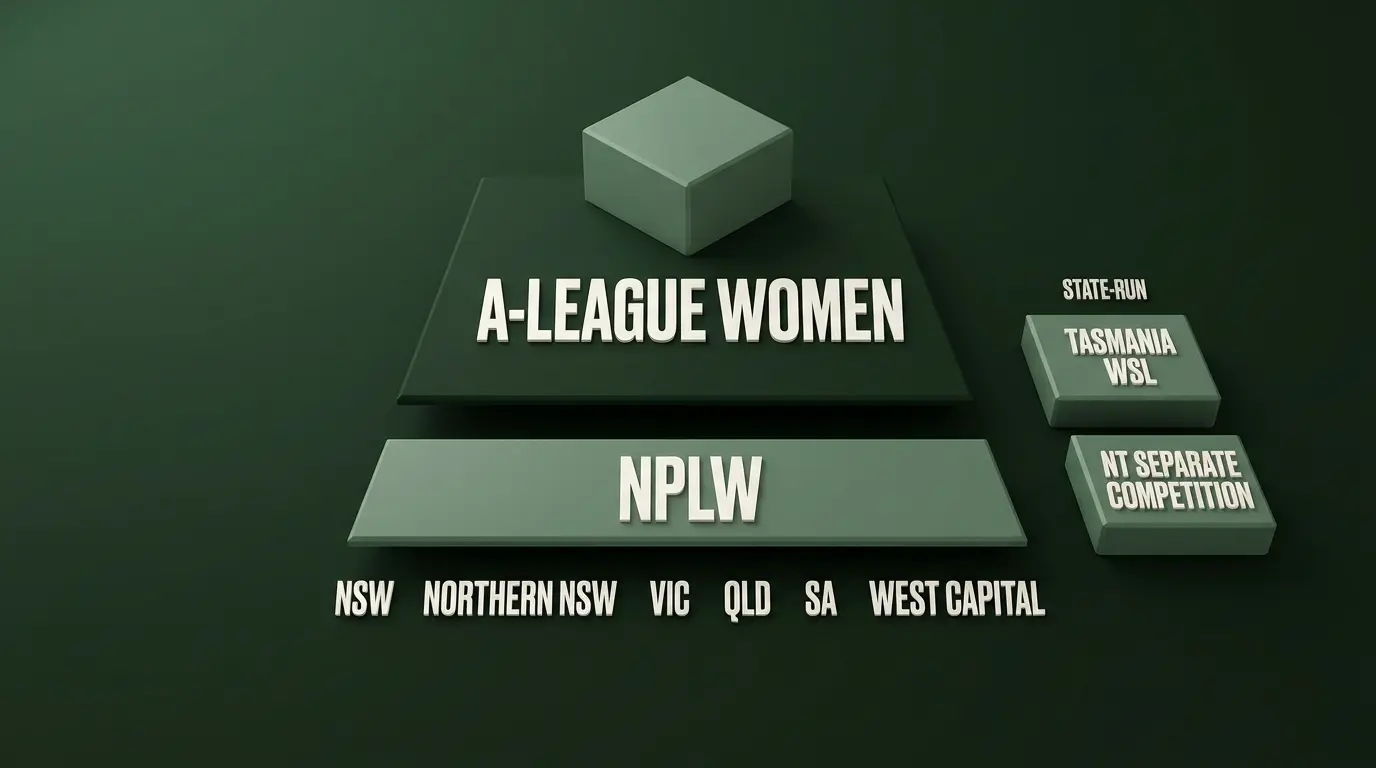
Your daughter has been invited to trial for NPLW. The letters stand for National Premier Leagues Women's. It is the top semi-professional women's competition in Australia outside the A-League Women. There is a structural difference here that most parents miss at first reading. NPL Men's is now the third tier of Australian football, sitting below the new Australian Championship that launched in October 2025. There is no Australian Championship for women. There is no national women's second tier at all. NPLW sits directly under the A-League Women as the second tier of Australian women's football, run state-by-state by your state body. NPLW operates in seven state bodies: Football NSW, Northern NSW Football, Football Victoria, Football Queensland, Football South Australia, Football West, and Capital Football. Football Tasmania has its own top women's competition called the McDonald's Women's Super League, not branded NPLW. Football NT runs separate. From the 2026 season, A-League Women clubs have started entering academy teams into NPLW. Here is what NPLW actually is and what the trial invitation means for your daughter.
The women's pyramid, which is different from the men's
The men's pyramid has three tiers right now: A-League Men at the top, Australian Championship in the middle, NPL Men's at the bottom of the senior pyramid. The women's pyramid has two: A-League Women at the top, NPLW directly below. There is no equivalent of the Australian Championship for women in 2026. Football Australia has not announced a women's national second tier.
This matters because it changes the pathway story. An NPL Men's Premier club has a clear next step: they take their state's slot at the Australian Championship in October. An NPLW Premier club has no equivalent national tournament. The pathway for a player from NPLW upward is more direct, through scouting and signing into an A-League Women academy or first team, rather than through a tier-jump.
The A-League Women, currently branded the Ninja A-League for sponsorship, is the top tier. It is run by the Australian Professional Leagues, not by Football Australia or any state body. It has eleven clubs in the 2025-26 season, semi-professional in pay structure currently, with a regular season from November to April. The league has discussed moving to full professionalisation but has not formally done so yet. No promotion-relegation exists between the A-League Women and NPLW. Entry to the A-League Women is by licence through the APL, the same way clubs enter the A-League Men.
NPLW in seven state bodies
NPLW runs as seven separate state competitions in 2026: Football NSW, Northern NSW Football, Football Victoria, Football Queensland, Football South Australia, Football West, and Capital Football. Each state body runs its own competition with its own structure, fixture calendar, and number of teams.
NPLW NSW has 14 clubs in the 2026 season, competing in First Grade and Reserve Grade, in a round-robin format. The top four teams at the end of the regular season enter a Championship Series, with the Premier crowned on points and the Champion decided in the Grand Final.
NPLW Victoria has 14 clubs in 2026, running 13 February to 30 August. The 2026 season made history: Football Victoria announced on 21 August 2025 that A-League Women clubs Melbourne City Women and Melbourne Victory Women would enter academy teams into both the senior NPLW Victoria competition and the U20 NPLW competition for the first time. They replaced the FV Emerging team, which previously held a development slot in NPLW Victoria. A third A-League Women club, Western United, also expressed interest in entering NPLW Victoria for 2026, with a final decision pending at announcement. The restructure went alongside a change to the FV Academy Girls program, which from 2026 focuses on players up to U15 only. From U16 onwards, female pathway players in Victoria graduate into club programs at A-League Women academies, established NPLW clubs, or other advanced pathways, while Football Victoria shifts its role to talent identification and state team selection.
The other federations run NPLW competitions with their own team counts and calendars. The 2026 NPLW season nationally runs from Friday 6 February 2026 to Sunday 13 September 2026 per Football Australia's Domestic Match Calendar.
Football Tasmania: McDonald's Women's Super League instead of NPLW
Football Tasmania has its top women's competition called the McDonald's Women's Super League, branded separately from NPLW. The 2026 WSL has eight teams after Launceston City joined the previous seven. The WSL season runs as a 21-round competition with no bye round, which the previous seven-team 2025 league required. It is the highest level of women's football in Tasmania, structurally equivalent to NPLW in the other states but operating outside the NPLW framework with its own naming and licensing.
If your daughter plays in Tasmania, the WSL is her top tier. The pathway upward goes WSL to A-League Women scouting or interstate signing, with similar implications as NPLW elsewhere.
Football NT: separate women's competition
Football NT runs its own women's competition, also outside the NPLW framework. The Northern Territory women's premier competition is administered locally with a different calendar to the dry season football schedule the Territory uses for men's competitions. As of December 2025, Football NT is collaborating with Football Queensland on pathway development. For a parent in Darwin or Alice Springs, the practical answer is that NPLW does not exist in the Territory, and the pathway upward goes through interstate moves to NPLW states or directly through A-League Women scouting if a player attracts attention through state representative football.
A-League Women academies enter NPLW from 2026
The Melbourne City Women and Melbourne Victory Women entries into NPLW Victoria from the 2026 season mark a structural shift. Until 2025, A-League Women clubs ran their senior teams in the A-League Women competition only. Their development pipeline below the senior team operated through emerging programs and academy structures that did not play in the same competition as state NPLW clubs.
From 2026, A-League Women clubs are direct competitors with state NPLW clubs at the NPLW level. The competitive dynamics shift. State NPLW clubs that previously dominated their competition now face professional academy structures. The pathway for a young female player at a state NPLW club potentially shortens, because direct competition against A-League Women academies may be more visible to A-League Women scouts. Other states may follow Victoria's lead in future seasons, though no public announcements have been made for 2026 in NSW, Queensland, or elsewhere.
Junior NPLW programs sit below senior NPLW in every state
Below the senior NPLW competition in each state, the state body runs junior pathway competitions for U13 to U17 girls under different brand names. In NSW, this includes NPLW Reserve Grade plus the Girls Youth League. In Victoria, the Girls Junior NPL covers similar ages. In Queensland, the FQ Academy Girls and Junior FQ Academy programs sit below senior NPLW. Each state has its own structure.
When a coach uses the word NPLW with a parent of a 12-year-old daughter, they almost always mean a junior pathway program inside an NPLW club rather than the senior NPLW competition. The structure of trials, the fees, and the time commitments differ between senior NPLW and the junior pathway programs that feed it.
What NPLW costs in 2026
The financial commitment for senior NPLW varies by state and by club. The state body component is set by the state body each November in their annual fee circular. The club component sits on top.
Football Victoria's 2026 fee schedule gives one verifiable example. The state body component for NPLW Senior and U20 competitions in 2026 sits at a $15,000 team entry fee paid by the club, plus a $200 player registration fee per player paid to Football Victoria, both unchanged or newly introduced from 2025 figures. The club then sets its own fee on top of this state body component, covering coaching salaries, ground hire, training equipment, training-session frequency, and any compulsory kit packages. The total a parent pays to the club typically runs materially higher than community club football, often comparable to senior NPL Men's fees in the same state.
Junior pathway programs that feed senior NPLW cost less than senior NPLW but more than community club football. In Victoria's 2026 fee structure, the Advanced Girls Metro Juniors team entry fee runs $750 at U13, $2,750 at U15, and $3,750 at U17, plus $100 player registration to Football Victoria. Club fees on top of these state body components vary by club and tier within the program.
These figures exclude kit purchases (often club-mandated), travel to training and games, and time committed by parents across two or three weekly evenings plus weekend matchdays.
What the pathway from NPLW actually looks like
The realistic Matildas pathway runs from NPLW senior to A-League Women academy or first team, then potentially to Junior Matildas at U17, Young Matildas at U20, and eventually the Matildas. The path is narrow. The same broad ratios that apply in the men's pathway apply here too, with the additional structural feature that there is no Australian Championship intermediate tier to land in between state-level NPLW and the A-League Women.
For girls following the international development map, the AFC U-17 Women's Asian Cup and the AFC U-20 Women's Asian Cup are the qualification routes for the FIFA U-17 and U-20 Women's World Cups. Australia hosted the AFC Women's Asian Cup in March 2026 across Perth, Sydney, and the Gold Coast, and the Matildas reached the final.
Boring procedural close: three things to clarify
Which state competition your daughter has been invited to trial for. Each state body runs its own competition with its own calendar and fee structure. The competition she would play in is not run by Football Australia.
Whether the trial is for senior NPLW or for a junior pathway program inside an NPLW club. The naming overlap is confusing on purpose, because some state bodies use "NPLW pathway" branding for both. Ask the coach to specify the league name, the age group, and the competition body that administers it.
Whether the inviting club is an A-League Women academy (in 2026, Melbourne City Women and Melbourne Victory Women in Victoria) or an independent NPLW club. The two are different propositions for a young female player in terms of competitive standard, technical environment, and what the natural next step looks like.
Football Australia's official confirmation of the 2026 NPL season structure covers both NPL Men's and NPLW. For broader context on how NPL fits with the rest of Australian football, the article on NPL explained covers the men's pyramid and how the Australian Championship slotted in during October 2025. The article on NPL1 vs NPL2 for girls covers the divisional structure within NPLW NSW specifically. The article on your daughter wanting to take the next step covers the decision-making around accepting the trial invitation.